

Romeo and Juliet Unit Plan for 9th Grade: Act-by-Act Pacing and Assessments
 Andy Navarro · Shakespeare & Drama · · 3 min read
A Romeo and Juliet unit plan for grades 8–10: Shakespeare intro, the prologue as a sonnet, act-by-act reading, quizzes and a final exam with SCR and ECR.
Romeo and Juliet is the Shakespeare play most students meet first, and it's usually in 9th grade. The language is the hard part. The story (impulsive teenagers, feuding families, bad timing) is something every student gets. Here's a Romeo and Juliet unit plan with act-by-act pacing, from the first Shakespeare lesson to the final exam.
For strategies on the language itself, see How to Teach Romeo and Juliet and How to Introduce Shakespeare.
Week 1: Shakespeare and the prologue
Day 1: Who was Shakespeare?
Start with a bell ringer: should we still read Shakespeare? Then cover the basics: born in Stratford-upon-Avon in 1564, about 39 plays and 154 sonnets, the Globe Theatre and the groundlings. Show students everyday words he's credited with, like "swagger" and "eyeball." It makes him feel less distant.
Day 2: Research the world of the play
A webquest on Elizabethan England, the theater and religion gives students the context to understand the feud, arranged marriages and Friar Laurence's role.
Day 3: Make it personal
Before reading a line, discuss the big ideas: Is true love real? How fast is too fast? Should you trust your parents' choices? Students write a quick personal response.
Days 4–5: The prologue
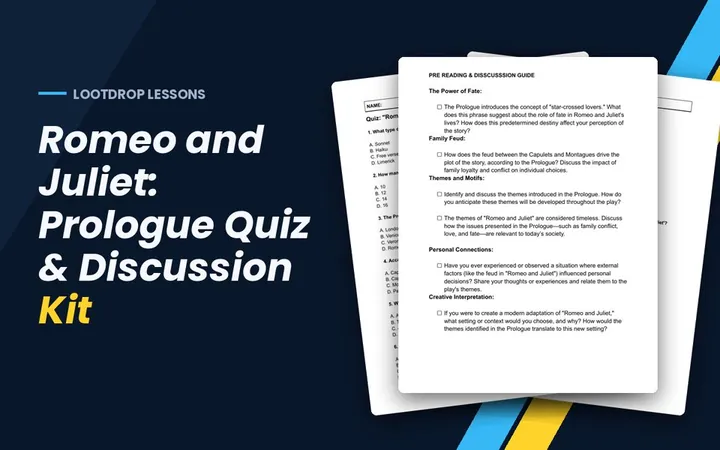
Teach the prologue as a sonnet: 14 lines, iambic pentameter, ABAB CDCD EFEF GG. Students mark the rhyme scheme, count syllables and then rewrite it in their own words. Follow with a prologue quiz. The prologue gives away the ending, which is a great way to talk about fate and dramatic irony.
Weeks 2–4: Act by act
Plan about three or four days per act. Read key scenes aloud or perform them, and use a film version for scenes you summarize.
- Act 1: the street brawl, Romeo's crush on Rosaline, the Capulet feast and the first meeting. End with a quick Act 1 quiz.
- Act 2: the balcony scene, Friar Laurence and the secret marriage. Discuss: are they moving too fast?
- Act 3: Mercutio and Tybalt die, Romeo is banished, and Juliet's parents push her to marry Paris. This is the turning point, so slow down here.
- Act 4: the Friar's plan and the potion.
- Act 5: the missed message, the tomb and the families' reconciliation.
Keep a running chart of fate vs. choice. At the end of each act, students add moments where characters chose something and moments that seem like fate.
Final week: discuss and assess
Hold a seminar on who is most to blame for the deaths: Romeo, Juliet, the Friar, the Nurse, the parents or fate. Then give the final exam. A good exam covers the whole play with multiple choice, two short constructed responses (the role of fate, and how Mercutio shapes the themes), and an argumentative ECR.
Questions teachers ask
How long should a Romeo and Juliet unit be?
Most teachers spend four to six weeks. Plan a week for background and the prologue, about three or four days per act, and a final week for review and assessment.
What grade reads Romeo and Juliet?
It's usually taught in 9th grade (English I), though some schools teach it in 8th or 10th grade.
Should students read the whole play?
Read the key scenes closely and summarize or watch the rest. Students get more from deep work on the prologue, the balcony scene, Act 3 Scene 1 and the ending than from rushing every line.
What is the main theme of Romeo and Juliet?
The power and danger of passionate love, the cost of hate and the role of fate. Students can argue for any of these with evidence from the play.
The resources below cover every step of this plan: the Shakespeare intro, the webquest, discussion prompts, the prologue remix and quiz, the Act 1 quiz and the comprehensive final exam.



Comments
Questions, tweaks that worked in your room, ideas for other teachers: share them here.
Loading comments...