How to Teach Romeo and Juliet in High School: Prologue, Act 1, Discussion and Assessment
 Andy Navarro · Shakespeare & Drama ·
How to teach Romeo and Juliet in high school: a prologue lesson, Act 1 hooks, discussion moves that get teens talking, and assessments that work.
If you're planning how to teach Romeo and Juliet in high school, you're working with a play students already think they know. They know the ending. They know the balcony. What they don't know yet is how fast, loud and funny the play is, or how much of it sounds like the people around them. My whole goal is to get them past the old language quickly so they can see that.
Here's how I run the opening of the unit, from the prologue through Act 1, plus the discussion and assessment pieces that hold it together.
Before the play: a little context, not a lecture
Students need three things before line one: who Shakespeare was, what a theater like the Globe was like, and why audiences stood for hours to watch plays. That's it. I'd rather they find this themselves, so I use a short research activity in pairs instead of twenty slides of biography.
The details that matter most for this play:
- The play was written in the 1590s, and it was meant to be watched, not read silently.
- Audiences ranged from wealthy patrons in the galleries to "groundlings" standing in the yard. The jokes are aimed at all of them.
- Every role, including Juliet, was played by a male actor.
- The story wasn't new. Shakespeare adapted an older poem, so his audience may have known the ending too. That makes the prologue even more interesting.
Teaching the Romeo and Juliet prologue
The prologue is fourteen lines, and it gives away the whole plot. That's my hook. I put it on the board and ask: Why would a writer spoil his own ending in the first minute?
Then we read it together, slowly, and translate it line by line. The two lines students remember all year:
From forth the fatal loins of these two foes
A pair of star-cross'd lovers take their life;
"Star-cross'd" is worth five minutes on its own. It means the stars, or fate, are against them. Ask students whether they think anything in life is "meant to be." You'll have the first big theme of the unit on the table before Act 1 starts.
Next, I show them that the prologue is a Shakespearean sonnet:
- Fourteen lines.
- Three quatrains and a final couplet.
- Rhyme scheme ABAB CDCD EFEF GG.
- Mostly iambic pentameter, ten syllables in a da-DUM rhythm.
Students label the rhyme scheme with colored pencils, then tap out the rhythm on their desks. It feels silly for about thirty seconds and then it clicks.
My favorite follow-up is a creative translation. Students rewrite the prologue as something modern: a news alert, a movie trailer voiceover, a group chat, a TikTok caption. The rule is that every key fact from the original has to survive: two equal families, an old grudge, a new fight, two lovers, their deaths, and the end of the feud. If a fact is missing, the translation doesn't count. This turns comprehension into something they actually want to do.
Act 1 hooks that keep students reading
Act 1 has everything you need to win the class: a street fight, a heartbroken teenager, an overbearing parent conversation, a wild speech and a party. I teach it scene by scene with one guiding question per scene.
- Scene 1, the brawl: Servants from both houses start a fight over an insult. I have students act out the opening exchange, including "Do you bite your thumb at us, sir?" Then I ask: what's the modern version of biting your thumb? The fight ends with Prince Escalus warning that the next public brawl will cost lives. Guiding question: How serious is this feud, really, if servants are fighting over a gesture?
- Romeo and Rosaline: Romeo is moping over a girl named Rosaline who isn't interested. Students love catching this. Guiding question: Is Romeo in love, or in love with being in love?
- Scenes 2 and 3, the marriage talk: Paris asks to marry Juliet. Lady Capulet asks Juliet what she thinks of marriage, and the Nurse won't stop talking. Juliet is not yet fourteen. Guiding question: Who is making decisions for Juliet, and how does she respond?
- Scene 4, Queen Mab: Mercutio's speech about dreams is long and strange, so I treat it as a performance. One student reads, the class sketches the images. Then we look at Romeo's line at the end of the scene, where he says he fears something "yet hanging in the stars." Fate again.
- Scene 5, the party: Romeo sees Juliet and forgets Rosaline instantly. Tybalt recognizes Romeo's voice and wants to fight, and Capulet stops him. Then Romeo and Juliet's first conversation turns out to be a shared sonnet, starting with "If I profane with my unworthiest hand." Show students the rhyme scheme again. They're shocked that the first conversation is a sonnet split between two people.
End the act with Juliet's line: "My only love sprung from my only hate!" Ask students to predict the very next problem. They always get it right, which is exactly what makes the rest of the play feel tense.
Discussion that gets teenagers talking
Romeo and Juliet works in high school because the characters are teenagers making fast decisions under pressure. Lean into that. I run discussions around personal connection first and the text second, then pull them back together.
Prompts that work every year:
- Have you ever made a big decision really fast and regretted it? Was it worth it anyway?
- Should parents have a say in who their kids date?
- Can you inherit a grudge from your family?
- Is love at first sight real, or is it just attraction?
- Who is most to blame for how this ends? (Save this one for after the play, and make them rank the characters.)
The move that matters is the follow-up: Where do you see that in the play? A personal opinion is a starting point. An opinion connected to a line in the text is analysis.
For structure, I like a quick write first, then partners, then whole class. Quieter students get a chance to think before they have to talk.
Keep them reading: a few practical moves
- Mix reading and watching. Read a scene, then watch a short clip of the same scene performed. Students understand the language far better once they hear it acted.
- Assign parts, but rotate them. Nobody should be Romeo for five acts.
- Keep a running character chart. Who's a Montague, who's a Capulet, who's neutral. Kids get lost in the names otherwise.
- Track the timeline. The whole story happens in about four days. Have students note the day at the top of each scene. It makes the rushing feel real.
How to assess Romeo and Juliet
I check understanding in small pieces and save the big writing for the end.
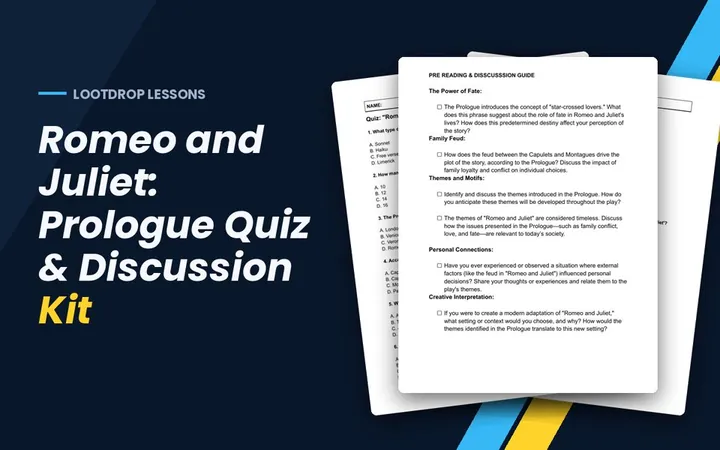
- Prologue check: a short quiz on what the prologue reveals and how a sonnet is built.
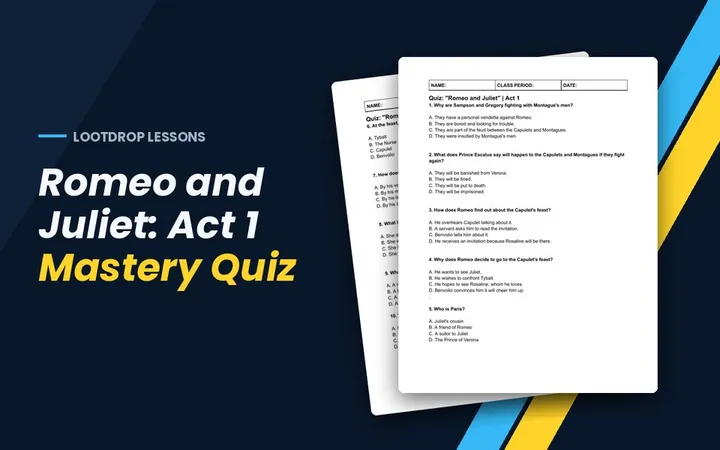
- Act 1 quiz: quick multiple choice on plot and characters, so I know who's lost before Act 2.
- Short constructed responses along the way: How does Shakespeare use the opening brawl to show the seriousness of the feud? One answer, one piece of evidence, an explanation.
- End-of-play test with multiple choice, a couple of SCRs and an extended response. A letter format works well here: students write as Friar Laurence, or to the Prince, explaining who is responsible.
The writing tasks double as STAAR and EOC practice without feeling like test prep, because students actually have opinions about these characters.
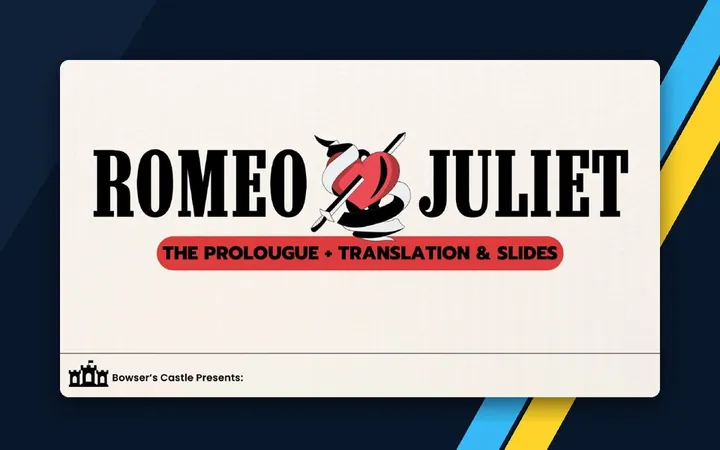
If you want the pieces I use for this, they're below: a Shakespeare webquest for the background day, the prologue translation activity and prologue quiz, an Act 1 quiz, personal-connection discussion slides with writing prompts, and a full-play exam with SCRs and a letter-format ECR.