
How to Introduce Shakespeare to High School Students (So They Don't Check Out on Day One)
 Andy Navarro · Shakespeare & Drama · · 4 min read · Updated
How to introduce Shakespeare to high school students: a quick background lesson, the language, the Globe, an insult activity and a webquest before the play.
The first day of a Shakespeare unit decides a lot. If students walk out thinking it's going to be weeks of confusing old English, you're fighting that feeling the whole unit. If they walk out curious, laughing, or at least surprised, you've got them. A good introduction isn't about cramming in biography. It's about making Shakespeare feel human and the language feel doable.
Here's how I introduce Shakespeare to high school students before we open the play.
Start with what they already know
Most students know more Shakespeare than they think. Ask them to finish phrases: "To be or not to be..." "Romeo, Romeo..." Then ask where they've heard them: cartoons, memes, movies. Point out that The Lion King borrows heavily from Hamlet, and that dozens of teen movies, like 10 Things I Hate About You (from The Taming of the Shrew) and She's the Man (from Twelfth Night), are Shakespeare in disguise. His stories are everywhere because they're about things that haven't changed: love, jealousy, revenge, ambition and family drama.
A quick background lesson (keep it short)
Students don't need a full biography. They need enough context to understand the plays. The essentials:
- William Shakespeare was born in 1564 in Stratford-upon-Avon, England, and died in 1616.
- He wrote around 37 plays (scholars debate the exact count because some were co-written) and 154 sonnets.
- He wrote comedies, tragedies and histories. Tragedies end in death, comedies usually end in marriage.
- He was an actor and part-owner of his theater company, so he wrote for real audiences who could get rowdy.
- He lived during the reign of Queen Elizabeth I and then King James I, and both monarchs supported the theater.
Ten minutes, a few images, done. Save the rest for students to discover.
The Globe Theatre: theater was for everyone
This part surprises students. The Globe, built in 1599, was an open-air theater that held a huge crowd. The cheapest tickets cost a penny and put you in the standing pit right in front of the stage. Those audience members, called groundlings, ate, drank, talked and yelled at the actors. Wealthier people paid more to sit in the covered galleries.
The point for students: Shakespeare wasn't written for fancy people in quiet theaters. It was popular entertainment, packed with jokes, fights, romance and gross-out humor to keep the whole crowd's attention. A few more details they love: performances happened in the afternoon using daylight, there was very little scenery, and women weren't allowed on stage, so young male actors played all the female roles.
Make the language less scary
The language is the real barrier, so tackle it head on:
- It's modern English, not Old English. Shakespeare wrote in early modern English. Old English is Beowulf, and students couldn't read it at all. They can read Shakespeare with some help.
- A few words do a lot of work. Teach thee, thou, thy (you, your), art (are), doth (does), wherefore (why) and hath (has). That small list unlocks a lot of lines.
- He made up or popularized words we still use. Many words show up for the first time in writing in his plays, like lonely, swagger and bedroom. Some were probably already being said out loud, but his plays are the earliest written record we have. Students like knowing they talk like Shakespeare without realizing it.
- It's meant to be heard. These are scripts, not novels. Reading lines out loud, with feeling, makes them much easier to understand than reading silently.
The insult activity (every teacher's favorite)
Give students a list of real Shakespearean insults, or a three-column insult generator where they combine words like "Thou artless, beef-witted canker-blossom." Students practice delivering insults to each other with dramatic flair. It's silly, but it gets every student saying Shakespeare's language out loud, with emotion, on day one. That's exactly the habit you want for reading the play.
Let students research it themselves
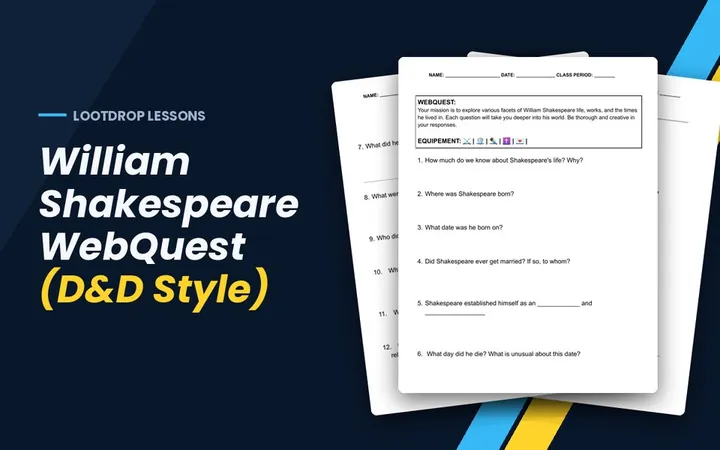
A webquest gives students ownership of the background. They explore sites about Shakespeare's life, Elizabethan England and the Globe, and answer questions as they go. Framing it as a quest, with levels and "equipment" sites to collect, turns research into something closer to a game. It's also a strong sub plan for the week before the unit starts.
Then get into the play fast
Don't let the intro drag. Two or three days is plenty. The play is the point, and students will build more context as they read. Have a quick reference sheet of the key vocabulary, and use summaries before each scene so students know what's happening and can focus on how it's said.
Questions teachers ask
How do you introduce Shakespeare to high school students?
Start with what students already know from Shakespeare's phrases and stories, give a short background lesson, show how the Globe Theatre was for everyone, and make the language less scary before reading the play.
Why do students struggle with Shakespeare?
The language feels unfamiliar and the plays were written to be performed, not read silently. Reading aloud, translating small parts and acting scenes out make the language click.
What is the Shakespeare insult activity?
Students combine words from columns of Shakespearean insults and use them on each other playfully. It gets them comfortable with the language and laughing on the first day.
My Introduction to William Shakespeare slide deck covers his life, the Globe, his plays and the words he gave us, ready to teach. There are two Shakespeare webquests, one set up as a D&D-style quest, both with answer keys. When you get to the end of Romeo and Juliet, there is a ready-made exam for that too. They're below.




Comments
Questions, tweaks that worked in your room, ideas for other teachers: share them here.
Loading comments...