
"A Christmas Carol" Drama Unit Plan for Elementary and Middle School
 Andy Navarro · Shakespeare & Drama · · 3 min read
A Christmas Carol drama unit with two tracks: readers' theater for grades 4–5 and the stage play for grades 7–8, plus ghosts, conflict, theme and tests.
"A Christmas Carol" is the December drama unit that never gets old. Students love the ghosts, Scrooge is the ultimate character change, and the question at the center, can people really change?, works at any age. Here's a complete A Christmas Carol drama unit plan with two tracks: a readers' theater for grades 4–5 and the stage play for grades 7–8.
For tips on running the performance itself, see A Christmas Carol Readers' Theater.
Which track fits your class?
- Elementary (grades 4–5): students perform a readers' theater script adapted from Dickens' public-domain novella. Six scenes give parts to the whole class.
- Middle school (grades 7–8): students read Israel Horovitz's stage adaptation from their literature anthology and compare it with passages from Dickens' original.
Both tracks cover the same core skills, so you can run them side by side in a combined class or a school with both grade levels.
Week 1: background, drama terms and Act One
Day 1: Hook and background
Start with an anticipation guide and a journal prompt: Can a person really change who they are? Give quick background on Victorian London. Middle schoolers can read about workhouses and the Poor Law so they understand why Scrooge's line about prisons and workhouses was so cruel.
Day 2: Elements of drama
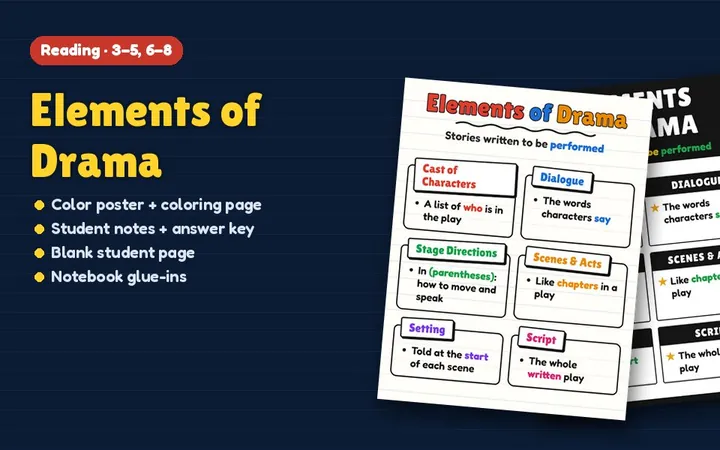
Teach cast list, dialogue, stage directions, scenes and acts. Students practice reading a few lines with and without stage directions to see how much they change.
Days 3–5: Read and perform
Assign parts and read through Marley and the Ghost of Christmas Past. Students fill out ghost cards for each spirit: what it looks like, what it shows Scrooge and what he learns. Check understanding with a short quiz.
Week 2: the change, the film and the writing
Days 6–7: Present and Yet to Come
Finish the reading. Focus on conflict, including character vs. self and character vs. the supernatural, and track Scrooge's transformation with a before-and-after chart.
Day 8: Tone, symbols and theme
Look at how word choice changes the tone (connotation vs. denotation), what the ghosts and Tiny Tim symbolize, and how the theme builds from scene to scene. Students practice writing an objective summary.
Day 9: Story vs. film
Watch a short film clip. First discuss surface-level differences (what changed), then go below the surface (why the director made those choices).
Day 10: Discuss and assess
Hold a discussion circle (elementary) or a Socratic seminar and four corners debate (middle school) on whether people can really change. Then give the unit test with short constructed responses. Good prompts:
- How does Scrooge change from the beginning to the end? Use evidence.
- Which ghost has the biggest effect on Scrooge, and why?
Capstone project options
- Body biography: students trace Scrooge and fill the outline with symbols, quotes and traits that show how he changes.
- One-pager: one page with images, quotes and a theme statement, finished with a gallery walk.
Questions teachers ask
Is A Christmas Carol good for elementary students?
Yes, especially as a readers' theater. Fourth and fifth graders can handle the story when it's adapted into short scenes with clear parts.
Which version of A Christmas Carol is in middle school textbooks?
Many 7th and 8th grade anthologies include Israel Horovitz's stage adaptation. Units written by act and scene work with whatever edition you have.
What is the theme of A Christmas Carol?
People can change, and generosity and compassion matter more than money. Scrooge's transformation is the proof.
How long is a Christmas Carol unit?
About two weeks fits well before winter break. You can shorten it to one week by skipping the film comparison and the capstone project.
The Christmas Carol unit below has both tracks ready: the original readers' theater script, the middle school play materials, ghost cards, character cards, quizzes, tests, SCRs, projects and two slide decks.



Comments
Questions, tweaks that worked in your room, ideas for other teachers: share them here.
Loading comments...