

"The Most Dangerous Game" Short Story Unit Plan for Grades 8–10
 Andy Navarro · Short Stories & Literature · · 3 min read
A Most Dangerous Game unit plan: survival pre-reading game, daily exit tickets, conflict, suspense, characterization, discussion, and SCR and ECR writing.
Richard Connell's "The Most Dangerous Game" (1924) might be the easiest short story in the curriculum to sell to teenagers. A big-game hunter falls off a yacht, washes up on Ship-Trap Island, and finds out he's the one being hunted. Here's a full Most Dangerous Game short story unit plan for grades 8–10, from the hook to the essay.
For more on individual lessons, see the Most Dangerous Game lesson plan post.
Day 1: Survival hook
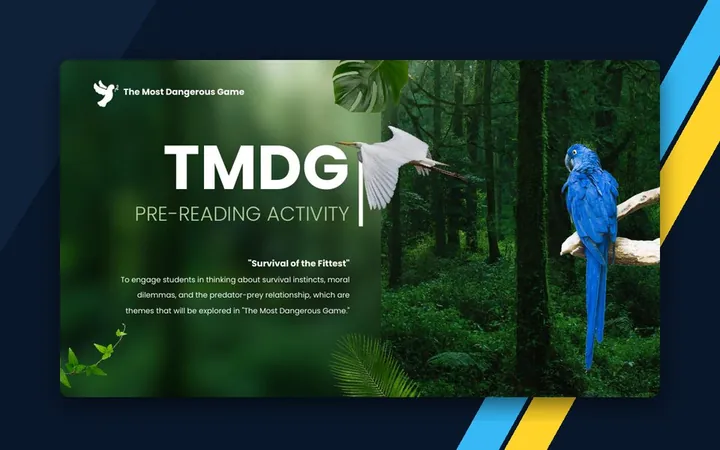
Start with "would you rather" survival questions, then put small groups on an imaginary island. They pick their top five survival items, and then you add a twist: there's another group on the island. Do they work together or compete? By the end of class, students are already arguing about where the moral lines are, which is exactly what the story asks.
Days 2–4: Read in three parts
- The yacht and the island: Rainsford and Whitney's conversation about whether animals feel fear, the fall, and the chateau.
- General Zaroff: dinner, Zaroff's "new animal" and Rainsford's choice.
- The hunt: three days, three traps, and the ending.
Use one exit ticket at the end of each reading day. Mix vocabulary in context (appraising, quarry, futile), short excerpt questions on Zaroff's characterization, and quick checks on foreshadowing and tone.
Day 5: Conflict and suspense
Map the conflicts: Rainsford vs. Zaroff, Rainsford vs. nature, and Rainsford vs. himself. Then look at how Connell builds suspense: short sentences during the hunt, cliffhanger breaks between days, and sounds in the jungle. Students pick the most suspenseful paragraph and explain the techniques in it.
Day 6: Characterization and setting
Compare Rainsford and Zaroff. They're both hunters, and that's what makes the story uncomfortable. Ask whether Rainsford changes by the end. Add setting: how does the island itself feel like a character? The name "Ship-Trap Island" is a great place to start.
Day 7: Discussion
Put one discussion question per slide and let small groups talk. Good ones:
- What's the double meaning of the title?
- Rainsford says early on that animals don't feel fear. How has his view changed by the end?
- Is Zaroff civilized? What does Connell suggest about the word "civilized"?
End by circling back to the island scenario from Day 1. Would students answer differently now?
Days 8–9: Short constructed responses
Project one SCR prompt a day as a warm-up, or let students choose. Prompts on Zaroff, Rainsford, Ivan, setting, suspense and the title all work well. Model one response with a claim, a short piece of evidence and an explanation.
Day 10: Extended constructed response
Finish with an ECR in one of the three STAAR modes:
- Argumentative: Does Rainsford become as savage as Zaroff?
- Correspondence: As Rainsford, write to the authorities about what happened on the island.
- Informational: How does Connell use setting to build suspense?
Questions teachers ask
What grade reads The Most Dangerous Game?
It's most common in grades 8 and 9, and it's in many 9th grade anthologies. It also works in 10th grade as a model for suspense and conflict.
What is the double meaning of the title?
"Game" means both the animal being hunted and the contest itself. The most dangerous game is a human, and the hunt is the most dangerous competition.
What are the main conflicts?
Person vs. person (Rainsford vs. Zaroff), person vs. nature (the sea and the jungle), and person vs. self as Rainsford fights fear and panic.
How long should I spend on this story?
One to two weeks. One week covers the hook, the reading and a discussion. Two weeks adds full SCR and ECR writing practice.
Everything in this plan is below: the survival pre-reading game, exit tickets, discussion questions with an answer guide, SCR prompts and ECR prompts in all three modes.



Comments
Questions, tweaks that worked in your room, ideas for other teachers: share them here.
Loading comments...