The Most Dangerous Game Lesson Plan: Pre-Reading, Discussion Questions and SCR Prompts
 Andy Navarro · Short Stories ·
A Most Dangerous Game lesson plan with a survival pre-reading hook, a chunked read, discussion questions and SCR prompts students can actually answer.
If you need a Most Dangerous Game lesson plan that keeps a room full of ninth graders reading, you picked the right story. Richard Connell's "The Most Dangerous Game" has a shipwreck, a mysterious island, a polished villain and a three-day chase. It also has real ideas underneath: what makes someone civilized, and whether the hunter ever thinks about the hunted. Students come for the action and stay for the argument.
Here's how I teach it, from the hook to the writing, so you can run it this week with nothing but the story.
Quick background for you
- Richard Connell published the story in Collier's magazine in January 1924.
- The main character, Sanger Rainsford, is a famous big game hunter who has written a book about hunting.
- The villain, General Zaroff, is a wealthy Russian exile who lives in a chateau on Ship-Trap Island in the Caribbean, with a huge, silent servant named Ivan.
- The story is told in third person, closely following Rainsford, so we only know what he knows. That's what makes the chase so tense.
Pre-reading: make them think like the prey
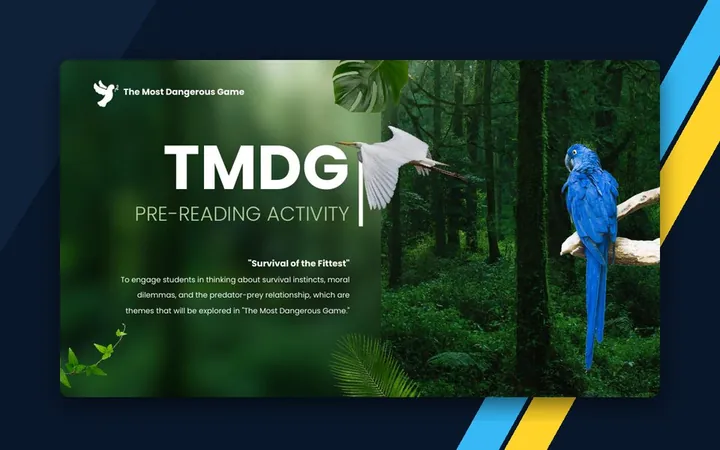
I never open with vocabulary. I open with a scenario. Students read a short prompt on the board: You wake up alone on an island. You have the clothes you're wearing and a pocket knife. Something is hunting you. What are your first three moves?
They quick-write for three minutes, then compare with a partner. Some will build a shelter, some will climb a tree, and someone always says they'd set a trap. Hold onto that. Rainsford does all three.
Then I ask the question that sets up the whole story: Is it fair to hunt an animal that can't hunt you back? Students who hunt with family, students who have never been near a gun and students who love animals all have opinions. Let them talk for five minutes. You don't need to settle it. The story will.
Last, I introduce two terms they'll use all week: conflict (person vs. person, person vs. nature, person vs. self) and foreshadowing. Both show up in the first two pages.
During reading: three chunks, three stops
This is a longer short story, so I break it up. I read the opening aloud and let students finish chunks with a partner or with an audio version.
- The yacht and the island: Rainsford and Whitney talk about hunting and the island's bad reputation, then Rainsford hears gunshots and goes overboard. Stop and ask: What do Rainsford's opinions about animals tell us about him? What details foreshadow danger?
- The chateau: Rainsford meets Zaroff, eats a fine dinner and slowly realizes what the general hunts. Stop and ask: How does Connell make Zaroff seem civilized and terrifying at the same time?
- The hunt: three days, three traps and the leap into the sea, then the final scene in Zaroff's bedroom. Stop and ask: How has Rainsford changed since the yacht?
At every stop, students write one line answering the same question: Who has the power right now, and how do you know? Asking the same thing three times lets them track how power shifts across the plot without me drawing a plot diagram for them.
The core lesson: Rainsford then vs. Rainsford now
The best conversation in this story is about character change. On the yacht, Rainsford tells Whitney that animals have no feelings and the world is made of hunters and huntees. By the end, he has been the huntee for three days.
I give students a two-column chart:
- Left column, "Rainsford on the yacht": what he says and believes about hunting, fear and animals.
- Right column, "Rainsford in the jungle": what he feels, does and learns while he's being hunted.
Pairs fill in at least four rows with short evidence. Then the big question: Has Rainsford actually changed, or did he just win? This is where the room splits. Some students say he understands fear now. Others point to the last scene and say he walks right into Zaroff's world. Both sides have evidence, and the ending never tells us what he decides, which makes it perfect for discussion.
Teaching Zaroff: the civilized villain
Zaroff is the reason students remember this story. He serves fine wine, dresses well, and has books and good manners, and he hunts people. I have students make a quick list called "civilized vs. savage" and sort details about him into each side.
Then we talk about irony. Zaroff calls the men he hunts the scum of the earth and thinks of himself as cultured. Students quickly see the situational irony: the most civilized man on the island is the most dangerous one. That leads straight to theme.
The three traps: a quick close reading
Rainsford's three traps are a great place for small groups. Each group takes one:
- The Malay man-catcher: a trap built on a dead tree that injures Zaroff's shoulder.
- The Burmese tiger pit: a hidden pit with sharpened stakes that kills one of Zaroff's hounds.
- The Ugandan knife trick: a knife tied to a bent sapling that kills Ivan.
Groups answer: What does this trap show about Rainsford's skills? How does Zaroff react? Does the chase get more or less tense after it? They teach it in two minutes. Students notice fast that every trap fails to stop Zaroff, which raises the stakes for the leap off the cliff.
Most Dangerous Game discussion questions
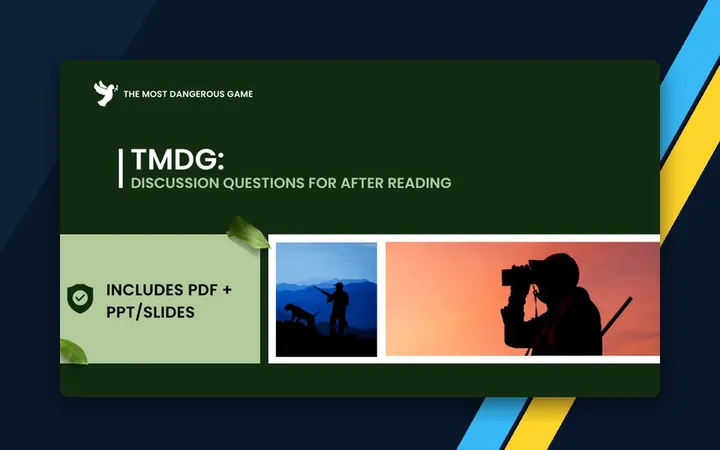
After reading, I use a handful of questions that push past plot. These work for whole class, small groups or a fishbowl:
- What is the "most dangerous game," and why does the title have more than one meaning?
- Rainsford says early on that the world is made of two classes, hunters and huntees. Does the story agree with him?
- Why does Connell make Zaroff so polite and educated? Would the story be scarier or less scary if he were rough and crude?
- Is Rainsford a hero? What would you need to know about what happens after the last line to decide?
- Is there a difference between hunting animals for sport and what Zaroff does? Where would you draw the line?
The title question is my favorite opener. "Game" means the animal being hunted and also the contest itself, and students love catching the double meaning.
SCR prompts for The Most Dangerous Game
Once students have their charts, short constructed responses are easy wins. I use one a day as a warm-up the week after reading:
- How does Connell use foreshadowing in the opening conversation between Rainsford and Whitney?
- How does Rainsford's view of hunting change over the course of the story?
- What does Zaroff's chateau reveal about his character?
- How does the setting of Ship-Trap Island create suspense?
- Why is the title "The Most Dangerous Game" significant?
For each one, students answer the question, cite one short piece of evidence and explain how it supports their answer. Keep the quotes short. A few words of evidence with a strong explanation beats a long copied paragraph every time.
Tips that make it smoother
- Pre-teach a handful of words (palpable, tangible, scruples, indolently) so the read doesn't stall at the chateau.
- Give a heads-up that the story involves hunting people. Most students are fine, and the warning keeps the focus on the writing.
- Save the ending discussion for the next day. Let students sit with it overnight and come in with a theory.
If you'd rather not build it all from scratch, I have the pieces ready below: a survival-themed pre-reading activity and predator/prey game, ten after-reading discussion questions with a teacher answer guide, five SCR prompts on slides and in a printable doc, ECR prompts for a longer essay, and a set of exit tickets with a short quiz and answer key.