How to Set Up a Writing Interactive Notebook (Plus a Paragraph of the Week Routine)
 Andy Navarro · Writing & Grammar ·
Set up a writing interactive notebook that goes from words to sentences to essays, and pair it with a Paragraph of the Week routine that sticks.
Most students don't struggle with writing because they have nothing to say. They struggle because nobody broke writing into pieces they could practice. A writing interactive notebook fixes that. It builds skills in order, from strong words to strong sentences to organized paragraphs to full essays, and it gives every student a reference they made themselves. Pair it with a Paragraph of the Week routine and students get steady, low-stakes practice using those skills every single week.
Here's how I set up a writing interactive notebook, the order I teach it in and how Paragraph of the Week fits around it. This works best in upper elementary and middle school, but the same structure holds up with older students who need to rebuild the basics.
Setting up the writing interactive notebook
The setup is the same as any interactive notebook, and it's worth a full class period:
- Composition notebook, glue sticks, scissors and colored pencils. Composition books survive a year of gluing. Spiral notebooks don't.
- Table of contents. Two pages at the front with columns for date, lesson and page number.
- Numbered pages. Every page, top outside corner, on day one.
- A sentence-parts color key. This is the most important page in the notebook. Assign one color per part: for example, blue for subjects, red for verbs, green for adjectives and adverbs, orange for transitions. Students use those colors every time they mark up a model sentence or paragraph.
The color key makes grammar visible. When students see that every complete sentence they color has a blue part and a red part, the idea of a sentence fragment stops being abstract.
The layout: teach it, then write it
I use a simple two-step page pattern for every lesson:
- Learn it. Notes, a foldable or a model paragraph that shows the skill clearly.
- Write it. A page where students immediately try the skill on their own, in their own words.
Never skip the second step. A notebook full of glued-in notes is a scrapbook. A notebook where every lesson ends with student writing is a writing notebook.
The order: words, sentences, paragraphs, essays
Writing skills stack. If students can't write a clear sentence, they can't write a clear paragraph. So the notebook builds from the smallest pieces up.
Stage 1: vivid words
Start with word choice, because it's the fastest win. Students learn to swap tired words for precise ones:
- Strong verbs: "walked" becomes "trudged," "strolled" or "marched," and each one tells a different story.
- Specific nouns: "a dog" becomes "a soaking-wet beagle."
- Sensory details: what does it look, sound, smell, feel or taste like?
A quick activity: put a boring sentence on the board, like "The man went down the street." Students rewrite it three different ways, each with a different mood. Then share. The same event becomes funny, scary or sad just by changing the words.
Stage 2: better sentences
Next, students learn what makes a sentence complete and how to make sentences more interesting:
- Subjects and predicates, marked with the color key.
- Fixing fragments and run-ons.
- Combining short choppy sentences with conjunctions.
- Varying how sentences begin, so a paragraph doesn't start "I" five times in a row.
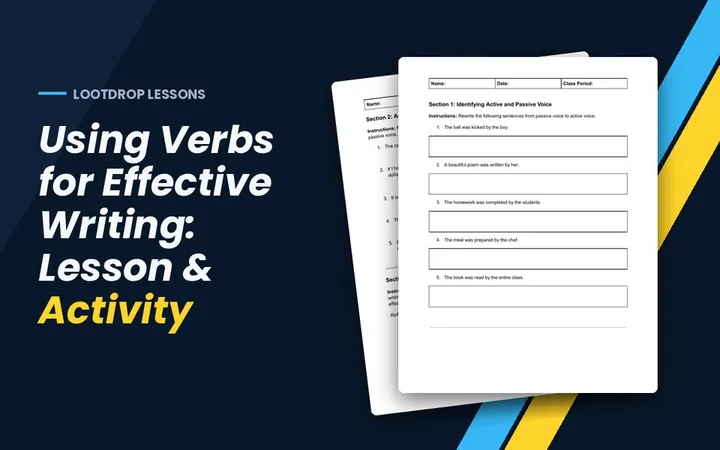
- Active versus passive voice. "The window was broken" hides who did it. "Marcus broke the window" doesn't. Students learn when each one is the right choice.
Older students can go further into verb moods here, like using the conditional ("If I had studied, I would have passed") and the subjunctive ("I wish I were taller") correctly.
Stage 3: paragraph types
Now students learn the parts of a paragraph: a topic sentence, supporting details, elaboration and a concluding sentence. Then they practice each main type:
- Narrative: tells a story with a clear sequence.
- Descriptive: paints a picture with sensory details.
- Informational or expository: explains or teaches something.
- Opinion or argument: takes a position and supports it with reasons.
- Compare and contrast: shows how two things are alike and different.
For each type, I start with a model paragraph. Students read it closely, color-code the parts using the key and then write their own. Seeing the structure marked up in color is what makes it click.
Stage 4: the essay
Once students can write strong paragraphs, the essay is just paragraphs in a row with a clear job each. Introduction with a thesis, body paragraphs that each prove one point and a conclusion. Students who skipped straight to essays often don't realize this. Students who built up through the notebook see it right away.
Where Paragraph of the Week fits in
The notebook teaches the skills. Paragraph of the Week is where students practice them, every week, all year. It's a simple routine that builds a lot of writing without a lot of grading.
Here's the weekly rhythm I use:
- Monday: introduce the prompt. Students read the prompt, talk with a partner for two minutes and jot ideas.
- Tuesday: plan. Students fill in a quick outline: topic sentence, two or three details, concluding sentence.
- Wednesday: draft. Students write the full paragraph in about fifteen minutes.
- Thursday: revise and edit. Students reread with the color key. Do you have a clear topic sentence? Strong verbs? Varied sentence starts? A partner checks one thing on the list.
- Friday: final copy and share. Students write the final version, and a few volunteers read theirs aloud.
Ten to fifteen minutes a day is plenty. Over a school year, that's dozens of polished paragraphs per student, which is far more practice than most students get from a couple of big essays.
Rotate the paragraph types
Don't use the same kind of prompt every week. I rotate through narrative, informational and opinion prompts so students practice each type regularly. Match the prompt type to what you're teaching in the notebook when you can. If the notebook lesson this week is opinion paragraphs, the Paragraph of the Week is an opinion prompt.
Grading without the stack
Use a short checklist, not a full rubric. Four or five items is enough:
- Clear topic sentence
- At least three supporting details
- Strong word choice
- Complete sentences with varied starts
- A concluding sentence
Grade the Friday final copy only. The rest of the week is practice. Many weeks, I give feedback on just one item from the checklist, the one we focused on in the notebook that week. Students fix one thing at a time, and you're not writing essays in the margins.
Tips that keep it running
- Keep a teacher model notebook so absent students can catch up on their own.
- Post the color key on the wall as well as in the notebook.
- Save one Paragraph of the Week from each month in a folder. In May, students reread September's paragraph and see how far they've come.
- Let students pick from two prompts some weeks. Choice keeps it from feeling like a chore.
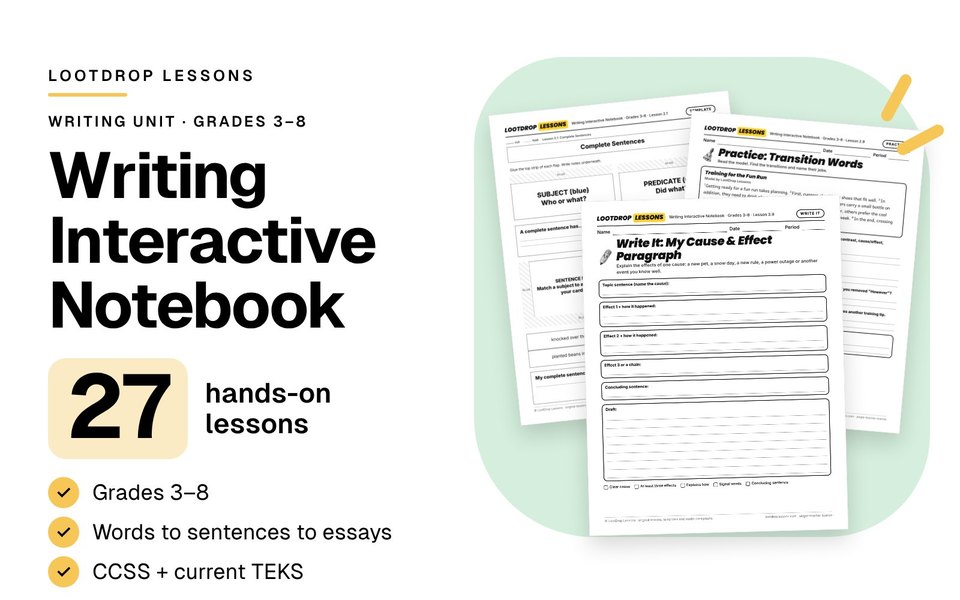
If you want the full sequence ready to go, my Writing Interactive Notebook has 27 hands-on lessons from vivid words to the essay, with model paragraphs, Write It pages, a sentence-parts color key and keys. Paragraph of the Week has 60 prompts on slides, split evenly between narrative, informational and opinion. And the Using Verbs for Effective Writing lesson covers active and passive voice and verb moods in more depth. They're all below.