Teaching Grammar in Context in Secondary ELA: Subject-Verb Agreement and Sentence Combining
 Andy Navarro · Writing & Grammar ·
Teaching grammar in context in middle and high school ELA: subject-verb agreement, sentence combining and short warm-ups that transfer to writing.
Every ELA teacher knows the frustration. Students ace the grammar worksheet on Tuesday, then turn in an essay on Friday full of the same errors. That's because isolated drills don't transfer. Teaching grammar in context means students learn a rule, see it in real sentences and then use it in their own writing right away. It doesn't need to take a lot of class time, either. A few focused minutes a day, done consistently, beats a two-week grammar unit every time.
Here's how I teach grammar in context in secondary ELA, using two skills that show up in almost every student essay: subject-verb agreement and sentence combining.
What "grammar in context" actually looks like
It doesn't mean never teaching rules. Students need the rule. It means the rule is always connected to real writing. My routine has four steps:
- Notice: show a sentence from a text or a student sample (anonymous) that uses the skill well, or gets it wrong.
- Name: teach the rule in one or two sentences, with a clear example.
- Practice: students fix or write a few sentences, fast.
- Apply: students go back to their own draft and find one place to use or fix the skill.
That last step is the one most grammar instruction skips, and it's the one that makes the skill stick.
Use warm-ups, not units
I teach most grammar in the first ten minutes of class as a warm-up. One skill a week, practiced a little each day. Students don't get overwhelmed, and the skill gets repeated enough to become automatic. Then, when we're drafting or revising, I can say "remember Tuesday's warm-up" and they do.
Teaching subject-verb agreement
The basic rule is simple: a singular subject takes a singular verb, and a plural subject takes a plural verb. "The dog barks." "The dogs bark." Most students get that right instinctively. The errors show up in trickier sentences, so that's where I spend the time.
Here are the trouble spots I teach, one per warm-up:
- Words between the subject and verb. "The box of chocolates is on the table." The subject is "box," not "chocolates." Teach students to cross out prepositional phrases to find the real subject.
- Compound subjects with "and." "My sister and her friend are coming." Two subjects joined by "and" usually take a plural verb.
- Compound subjects with "or" and "nor." The verb agrees with the subject closest to it. "Neither the players nor the coach was happy." Flip it, and the verb flips: "Neither the coach nor the players were happy."
- Indefinite pronouns. "Everyone," "each," "somebody" and "nobody" are singular. "Everyone has a notebook." Students want to say "have" because "everyone" feels like a lot of people.
- Inverted sentences. In sentences that begin with "there" or "here," the subject comes after the verb. "There are three reasons." "Here is the answer."
- Collective nouns. "The team is winning" when the group acts as one unit. This one varies between American and British English, so it's a good discussion point for older students.
A quick subject-verb agreement activity
Put five sentences on the board, each with one of the trouble spots above. Some are correct, some aren't. Students do three things for each one:
- Underline the subject.
- Circle the verb.
- Write "correct" or fix it.
Go over it together and have students explain how they found the subject. Then the apply step: students open their current draft, find three sentences, underline the subjects and circle the verbs. Most of them will find at least one error they didn't know they made.
Teaching sentence combining
Sentence combining is the grammar skill that does the most for student writing, in my experience. Students who write in short, choppy sentences sound younger than they are. Students who string everything together with "and" write run-ons. Sentence combining teaches the middle ground.
The idea is simple: give students two or three short sentences and have them combine them into one smooth sentence. For example:
- The storm was loud.
- The storm lasted all night.
- We couldn't sleep.
Students might write:
- "The loud storm lasted all night, so we couldn't sleep." (adjective moved, coordinating conjunction)
- "Because the loud storm lasted all night, we couldn't sleep." (subordinating conjunction)
- "The storm, loud and relentless, lasted all night and kept us awake." (paired adjectives set off with commas, compound verb)
There's no single right answer, and that's the point. I have students share their versions and then vote on which one sounds best and why. That conversation about why one sentence sounds better than another is where real writing instruction happens.
The combining moves to teach
I introduce these one at a time, over several weeks:
- Coordinating conjunctions (FANBOYS): for, and, nor, but, or, yet, so. Teach the comma before the conjunction when it joins two complete sentences.
- Subordinating conjunctions: because, although, when, since, if, while. Show how starting with one needs a comma after the clause.
- Relative clauses: who, which, that. "My uncle lives in Houston. He drives a truck." becomes "My uncle, who lives in Houston, drives a truck."
- Appositives: a noun phrase that renames. "Ms. Lopez is the soccer coach. She teaches biology." becomes "Ms. Lopez, the soccer coach, teaches biology."
- Moving adjectives and adverbs: folding a whole sentence down into a single word.
Apply it to real writing
After a few practice rounds, students take a paragraph from their own draft and find two places where short sentences could be combined. Then they rewrite the paragraph. Reading the before and after out loud is the best proof. Students can hear the difference immediately.
Make it seasonal once in a while
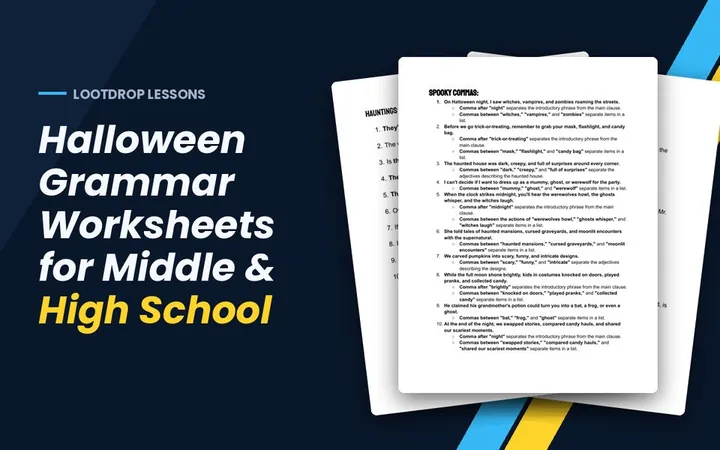
A themed set breaks up the routine and keeps engagement up, especially around holidays when attention is low. In late October, I swap my usual warm-ups for Halloween-themed grammar practice: same skills, spookier sentences. Students who groan at grammar will happily fix the commas in a sentence about a haunted house. It's a small change that buys a lot of goodwill, and the skills still get practiced.
Tips for making grammar stick
- One skill at a time. Teach one rule per week and practice it daily.
- Use mentor sentences. Pull sentences from the novel or story you're reading so grammar connects to literature.
- Always end with their own writing. The apply step is not optional.
- Grade it in essays. Add the skill of the week to your rubric for the next writing assignment so students know it counts.
- Spiral back. Every few weeks, mix in a warm-up on an old skill so it doesn't fade.
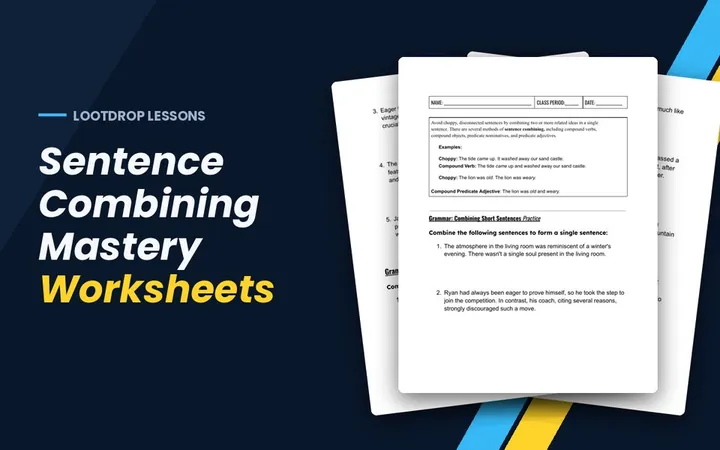
If you want warm-ups ready to project, my Subject-Verb Agreement bundle has 10 warm-ups, each with a review slide explaining the rule. The Sentence Combining Mastery worksheets give practice and an assessment at two levels with keys. And for the end of October, the Halloween Grammar Worksheets cover commas, homophones, who and whom, spelling and sentence combining. They're below.