
Winter Activities for Elementary: Story Problems, Seasonal Writing and Coloring That Teach

Winter activities for elementary classrooms: winter story problems, seasonal writing prompts, winter reading and coloring pages that still teach.
The weeks between Thanksgiving and spring break are long. Kids are excited, schedules get weird, and attention gets short. Good winter activities for elementary classrooms ride that energy instead of fighting it. The trick is keeping the theme seasonal and the skills real, so a snowy story problem is still a story problem and a winter coloring page still practices something.
Here are winter activities across math, writing, reading and quiet work time, with ideas you can use tomorrow.
Keep winter inclusive
Before the activities, one quick note. Not every family celebrates Christmas, and not every school gets snow. Plenty of us teach in places where winter means a jacket for a week. A few easy habits keep everyone included:
- Lean on weather, animals, cozy indoor things and winter sports more than any one holiday.
- When you do holidays, include several, like Hanukkah, Kwanzaa and Lunar New Year, and invite students to share their own traditions if they want to.
- Make "winter where you live" a fair topic. A student describing a chilly morning at the bus stop is writing about winter too.
Winter story problems that build real problem solving
Word problems are where kids show whether they understand addition and subtraction or just know how to do the steps. A winter theme makes them easier to picture: snowballs, mittens, sleds and cocoa cups are things kids can draw.
A simple routine for K-2 story problems:
- Read it three times. First for the story, second for the numbers, third for the question. Don't let anyone grab numbers on the first read.
- Picture it. Students draw what's happening. Simple shapes are fine: circles for snowballs, rectangles for sleds.
- Write a number sentence. 7 + 5 = 12, or 12 - 4 = 8.
- Answer in a sentence. "Mia made 12 snowballs." This catches kids who solved the math but forgot what the question was.
Mix the problem types on purpose. Kids get comfortable with "some, then some more" quickly. Push them with problems where the start is missing ("Some birds were on the fence. 3 more came. Now there are 9. How many were there at first?") and comparing problems ("Leo has 8 mittens. Ana has 5. How many more does Leo have?"). Those are the ones that show who really understands the math.
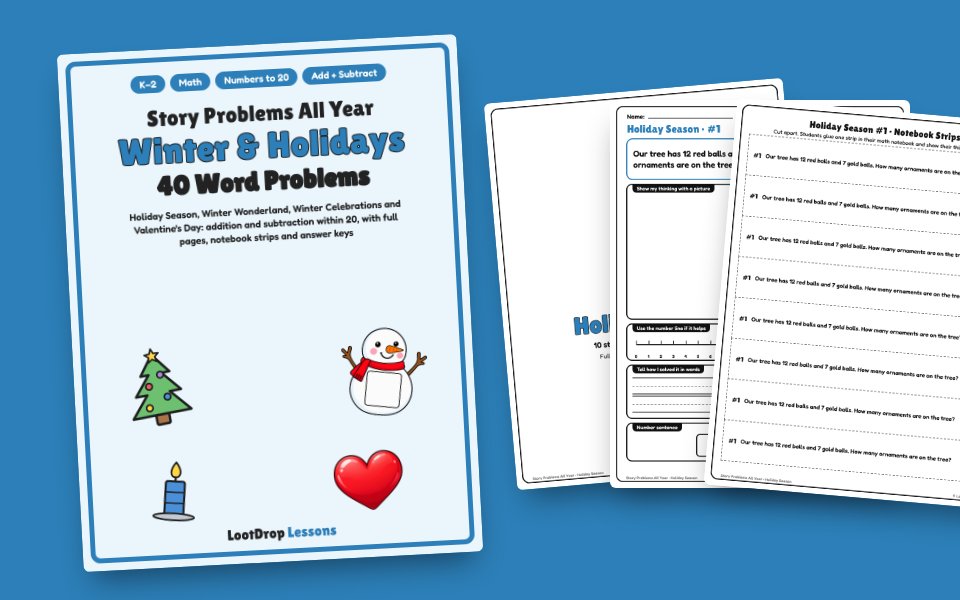
For extra reps, cut problems into strips and glue one into a math notebook each morning. It's a quick warm-up that takes almost no prep.
Seasonal writing prompts for winter
Winter writing works best when kids have something to describe or a reason to argue. Some prompts that tend to get even reluctant writers going:
- Opinion: Is winter the best season? Give three reasons. (Kids who hate the cold have the most to say.)
- Opinion: Hot cocoa or warm cider: which is the better winter drink, and why?
- How-to: How to build a snow friend, step by step, using first, next, then and last.
- Narrative: You wake up and everything outside is covered in snow, even though it never snows here. What happens next?
- Descriptive: Describe a cold morning using all five senses.
- Informational: Pick a winter animal. How does it stay warm or survive the cold?
Give younger writers a word bank with pictures: snow, cold, mittens, scarf, ice, sled, freeze, warm. For older students, ask for one simile about cold ("as cold as...") and one strong verb in place of "went." Small targets like that make revision easier.
Winter reading that does double duty
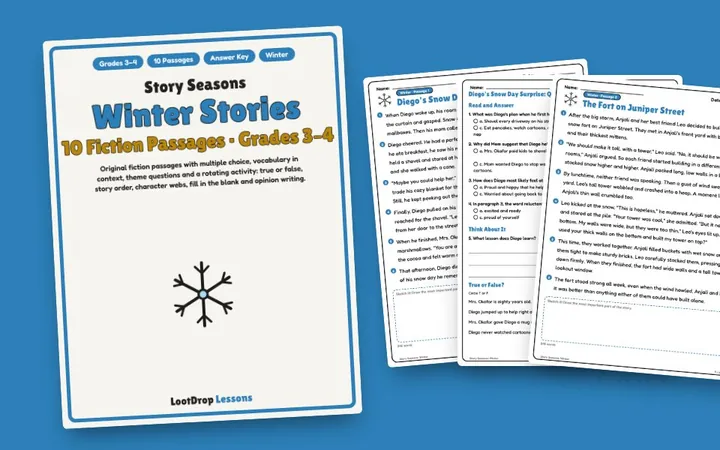
Short fiction passages are a good fit for December and January because you can finish one in a single sitting, even on a day with an assembly. Pair each story with a few questions that go past recall:
- One multiple choice question about a key detail.
- One vocabulary-in-context question: what does this word mean here, and what clue helped?
- One theme question: what lesson does the character learn?
The theme question is where winter stories shine. Winter stories are often about patience, kindness or getting through something hard, which gives third and fourth graders plenty to say.
Coloring pages that still teach
Coloring gets a bad reputation, but in winter it earns its place. It's calm, it works on the day before break, and it's good fine-motor practice for little hands. The key is giving the coloring a job.
- Color by code: each space has a sight word, sum or short vowel sound, and the key tells kids what color to use. They have to read or solve before they color.
- Color by sum: spaces show 4 + 3 or 10 - 6. A snow scene appears as kids get the answers right.
- Label and color: a winter scene with blanks for kids to label (sled, scarf, icicle), then color.
- Color, then write: after coloring a winter picture, students write two sentences about what's happening in it.
Coloring is also a great anchor activity. When a group finishes early, they pull out their winter coloring page instead of asking what to do next.
Winter centers for K-1
Centers are an easy place to work in a winter theme without changing your routines. A few that fit well:
- CVC match-up: match a word on a hat to the picture on a snow friend. Add a recording sheet so you can see who did what.
- Ten frames with snowballs: students fill a ten frame with cotton balls and write the number.
- Measure the icicle: paper icicles of different lengths, measured with cubes or paper clips.
- Winter graph: survey the class on favorite winter treat and build a tally chart or bar graph.
A sample winter week
- Monday: winter story problem warm-up, then a short winter reading passage.
- Tuesday: story problem strip, how-to writing about building a snow friend.
- Wednesday: phonics and math centers with a winter theme.
- Thursday: opinion writing, "Is winter the best season?"
- Friday: color by code, a final story problem and sharing writing.
If you want this ready to print, I've made several winter resources below: 40 winter and holiday story problems for K-2 with show-your-thinking pages and notebook strips, ten original winter reading passages with questions for grades 3-4, a winter train math and literacy unit for K-1, and a CVC and CCVC snow friend phonics center.