A Daily Phonics Routine With Decodable Practice (and How Level Up Phonics Runs It)

A simple daily phonics routine with decodable practice: warm-up, new sound, blending, word chains, heart words, dictation and a decodable story.
A good phonics routine is boring in the best way. Same steps, same order, every day, so kids spend their energy on the new sound instead of figuring out what's happening next. Add decodable practice at the end, a story built only from sounds they've been taught, and students get to use the skill the same day they learn it.
I built Level Up Phonics around that idea. Below is the routine itself, step by step, so you can run it with any phonics scope you already have. Then I'll show how the levels are organized if you want everything ready to print.
Why a daily phonics routine works
Explicit, systematic phonics is one of the most supported findings in reading research. Explicit means you tell students the sound and show them the spelling, instead of hoping they notice. Systematic means skills build in a planned order, from simple to complex.
A fixed routine makes both easier. Kids learn the moves of the lesson once, so every new sound slots into a pattern they already know. You also get faster, because you aren't planning a new lesson shape every night.
The seven-step routine (about 35 minutes)
Here's the loop, with rough timings. If your block is shorter, split it across two days (more on that below).
- Warm up (3 minutes). Oral phonemic awareness with no letters at all. "Say map. Now say it without the /m/." Start the year with first sounds and work up to blending, segmenting and swapping sounds.
- Sound drop (5 minutes). Introduce the new sound. Show the card, model the mouth position, have students say it, sky-write it, then write it on whiteboards.
- Blend run (5 minutes). Students read a list of words with the new sound, sound by sound, then sweep a finger under the word and say it smoothly.
- Chain reaction (5 minutes). Build a word with letter tiles, then change one sound at a time: cat, cap, map, mop. Ask students what changed. This is where they stop guessing and start looking at every letter.
- Heart words (3 minutes). Teach high-frequency words that aren't fully decodable yet. Tap the sounds, write the regular parts, and draw a heart over the part students have to learn by heart. In said, the s and d are regular and the ai gets the heart.
- Dictation (5 minutes). Say a word, students repeat it, tap the sounds and write it. Do three words and one sentence. Dictation is spelling practice and phonics practice at the same time, and it shows you who really has the sound.
- Decodable story (10 minutes). Students read a short story built only from sounds and heart words already taught. Read it three times: a whisper read, a partner read, then a smooth reread. Finish with a couple of quick comprehension questions.
What makes decodable practice actually decodable
A decodable text only works if students can really sound out every word with what they've been taught. If a short-vowel story slips in boat or night, students go back to guessing from pictures, which is exactly the habit you're trying to replace.
When you pick or write decodable stories, check three things:
- Every word uses only sound-spellings already taught.
- Any irregular words were taught as heart words before the story.
- Character names follow the same rule. "Pip" works in a short vowel story. "Chloe" doesn't.
After the story, give students a fluency page with the day's sounds, words, heart words and sentences. Have them reread it in timed rounds, or count how many words they read in one minute. The goal is smooth, not rushed.
Two-day pacing for shorter blocks
If 35 minutes won't fit, split it:
- Day 1: warm up, sound drop, blend run, chain reaction, and a first read of the story.
- Day 2: heart words, dictation, the full story routine and the fluency page.
Small groups can reread the story and fluency page later in the day. Students who need more time can repeat a lesson the next day before moving on. Repeating is not falling behind. It's what makes the next sound stick.
How Level Up Phonics is organized
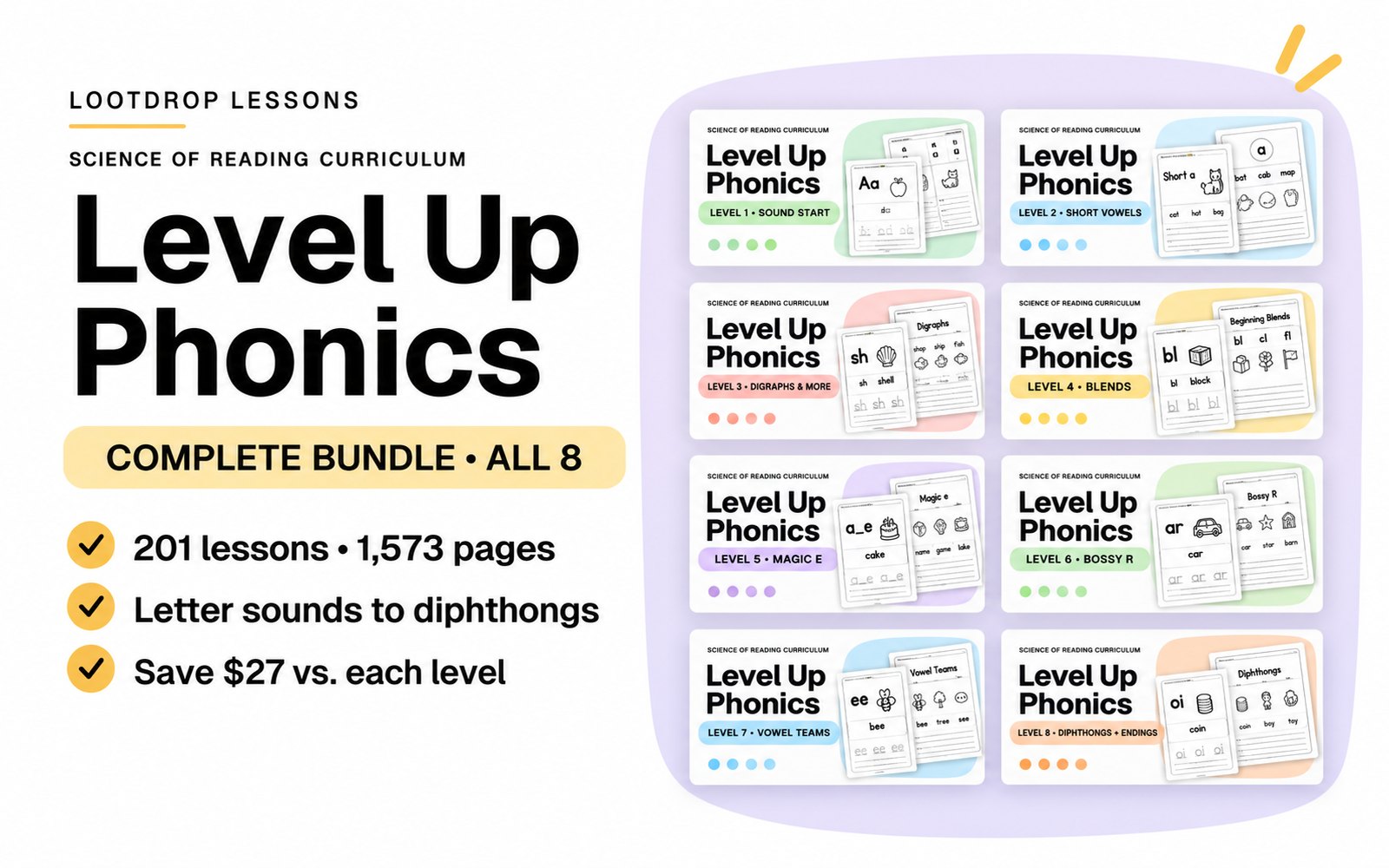
Level Up Phonics follows that routine across eight levels, Pre-K through second grade and intervention. Every level is a complete Science of Reading unit. Here's the scope:
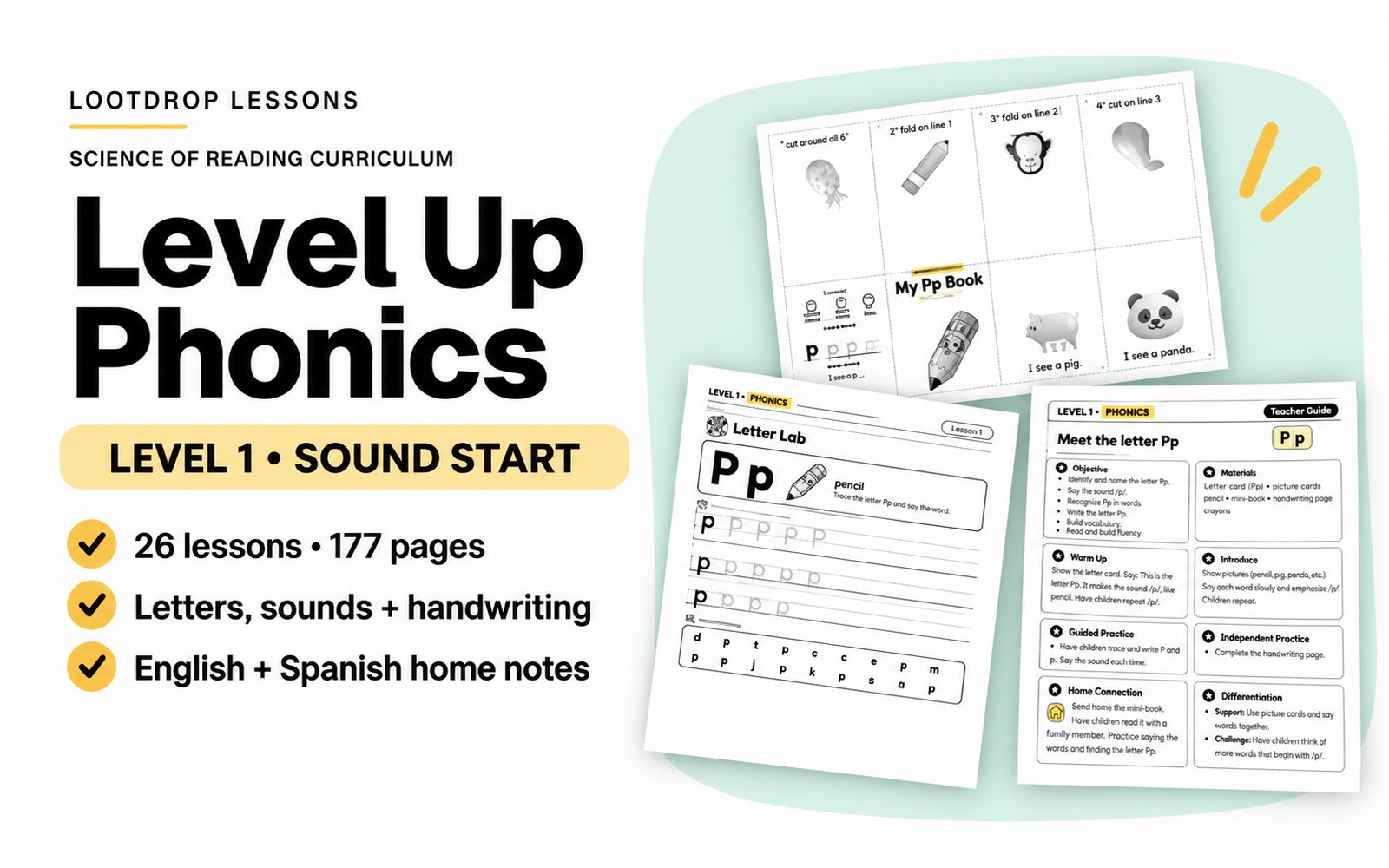
- Level 1, Sound Start: letters and sounds. 26 lessons, one letter a lesson, with handwriting paths, sound hunts, picture mini-books, Letter Run fluency and daily phonemic awareness.
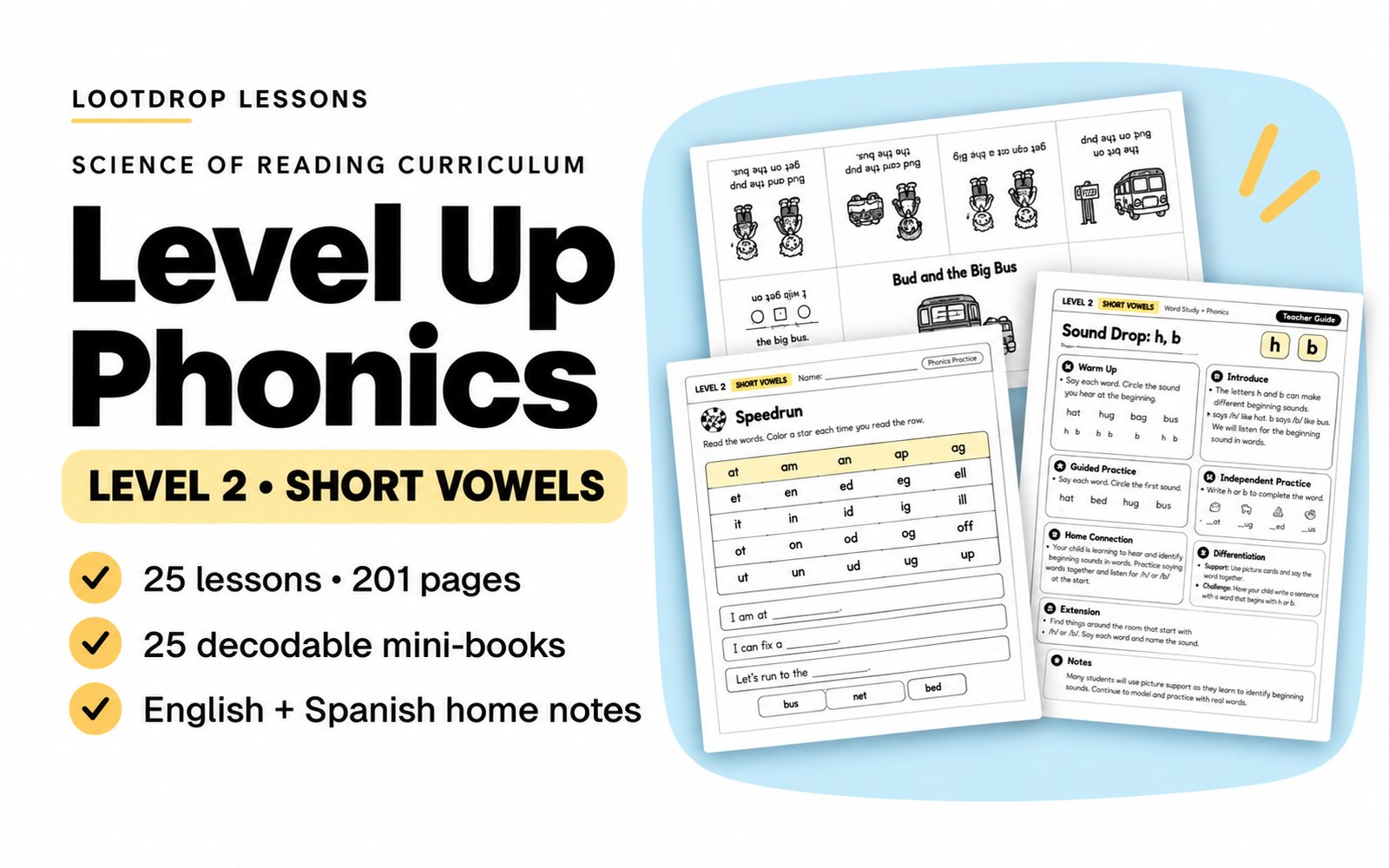
- Level 2, Short Vowels (CVC): 25 lessons with word chains, Map It sound boxes, dictation and the first fully decodable mini-books.
- Level 3, Digraphs and Double Letters: sh, ch, th, wh, ck, ng, nk, FLSZ double letters, -es and open syllables.
- Level 4, Blends: s-, l- and r-blends, ending blends, three-letter blends, -tch and -dge.
- Level 5, Magic e: a_e, i_e, o_e, u_e, e_e, soft c, soft g, y as long i and long e, and double consonants.
- Level 6, Bossy R and Word Families: ar, or, ore, er, ir, ur, all, wor, war, are, plus the -ind, -ild, -old and -ost families.
- Level 7, Vowel Teams: ai, ay, ee, ea, oa, ow, oe, igh, ie, ue, ew, both sounds of oo, ea as short e, and ey.
- Level 8, Diphthongs and Endings: oi, oy, ou, ow, au, aw, silent letters kn, wr, mb and ph, plus -ed, -ing, -er and -est.
Levels 2 through 8 each have 25 lessons and 25 original mini-books that are 100% decodable for that point in the sequence, along with Map It sound boxes and Speedrun fluency pages. Every level has home notes in English and Spanish, which matters a lot in multilingual classrooms. Families can see the week's sound and words even if they don't read English.
Where should students start?
Don't start everyone at Level 1 just because it's first. Give a quick placement check:
- Students who don't know most of their letter sounds start with letters and sounds.
- Students who know their sounds but can't yet read short-vowel words like sat and pig start with CVC words.
- Students who read real and nonsense CVC words easily are ready for digraphs.
Nonsense words are the honest test. A student can memorize cat. They can't memorize vop, so reading it shows they're actually decoding.
That's also why each level in the bundle comes with pre and post tests. You can place students, group them, and see growth at the end of a level instead of guessing.
Small tips that keep it running
- Keep sound cards on a ring by your teaching spot so the sound drop takes seconds.
- Use the same hand signals for tapping sounds and sweeping words every day.
- Correct quickly and warmly: model the sound, have the student repeat, reread the word.
- Send the mini-book home. A book a child can actually read is the best homework there is.
You can run this routine with nothing but letter tiles, whiteboards and a stack of index cards. If you want the lessons, mini-books, fluency pages, dictation sheets and home notes already done, each Level Up Phonics level is below, or grab all eight in the complete bundle.