How to Use Anchor Charts in Elementary and Middle School (So Kids Actually Use Them)

How to use anchor charts students actually look at: make them with your class, display them well, rotate them and let kids build their own.
Most classrooms have anchor charts. Fewer classrooms have anchor charts that students actually use. If you've ever pointed at a chart and watched a kid look right past it, you know the difference. Learning how to use anchor charts well isn't about making them prettier. It's about making them part of how students think and work, in elementary and middle school alike.
Here's the whole cycle I recommend: what goes on a chart, how to make it with your class, where to hang it, when to take it down, and how to get students building their own.
What an anchor chart is (and isn't)
An anchor chart is a visual record of thinking you taught. It "anchors" a skill or routine so students can go back to it when you're not standing next to them. That last part is the test. A good anchor chart answers the question a student would otherwise raise their hand to ask.
It isn't a decoration, a vocabulary list or a copy of the textbook page. If a chart has fifteen bullet points in small handwriting, nobody is using it from their seat.
The strongest charts usually have:
- One clear title that names the skill in kid words ("How to Find the Main Idea," not "Main Idea and Supporting Details: Key Concepts").
- Three to five steps or parts, numbered if order matters.
- One worked example students recognize, ideally from a text or problem you did together.
- A simple picture or icon next to each step, so non-readers and multilingual learners can follow along.
- Color with a job. If the claim is blue on the chart, the claim is blue when students highlight their own writing.
Making anchor charts with your class, not before class
The single biggest change you can make is building the chart in front of students during the lesson. A chart you made at your kitchen table the night before is your thinking. A chart you build with them is their thinking, and they remember it.
That doesn't mean you start from a blank sheet. A simple way to do it:
- Prep the frame. Write the title and draw the sections ahead of time. Leave the content blank.
- Teach and fill. As you model the skill, add each step to the chart in your own words, then ask students to help you say it shorter.
- Add the example last. Use the sentence, paragraph or problem you just worked through together. Students will point to it later and say, "oh, the one with the dog."
- Have students sign it. In the younger grades, a corner of initials or fingerprints gives kids ownership. In middle school, a class period label does the same job.
If you'd rather start from a printed poster, that works too. Just hide part of it with sticky notes and reveal sections as you teach, or leave one section blank for the class to fill in. You still get the "we made this" effect.
How to display anchor charts so kids can use them
Where a chart hangs decides whether it gets used. A few rules of thumb:
- Eye level for the kids, not for you. In a K-2 room, that's lower than you think. Sit in a student chair and look around.
- Near the work. Math charts by the math area or the board where you model problems. Writing charts near the writing center or where drafts get turned in.
- Fewer is better. A wall with twenty charts reads as wallpaper. Five to eight current charts is plenty for most rooms.
- Group by subject. A reading wall, a math wall, a routines spot by the door. Students learn where to look.
- Big enough to read from the back. If a student in the far corner can't read the title, the chart needs to move or get bigger.
Then point to it. Every time a student asks something the chart answers, walk over and touch the chart instead of answering. It feels slow the first week. By the third week, students start doing it themselves.
Rotating anchor charts: when to take one down
Anchor charts aren't permanent. A chart should stay up while the skill is new and come down once students have it. If everything stays up all year, the new charts get lost in the old ones.
A simple rotation system:
- Current wall: charts for the skills you're teaching right now.
- Review spot: a smaller area, a door or the side of a cabinet, for skills you taught last month and still spiral back to.
- Archive: a chart ring, binder or clothes hanger with clips. Kids can still flip to an old chart when they need it.
Some charts never rotate out. Routines like voice levels, what to do when you finish early or how to ask for help can live on the wall all year, because students use them every single day.
One more trick: take a photo of each chart before you take it down. Project it during review weeks, or print it small for students who need it at their desk.
Student-made anchor charts and notebook copies
The wall chart helps the whole class. A student's own copy helps that one kid at their desk, during a test review or at home. There are a few ways to get there:
- Mini charts. Students copy the class chart onto a half sheet and glue it into their notebook. Have them add their own example, not yours.
- Fill-in student notes. A version of the chart with key words left blank. Students fill it in as you build the big one. This works well for students who struggle to copy from the board.
- Coloring versions. For younger students, a black-and-white version they color while you talk through each part keeps hands busy and attention on the content.
- Blank chart challenge. Once a skill is solid, give small groups a blank page and ask them to make the anchor chart for a class that hasn't learned it yet. If they can teach it on paper, they know it.
The student-made version is where middle schoolers really get going. Ask a group of seventh graders to design the "how to cite text evidence" chart for sixth graders and they'll argue about every word. That argument is the learning.
Anchor charts across subjects
Anchor charts aren't just for reading. A few that tend to earn their wall space:
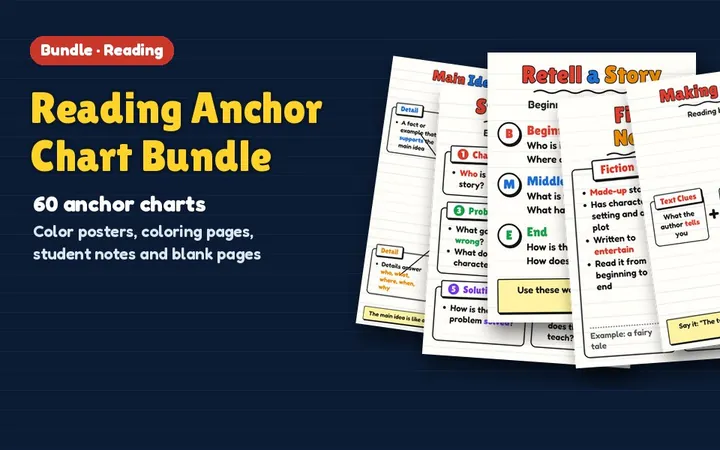
- Reading: main idea, story elements, making inferences, text structures, theme.
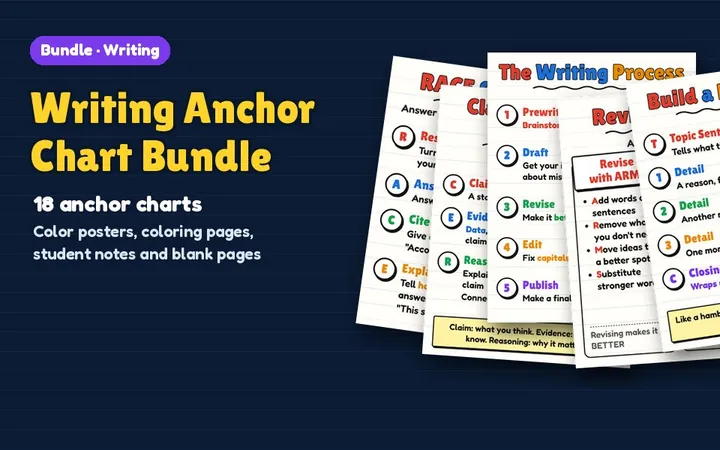
- Writing: the writing process, building a paragraph, transition words, revise vs. edit.
- Math: strategy charts are gold here. Addition and subtraction strategies, ways to show multiplication, fractions on a number line, area vs. perimeter. Real visuals matter more in math than anywhere else.
- Science: the scientific method, states of matter, the water cycle, lab safety.
- Routines and SEL: voice levels, calm-down strategies, being a good partner, finished early.
Quick checklist before you hang it
- Can a student use it without you there?
- Does it fit in five steps or fewer?
- Is there an example from your actual lesson?
- Can the kid in the back corner read the title?
- Do you know when it's coming down?
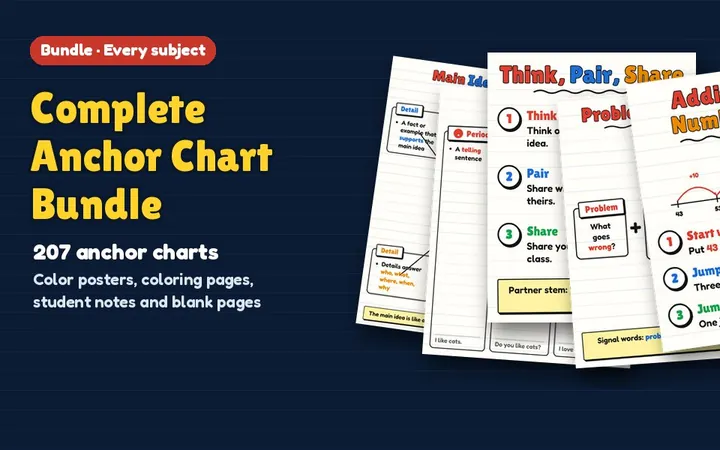
If you'd like a head start, I've put together anchor charts for reading, writing, math, science and classroom routines. Each one comes with a color poster, a coloring page, student notes and blank pages, so you can do the build-it-together, notebook and student-made steps above without making every page yourself. Grab one subject bundle or the complete set below.