The Lady or the Tiger Lesson Plan: Ambiguous Endings, Argument Writing and Alternative Endings
 Andy Navarro · Short Stories ·
A Lady or the Tiger lesson plan built on the ambiguous ending: close reading, an evidence debate, argument writing and an alternative ending.
If you're putting together a Lady or the Tiger lesson plan, you're working with the best argument starter in the anthology. Frank Stockton ends his story with a question and never answers it. Students are furious for about thirty seconds, and then they start arguing. That argument, backed by evidence, is the whole lesson. By the end of the week they've done close reading, debated, written an argument and maybe even written their own ending.
Here's how I teach it.
Quick background for you
- Frank R. Stockton published "The Lady, or the Tiger?" in The Century magazine in 1882. It became so famous that readers kept writing in to demand an answer.
- Stockton never gave one. He later wrote a follow-up story, "The Discourager of Hesitancy," which only adds another puzzle.
- The story is in the public domain, so you can print it freely and quote it as much as you like.
- The language is old-fashioned and the sentences are long. Plan for vocabulary support.
Pre-reading: the impossible choice
I start with a quick-write: Would you rather see someone you love be happy with someone else, or lose them forever? Students groan, then write. When they share, the room splits, and that split is exactly the one the princess faces.
A second warm-up that works: put two doors on the board and ask, "If your future was decided by picking one, would that be fair?" Students will argue about luck, justice and whether chance can ever be fair. Keep their answers. The king thinks his arena is perfectly fair.
Reading in three chunks
- The king and his arena: Stockton describes a "semi-barbaric" king and his system of justice. An accused man opens one of two doors. Behind one is a hungry tiger. Behind the other is a lady he must marry on the spot. Stop and ask: What kind of person invents this? Why does the king think it's fair?
- The princess and the young man: the king's daughter loves a young man of low rank, the king finds out, and the young man is sent to the arena. The princess learns which door hides which, and she knows the lady behind the door, a woman she hates. Stop and ask: What do we know about the princess so far?
- The signal: the young man looks to the princess, she signals to the right, and he opens that door. Then Stockton stops and hands the question to us.
Read the last paragraph aloud slowly. Stockton says he leaves the question with all of us: which came out of the opened door, the lady or the tiger? Then stop talking and let the reaction happen.
Teaching the ambiguous ending
Students need to know this isn't a trick or a missing page. An ambiguous ending leaves the outcome open on purpose, so readers have to decide based on the evidence. Stockton isn't hiding the answer. He's testing whether we were paying attention to the princess.
I ask: Why would an author refuse to finish a story? Students usually land on good answers: to make readers think, to start arguments, to show that people are hard to predict. That's author's purpose, and they got there without a worksheet.
Close reading the princess
Everything depends on her character, so we read her closely. I give students a two-column evidence chart:
- Left column, "Evidence for the tiger": details that suggest she'd rather see him die than marry another woman.
- Right column, "Evidence for the lady": details that suggest her love would win out.
Strong evidence students find every year:
- Stockton says the princess is as semi-barbaric as her father, with a soul as "fervent and imperious" as his own.
- She has seen the lady behind the door throw glances at the young man, and she hates her for it.
- Stockton describes her imagining both outcomes in agony, the tiger's attack and the joyful wedding, over many days and nights.
- She clearly loves the young man deeply, enough to discover the secret no one else could.
- She signals without hesitation, which suggests she had already decided.
Pairs fill in at least three rows on each side. The point is to see that both answers have real support, and the stronger argument is the one that explains the evidence best.
Run a quick evidence debate
Once the charts are done, I run a four corners or two sides debate. One side of the room is the lady, the other is the tiger. Students pick a side and must give one piece of evidence before they're allowed to sit. If someone on the other side convinces them, they can walk across the room, but they have to say what changed their mind.
A few rules keep it focused:
- Every claim needs a detail from the text, not just "she seems nice."
- Respond to the person before you, don't just repeat your own point.
- Consider the young man too. He trusts her signal completely. Does that tell us anything?
Argument writing: lady or tiger?
The debate turns straight into writing. I keep the structure simple:
- Claim: one sentence that answers the question. "The princess sent the young man to the tiger."
- Two reasons with evidence: each one backed by a quote or specific detail from the chart.
- Explanation: two or three sentences for each, explaining how the evidence proves the claim.
- Counterargument: name the best evidence for the other side, then explain why it's weaker.
- Conclusion: return to what the ending shows about the princess, or about people in general.
The counterargument is where this story shines. Students already spent a full period hearing the other side, so they actually know what it is. For many of my students this is the first time a counterclaim feels natural instead of forced.
Short constructed response practice
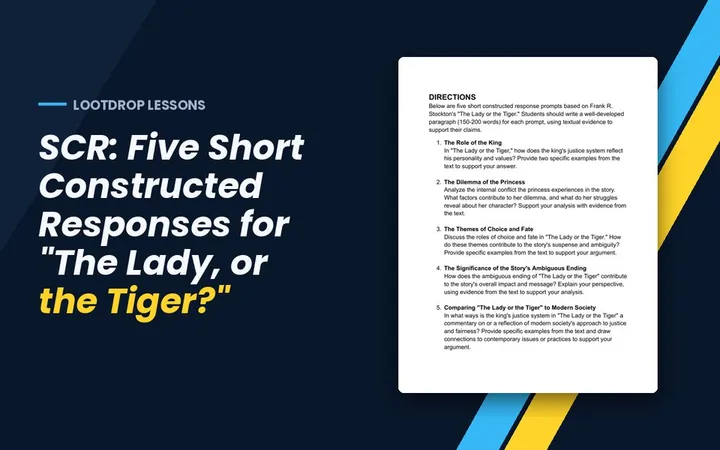
For quicker checks, I use one SCR a day the week after reading:
- How does Stockton characterize the king in the opening of the story?
- Why does Stockton describe the princess as semi-barbaric? How does that affect the ending?
- Is the king's system of justice fair? Use evidence to support your answer.
- What is the effect of ending the story with a question?
Alternative ending: let them finish it
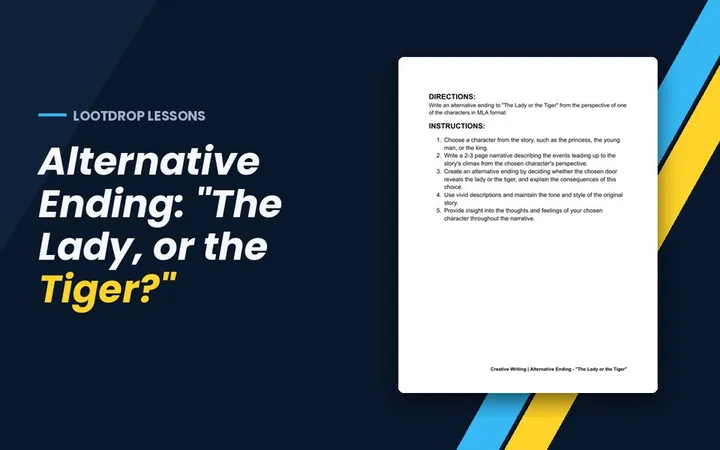
The perfect creative follow-up: students write what happens when the door opens. I ask them to write from one character's point of view, the princess, the young man, the lady, or even the king, and to keep the ending consistent with the evidence from the story. A tiger ending has to fit the princess's jealousy. A lady ending has to fit her love. The best ones read like Stockton could have written them.
This also works as a quiet assessment of characterization. If a student's princess acts nothing like Stockton's, you'll see it right away.
Tips that help
- Pre-teach a few words (florid, imperious, fervent, anguish) before reading.
- Read the long opening paragraphs aloud. The style is tougher than the plot.
- Don't tell students what you think until the very end, if ever. Once you pick a side, half the room stops arguing.
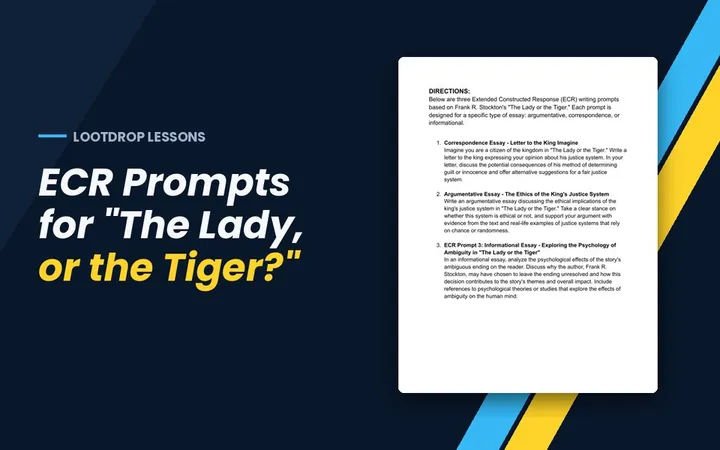
If you want the materials ready to go, the resources below include five SCR prompts on the ambiguous ending, three ECR prompts, an alternative ending assignment, a characterization one-pager and a character analysis presentation project.