Gift of the Magi Lesson Plan: Teaching Situational Irony to Every Reader
 Andy Navarro · Short Stories ·
A Gift of the Magi lesson plan that differentiates for struggling readers with five text versions, and teaches situational irony step by step.
"The Gift of the Magi" is the perfect December story: short, warm, and built around one of the cleanest examples of situational irony in literature. The catch is O. Henry's language. His sentences are long, playful and full of words my students have never seen. So when I build a Gift of the Magi lesson plan, my first question isn't "what will we analyze?" It's "how will every kid in the room actually read it?"
Here's what works for me, including the five-version trick that lets struggling readers and advanced readers join the same discussion.
The problem with teaching classics to mixed classes
Every year I have students who devour this story and students who stall in the first paragraph. If I hand everyone the original and push through, half the class spends the period decoding instead of thinking. If I hand out a simplified summary, students miss the voice that makes the story fun.
The fix: give everyone the same story in different versions, all with matching paragraph numbers. When I say "look at paragraph 12," every student finds the same moment, no matter which version is on their desk.
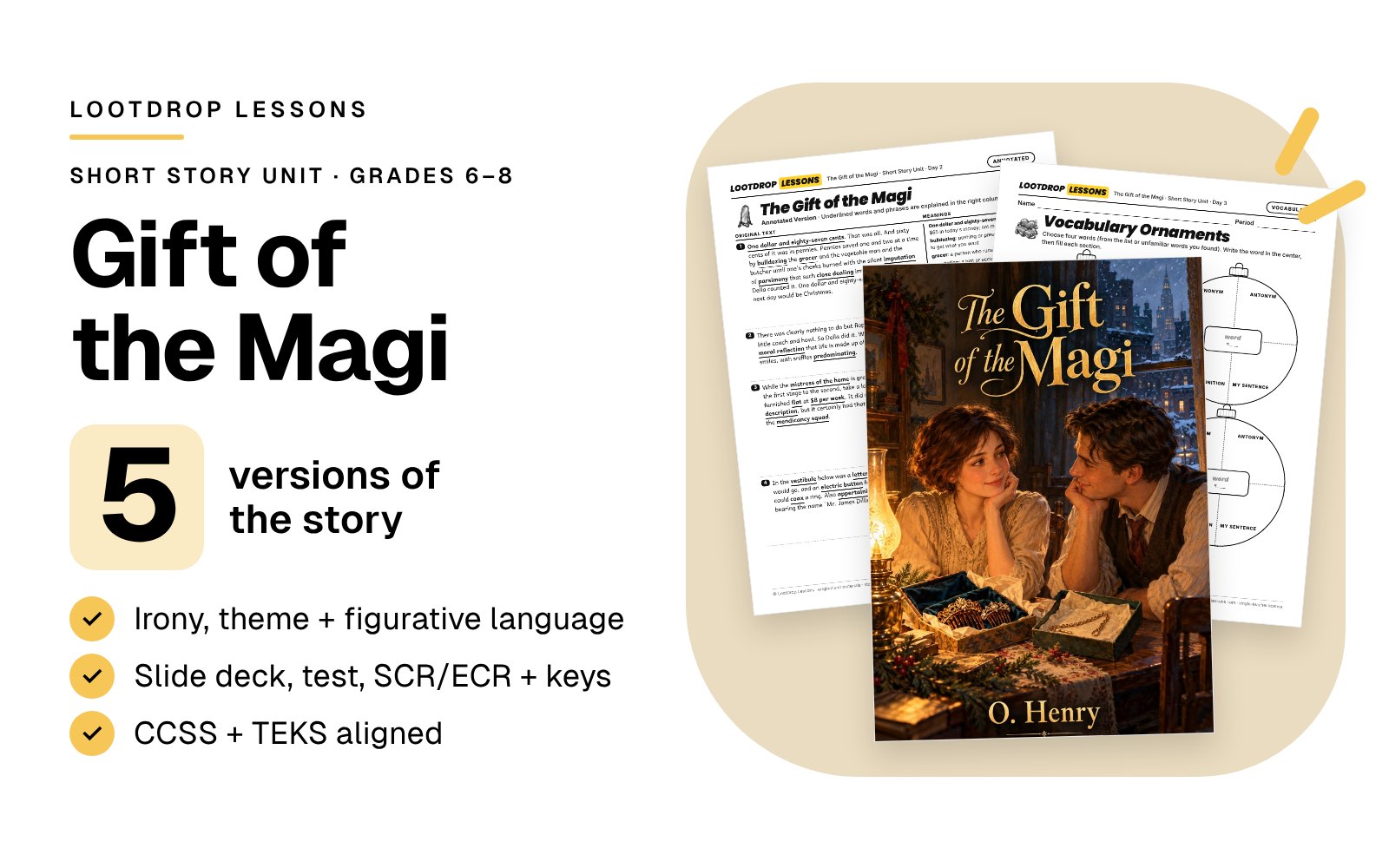
The five versions
The story is public domain (it was published in 1905), so you can build these yourself.
- Original: O. Henry's text exactly as written. For strong readers and for anyone you want to stretch.
- Modified: the same events in clear, modern language, paragraph for paragraph. For students reading below grade level or still learning English.
- Annotated: the original with short definitions and notes beside the hard parts (what a "flat" is, who the Queen of Sheba was, what a fob chain looks like).
- Note-taking: the original with wide margins and prompts for students to write their own notes as they read.
- Side-by-side: the original and the modified version next to each other. This one is great for English learners and for students who want to try the original but need a safety net.
I don't announce who gets which version. I let students choose, and I steer quietly when needed. Plenty of kids start with side-by-side and end up reading mostly in the original column by the end. That growth is the point.
Before reading: money then and now
The story only works if students feel how broke Della and Jim are. The opening line is "One dollar and eighty-seven cents." In 1905, that was a little money, but not much, and Jim's weekly pay had just been cut from thirty dollars to twenty.
I have students guess what $1.87 in 1905 would be worth today, then show them a rough estimate using an online inflation calculator (it's somewhere around sixty to seventy dollars). Then I ask: What gift could you buy for someone you love with that? Suddenly the story is personal.
I also front-load a few allusions with a quick slide: the Queen of Sheba and King Solomon (known for great wealth) and the Magi (the wise men who brought gifts to the infant Jesus). Two minutes now saves a lot of confusion later.
During reading: stop before the twist
I read the story aloud while students follow in their version. The key move is where I stop: right when Jim walks in, stares at Della's short hair, and pulls a package from his coat.
Students write a prediction. What's in the package? Why is Jim acting so strange? Most guess something close, but almost nobody guesses both halves of the twist. Then we finish the story, and the room reacts.
Teaching situational irony
Situational irony is when the outcome is the opposite of what the characters, or readers, expect. This story is the textbook example.
I build it on the board as a simple chart with three columns: Character, What they sacrificed, and What they bought.
- Della sells her long, beautiful hair for twenty dollars and buys a platinum fob chain for Jim's watch.
- Jim sells his gold watch, the one that belonged to his father and grandfather, and buys Della a set of combs for her hair.
Then I add a fourth column: Can they use the gift now? Both answers are no. Each one gave up their most treasured possession to buy something for the other person's most treasured possession, and now neither gift can be used.
That chart is the whole lesson on situational irony in one picture. Struggling readers get it because it's visual. Advanced readers can push further.
The second layer: why the ending isn't sad
Here's where I push every class past "that's so sad." O. Henry's narrator says the gifts were foolish, then flips it. In the last paragraph, he says that of all who give gifts, these two were the wisest, and ends with "They are the magi."
I ask students: If the gifts are useless, how can they be the wisest givers? Let them sit with it. Eventually someone says the real gift was the sacrifice, or the love behind it. That's the theme, and the students found it themselves.
For older or stronger readers, I add a follow-up: the story has situational irony in the plot, but is the narrator also being ironic when he calls them foolish? That opens up a nice conversation about tone.
Characterization with STEAL
Della is a great character for practicing indirect characterization. Students use STEAL (Speech, Thoughts, Effect on others, Actions, Looks) and find one piece of evidence for each letter. Good examples to look for:
- Actions: counting the money three times, crying on the couch, then making a quick, brave decision.
- Thoughts: her worry about whether Jim will still think she's pretty.
- Looks: her hair before and after.
Every version has the same paragraph numbers, so students can cite "paragraph 9" no matter what they read. That's what makes the differentiation work in discussion and in writing.
Figurative language worth stopping for
O. Henry loves big, funny lines. One of my favorites is the narrator's line that "life is made up of sobs, sniffles, and smiles, with sniffles predominating." I have students explain what it means in their own words, then write their own version about something in their life. It's a quick, low-stakes way to practice voice.
Wrap it up with writing
A few options depending on your class:
- SCR: How does O. Henry use situational irony to develop the theme? Use evidence from the text.
- Theme statement: students write a theme on a paper gift tag and hang them up. It's a December bulletin board that took zero extra prep.
- Creative writing: students write their own short story with an O. Henry style twist. They have to plant at least two clues a careful reader could catch.
Gift of the Magi lesson plan tips for struggling readers
- Keep paragraph numbers on every version. It's the single most important detail.
- Pre-teach five or six words, not twenty.
- Read aloud. Hearing O. Henry's rhythm helps more than any worksheet.
- Use the chart. Visual irony beats a definition every time.
If you want all five versions ready to print, plus the irony charts, STEAL organizers, Socratic seminar and assessments, my Gift of the Magi unit is below. It's built for middle school, and every activity works as a worksheet, a craftivity or a center.