A Christmas Carol Readers Theater: How to Teach It as a Drama in Elementary and Middle School
 Andy Navarro · Short Stories ·
A Christmas Carol readers theater tips for grades 4 to 8: casting, rehearsal, tracking Scrooge's change, and a body biography to finish strong.
December is a hard month to hold attention, and "A Christmas Carol" is one of the few texts that actually gets easier to teach as break gets closer. Students already half know the story, they love the ghosts, and when they get to perform it, even the quiet kids want a part. A Christmas Carol readers theater turns the classic into something students do instead of something they sit through.
Here's how I teach it as a drama, with tips for elementary and middle school, a simple way to track Scrooge's change, and the body biography project I use to wrap it up.
Why teach it as a drama?
Dickens published A Christmas Carol in 1843 as a short novel divided into five "staves" (a stave is a verse of a song, which fits a story called a carol). The novella is wonderful, but the language is dense for younger readers. A script keeps the story and the ghosts and puts the focus on dialogue, character and voice.
Drama also gives you a natural way to teach the elements of drama: cast of characters, stage directions, scenes, dialogue and acts. Students learn them by using them, not by memorizing a list.
Elementary (grades 4 and 5): readers theater basics
In readers theater, students read their parts aloud from a script. No memorizing, no sets, no costumes required. The whole point is fluency, expression and understanding the story through voice.
The story's public domain, so you can find or write a script adapted from Dickens. Look for one that breaks the story into short scenes (Marley's ghost, each of the three spirits, and Christmas morning) and has enough narrator parts to include the whole class.
A Christmas Carol readers theater tips that save the week
- Use several narrators. Narrator parts are perfect for strong readers and for spreading lines around. I split them by scene so nobody reads too much.
- Cast the class twice. Run two casts, one per scene or one per day. More kids get bigger roles, and the audience gets to see the same scene read two ways.
- Highlight lines. Every student highlights their own lines in one color. It's simple, and it prevents most of the "wait, is it my turn?" pauses.
- Practice the voice, not just the words. Before rehearsal, have students read a single line three ways: angry, scared, cheerful. Then ask which one fits Scrooge right now. That's characterization, taught through tone.
- Rehearse in small groups first. Groups practice one scene each, then perform for the class. It's lower pressure than a whole-class run-through on day one.
- Give the audience a job. While one group performs, everyone else jots one thing they learned about Scrooge in that scene. No one is just waiting.
Middle school (grades 7 and 8): reading the stage play
Many middle school anthologies include Israel Horovitz's stage adaptation of the story. It's a great text, but it's longer and asks more of readers, so I treat it differently.
- Assign roles by act so a lot of students read major parts over the course of the play.
- Read the stage directions aloud. Assign a reader just for those. Middle schoolers skip them when reading silently, and they hold half the mood.
- Compare the play to the novella. Give students a short passage from Dickens and the matching scene from their anthology. What did the playwright cut, add or change? Why might a play need to do that?
- Add historical context. A short reading on Victorian workhouses and the Poor Law changes how students hear Scrooge's early lines. When he asks the gentlemen collecting for the poor, "Are there no prisons?" students who know what a workhouse was understand exactly how cold that answer is.
Teaching Scrooge's change
The essential question for this whole unit: Can people really change? I put it on the board on day one and come back to it after every scene.
The easiest way to make Scrooge's change visible is a simple before-and-after chart. Students fill in what Scrooge says, does, thinks and how others react to him, once at the beginning and once at the end.
At the start, Dickens describes Scrooge as "solitary as an oyster." He's cold to his nephew Fred, he barely lets Bob Cratchit keep a fire going, and he turns away the men collecting for the poor. By the end, Scrooge promises, "I will honour Christmas in my heart, and try to keep it all the year." The narrator says he became "as good a man, as the good old city knew."
Then the important part: what caused the change? Students track what each visitor shows Scrooge and how he reacts:
- Marley's Ghost: a warning. Marley says, "I wear the chain I forged in life." Ask students what chain Scrooge might be forging right now.
- The Ghost of Christmas Past: memories. Young Scrooge alone at school, the joyful party at Fezziwig's, and Belle ending their engagement because he cares more about money.
- The Ghost of Christmas Present: the world around him now. The Cratchits' happy, poor Christmas and Tiny Tim's illness.
- The Ghost of Christmas Yet to Come: the future. People coldly discussing a dead man, and Scrooge's own grave.
I make a quick "ghost card" for each spirit: what it looks like, what it shows Scrooge, and how Scrooge changes after the visit. Students can see the transformation happen in steps instead of all at once on Christmas morning.
Theme and symbols worth a mini-lesson
- Marley's chain: the weight of a selfish life, built one choice at a time.
- Tiny Tim: the people who suffer when the powerful don't care, and the hope that things can be different.
- Ignorance and Want: the two children hidden under the Ghost of Christmas Present's robe. They're a good way to talk with older students about Dickens's message to his readers about poverty.
From there, students write a theme statement. A strong one goes beyond "be nice." Something like: Dickens suggests that it is never too late to change, but change starts with honestly facing who you've been.
Wrap it up with a body biography
A body biography is my favorite way to close this unit, especially in December when students need something hands-on. Small groups trace a body outline on butcher paper (or use a printed outline) and fill it with evidence about Scrooge.
Here's how I divide it up:
- Head: what Scrooge thinks and believes, at the start and at the end.
- Heart: what he feels and what he cares about. Have groups split it in half: before and after.
- Hands: his actions, both cruel and generous.
- Feet: his journey, with one moment from each ghost's visit.
- Background: colors and symbols that fit him, with a sentence explaining each choice.
- Around the outside: two or three quotes, each with a short explanation of what it shows about him.
For elementary, I keep it to head, heart, hands and one quote. For middle school, I require text evidence in every section and a theme statement at the bottom. Groups present in two minutes each, and you get a hallway display that tells the whole story.
A few final tips
- Watch a film clip after reading, not before, so students build their own picture of Scrooge first. Then compare.
- Keep checking the essential question. By the end, students have a real answer with evidence.
- Finish with a short constructed response: How does Scrooge change, and what causes the change?
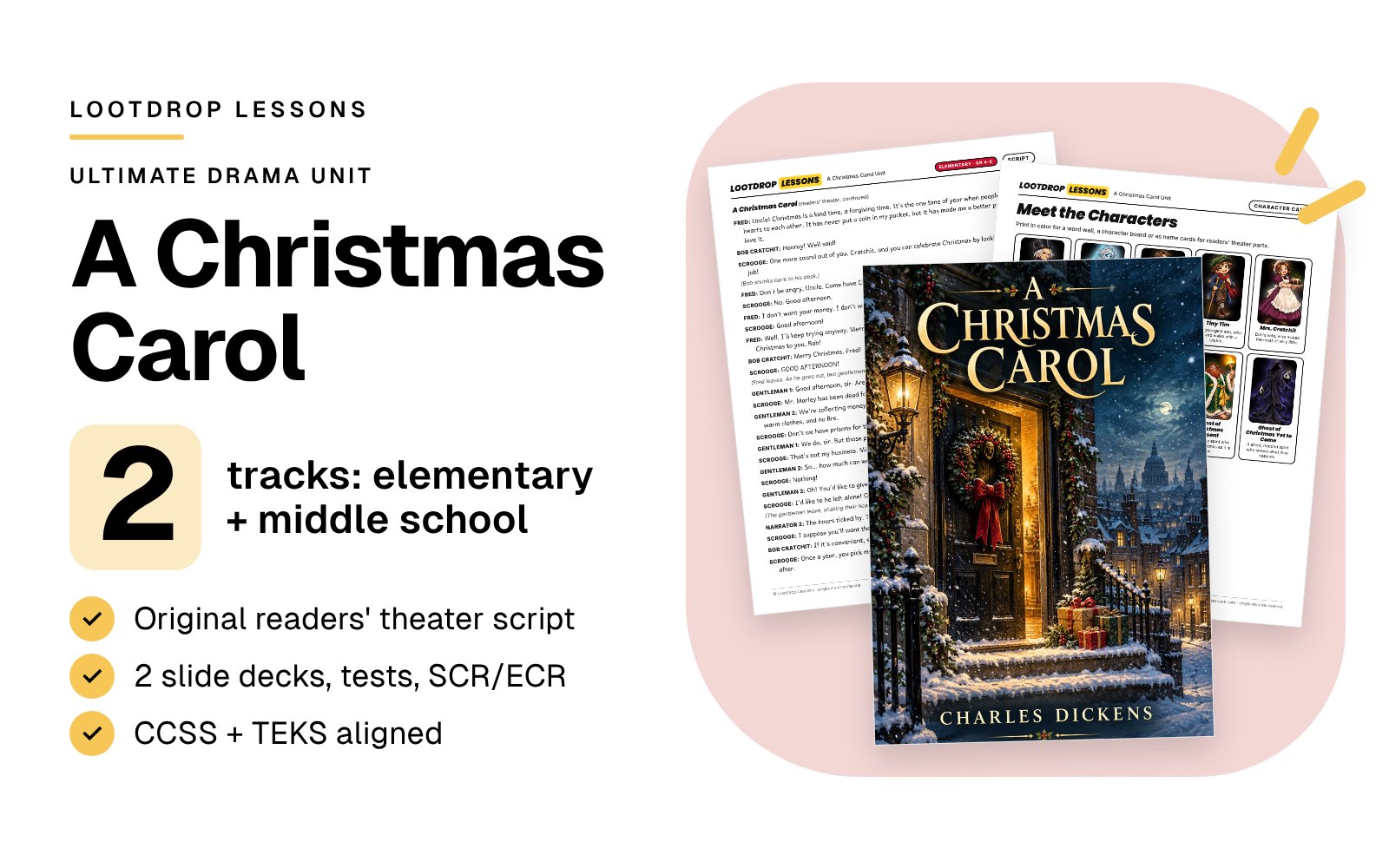
If you want this ready to go, my Christmas Carol unit has an original six-scene readers theater script for elementary, a full middle school track for the stage play, character cards, ghost cards and assessments for both. It's below.