


"The Cask of Amontillado" Short Story Unit Plan: 5 Days for Grades 8–10
 Andy Navarro · Short Stories & Literature · · 8 min read
A 5-day unit plan for Poe's "The Cask of Amontillado": background, close reading, irony, the unreliable narrator, setting and mood, plot, theme and projects.
Edgar Allan Poe's "The Cask of Amontillado" (1846) is about 2,300 words long, it's in the public domain, and it hands you almost every literary element you want to teach in one sitting. Montresor tells us in the first paragraph that he plans to kill Fortunato and get away with it. Then he walks Fortunato, drunk and dressed as a jester, down into the family catacombs and walls him in. Students know what's coming the whole time, and that is exactly what makes it work. Here's a five-day plan.
Before you start: print the whole story
Because the story is in the public domain, every student can have the full text with numbered paragraphs and a margin for notes. Numbered paragraphs let every answer point to "¶42" instead of "somewhere in the vaults." Give students an annotation code built for this story: underline what Montresor plans or hides, box details of setting and mood, and star every moment of irony. By the end, most copies are covered in stars.
Day 1: Poe, Carnival and the catacombs
This story needs more background than most, and ten minutes of it pays off for the whole week. Students should know who Poe was and what Gothic literature does: dark settings, death, building suspense and narrators you can't trust. Poe believed a story should create one single effect, and here the effect is dread. Then cover four things the story assumes readers know. Carnival is a festival of masks and costumes, which explains why nobody notices two men leaving. Wealthy Italian families kept vaults under their homes for burying the dead and storing wine. Amontillado is a rare sherry, and a "pipe" is a huge cask. And "mason" has two meanings: a member of a secret brotherhood, or a bricklayer. Don't explain why that last one matters yet. Preview vocabulary like impunity, retribution, motley, nitre and aperture.
Day 2: The plan and the bait (¶1–50)
Read the first paragraph slowly. Montresor sets two rules for his revenge: he must punish "with impunity," and Fortunato must know who is punishing him. Ask students to watch for both rules, because the ending keeps them. Then read on and notice how Montresor works: he keeps saying he will ask Luchesi instead, he worries out loud about Fortunato's cough, and he tells his servants to stay home, knowing they'll leave. Stop at ¶24 and ask why he wants the house empty. Stop again at the coat of arms (¶47–49): a golden foot crushing a serpent whose fangs are in its heel, and the motto "No one attacks me with impunity." Fortunato's answer is "Good!"
Day 3: The sign and the wall (¶51–89)
When Fortunato makes a secret masons' gesture and asks for "a sign," Montresor pulls a trowel from under his cloak. Students who remember Day 1 usually catch it out loud. Then the pace changes: the niche, the chain, the tiers of stone, the screams, the laughter and finally "For the love of God, Montresor!" Spend real time on the last paragraph. Montresor says his heart grew sick "on account of the dampness of the catacombs," and he tells the story fifty years later. Ask who "you" is in the first paragraph, and why he is telling it now.
Day 4: Irony and the narrator
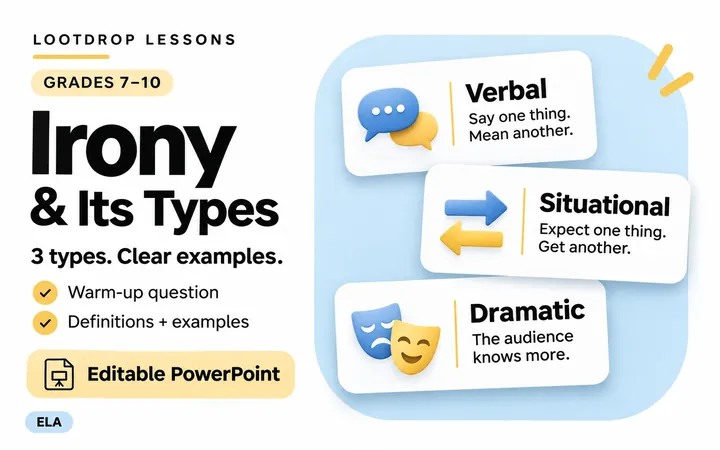
- Verbal irony: "Your health is precious" (¶35); "And I to your long life" (¶42).
- Dramatic irony: readers know the plan from ¶1. Fortunato's "I shall not die of a cough" (¶36) is true, and terrible.
- Situational irony: his name means "fortunate," and he goes to his death in a fool's costume during a festival.
Then debate the narrator. Montresor never tells us what the insult was. He admits he smiled while plotting. He blames his sick heart on the damp. Students split on whether he is honest or hiding something, and either side can be argued with evidence. Close the day by mapping the plot as a descent: each step down into the crypt is a step closer to the climax.
Day 5: Setting, mood and theme
Students often treat setting and mood as the same thing. Separate them: setting is where and when; mood is how the reader feels. Then have students find the words that build the mood: bones "piled to the vault overhead," nitre that "hangs like moss," drops of water trickling "among the bones," a light too feeble to see the end of the recess. Ask why Poe takes us downward. Then move from topic to theme. "Revenge" is a topic; "Revenge can turn a person into something worse than the wrong he suffered" is a theme. Finish with the test or a review game.
Mistakes students make
- Believing Montresor. Students take "I had borne the thousand injuries" at face value. Ask: what evidence of any injury does he give?
- Missing the double meaning of "mason." Teach both meanings on Day 1 and let students find the trowel themselves.
- Calling Montresor's calm "the mood." His tone is calm and almost proud; the reader's mood is horror. That clash is the point.
- Skipping the last paragraph. "In pace requiescat" (rest in peace) from the man who did it is the most chilling line in the story.
Stretch it to two weeks
If you have more time, add hands-on projects that keep the analysis going: a hidden door that opens to reveal what's behind the wall, a two-faced Carnival mask, a wine label whose "tasting notes" are character analysis, or a coat of arms that decodes the Montresor family motto. Pair the story with a short informational text on the real catacombs of Rome and Paris and the 1800s fear of being buried alive, and Fortunato's bells in the dark land differently. End with an escape room review before the test.
Outside sources
The Edgar Allan Poe Society of Baltimore keeps a page on "The Cask of Amontillado" with the story's texts and its first printing in Godey's Lady's Book, November 1846.
Questions teachers ask
How long should a Cask of Amontillado unit be?
One week covers it: a day of background, two days of reading, a day on irony and the narrator, and a day on setting, mood and theme. Two weeks adds projects, a paired informational text and a review before the test.
What grade level is The Cask of Amontillado?
It's most often taught in grades 8 to 10. The plot is simple, but the vocabulary and the 1846 references are hard, so plan the background lesson on Day 1 before anyone reads.
What skills does The Cask of Amontillado teach?
All three types of irony, the unreliable narrator, setting versus mood, plot structure and theme. The story also gives students steady practice citing evidence by paragraph number.
Is The Cask of Amontillado in the public domain?
Yes. Poe published it in 1846, so you can print the full text for every student, number the paragraphs and let them annotate their own copy.
Resources for "The Cask of Amontillado"
Everything above is in The Cask of Amontillado Ultimate Bundle. The bundle holds nine sets and every standalone activity, and each set also works on its own:
- Nitre and Bones: the 5-day unit with step-by-step plans, 35 editable slides, the full story, a vocabulary task and game cards, a visual plot task and a final test in two versions.
- Torchlight: the 35-slide editable presentation on its own.
- Thinking Like a Reader: a literary analysis set for 75-minute periods: comprehension questions, a quiz, a paired text, six skills focus sheets, an irony sort and an argument prompt.
- Behind the Wall: the hidden door project with templates, examples, a rubric and 17 pages of images.
- Nitre + Shadow: setting vs. mood handouts and a close reading quotations organizer.
- Carnival Crafts: the two-faced mask and the Amontillado wine label projects.
- Nemo Me Impune: a coat of arms project with a heraldry guide and seven shield templates.
- In Pace: a one-pager project with six templates and an example.
- Two Faces: body biography posters for Montresor and Fortunato that print on six pages each.
- Escape the Crypt: a five-task escape room review.
Need just one piece? Every activity is also sold individually:
- Poe's Shadow: Poe, Gothic literature, Carnival, catacombs, wine + masons, guided notes, prediction.
- Sixteen Words: 16 words in context, vocabulary handout, apply-it task.
- Word Games: 16 word cards, 16 meaning cards, six game options.
- Down the Stairs: 13 text-based questions in 5 parts, big question on the narrator, answer key.
- Margin of Bones: Complete story, numbered paragraphs, annotation margins.
- The Descent: Six-box plot descent into the crypt, finished example, plot reflection.
- Final Seal: 11 multiple choice, 9 true/false, 5 vocabulary.
- Reader + Writer: 6 reader questions, 6 writer's craft questions, cited by paragraph.
- Twelve Questions: 12 multiple-choice questions, reading check, answer key.
- Walls of Bones: Original catacombs article, questions, fact-to-story connections.
- Six Skills: Opening-line vocabulary, setting tracker, irony.
- Masks of Irony: Irony skills sheet, 16 cards: verbal, situational, dramatic, sorting mats.
- The Case Against Montresor: Two prompts, claim + evidence planner, counterclaim.
- Two-Faced Mask: Outside vs. inside character mask, planner, templates.
- Luchesi's Regret: Label directions + planner, two templates, finished example.
- Setting vs. Mood: Setting vs. mood, misconceptions, 5 mood tools.
- Close Reading Mood: 8 quotations to locate, mood word + explanation, reflection.
- Family Crest: Decode the Montresor arms, heraldry guide, mottos.
- Crypt Image Pack: Montresor + Fortunato poses, 10 story objects, 17 pages.
- Freytag's Crypt: 9 plot events on Freytag's pyramid, code-word reveal, answer key.
- Figuratively Speaking: 9 quotes, 9 devices, shaded-box code.
- Criss-Cross: 10-word crossword, literary elements + plot, circled-letter code.
- Vocab Match-Up: 7 sentences, word bank, shaded-box code.
- Jigsaw Quote: 12-piece jigsaw, reveal a key quote, missing word.
For more on teaching irony with this story and others, see teaching irony and figurative language with short stories. For a second Poe story with an unreliable narrator, see "The Tell-Tale Heart" unit plan.



Comments
Questions, tweaks that worked in your room, ideas for other teachers: share them here.
Loading comments...