Teaching the Types of Irony and Figurative Language with Short Stories
 Andy Navarro · Short Stories ·
Teach the three types of irony and figurative language with classic short stories: clear definitions, story pairings and activities for grades 7 to 10.
Irony and figurative language are two skills students meet on every reading test, and two skills they often memorize without really understanding. The fix is teaching the types of irony and figurative language with short stories. A good short story gives students the definition, the example and the "so what" all in one sitting. And the classics most of us already teach are packed with both.
Here's how I teach the three types of irony and the main kinds of figurative language, which stories to pair with each and how to push students past labeling into real analysis.
Start with what irony is (and isn't)
Students often think irony means "a coincidence" or "something bad happening." I clear that up on day one. My working definition:
Irony is a gap between what we expect and what actually happens, or between what is said and what is meant.
Then I give them a quick warm-up. A fire station burns down. A traffic cop gets a parking ticket. A sign that says "Keep off the grass" is sitting in the middle of the grass. Students explain the gap in each one. Within five minutes, they understand irony better than any definition could teach them.
The three types of irony
Once the core idea is clear, I teach the three types. I keep them on an anchor chart all unit.
- Verbal irony: a character says something but means the opposite, or something very different. Sarcasm is a common form. Looking out at a thunderstorm and saying "Great day for a picnic" is verbal irony.
- Situational irony: what happens is the opposite of what the characters or readers expect.
- Dramatic irony: the reader or audience knows something a character doesn't. That gap creates tension, suspense or humor.
A quick check: give students ten short scenarios and have them sort each into one of the three types. Have them explain the gap, not just the label. "It's situational because we expected ___ but ___ happened."
Short stories for teaching each type of irony
Here are the pairings I come back to every year. All of them work for grades 7 to 10.
Situational irony: "The Gift of the Magi"
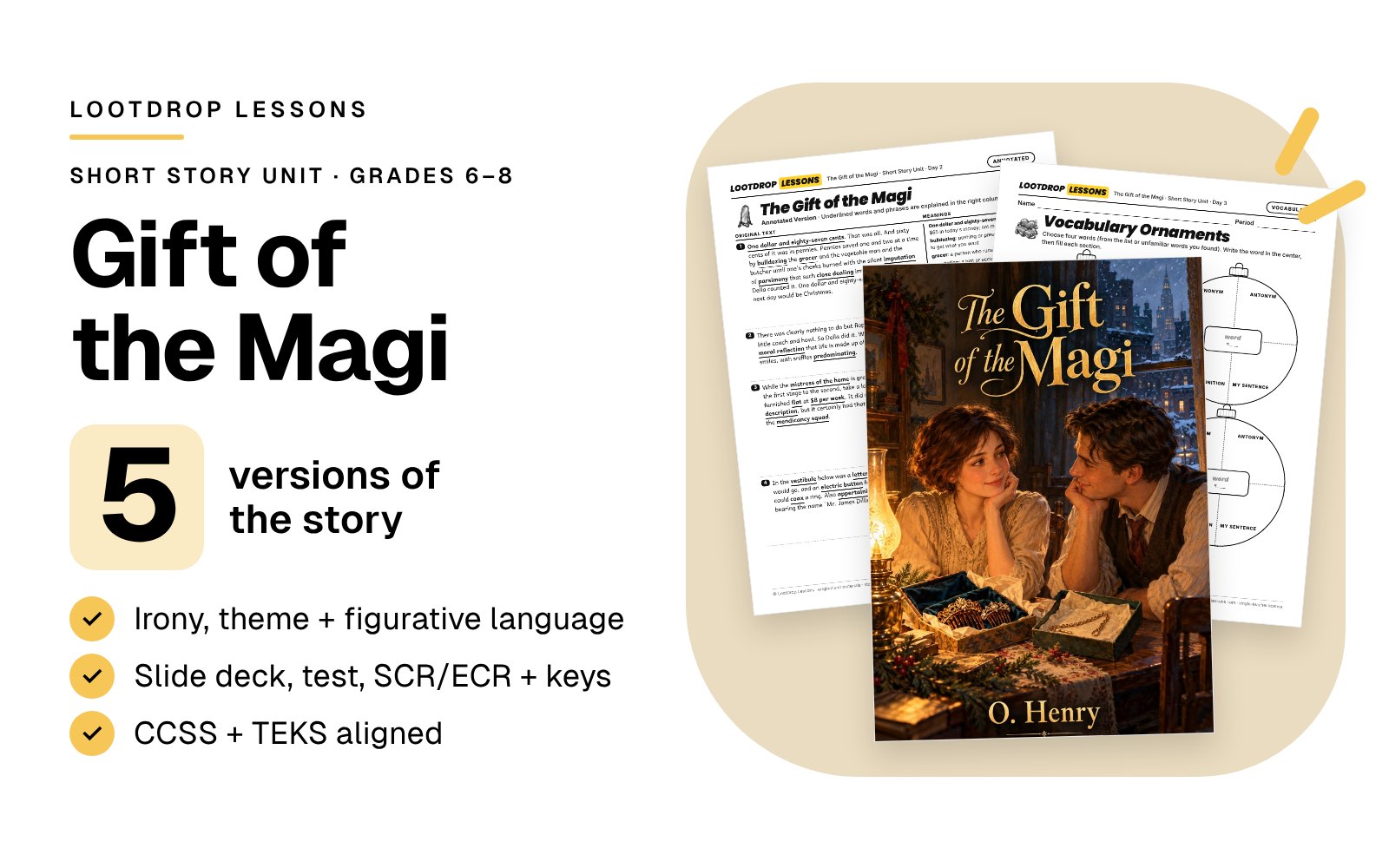
O. Henry's 1905 story is the clearest example of situational irony I know. Della sells her hair to buy Jim a chain for his watch. Jim sells his watch to buy Della combs for her hair. Each gift is now useless, and readers never see it coming.
The best discussion question: Were the gifts wasted? Students first say yes. Then they reread the ending, where the narrator calls the two of them the wisest of all who give gifts, and the conversation shifts. The irony isn't just a twist. It's how O. Henry makes his point about what love really costs.
Other strong choices for situational irony: Guy de Maupassant's "The Necklace" and W. W. Jacobs's "The Monkey's Paw," where every wish comes true in the worst possible way.
Dramatic and verbal irony: "The Cask of Amontillado"
Poe's "The Cask of Amontillado" is the best story I know for teaching dramatic and verbal irony together. From the first paragraph, readers know Montresor wants revenge on Fortunato. Fortunato has no idea. Every friendly word between them is dramatic irony.
The verbal irony is everywhere, too. When Fortunato raises a drink "to the buried that repose around us," Montresor answers, "And I to your long life." He knows exactly how short that life is going to be. Even Fortunato's name, which suggests good fortune, is ironic.
A great activity: students make a two-column chart. On the left, what Montresor says. On the right, what he really means. Students find at least five rows, and by the end they're catching irony on their own.
Teaching figurative language with the same stories
You don't need separate texts for figurative language. The same stories are full of it. I teach these types:
- Simile: a comparison using "like" or "as."
- Metaphor: a direct comparison without "like" or "as."
- Personification: giving human qualities to something that isn't human.
- Hyperbole: exaggeration for effect.
- Imagery: language that appeals to the senses.
- Symbolism: an object, character or setting that stands for a bigger idea.
Some examples from public domain stories that work well:
- In "The Gift of the Magi," Della's hair falls around her "rippling and shining like a cascade of brown waters." That's a simile, and it shows how much the hair is worth to her, which makes the sacrifice hit harder.
- O. Henry also writes that "life is made up of sobs, sniffles, and smiles, with sniffles predominating." Students can find alliteration and a touch of humor in a line about being poor.
- In "The Tell-Tale Heart," the narrator describes the heartbeat as "a low, dull, quick sound, such as a watch makes when enveloped in cotton." That simile connects to the idea of time running out.
- In "The Cask of Amontillado," the catacombs, the damp and the nitre on the walls work as imagery that builds dread and as a symbol of the death waiting at the end.
Move from labeling to analysis
This is where most figurative language lessons stop too early. Finding a simile is a starting point. The real skill is explaining what it does. I teach students a simple three-part frame:
- Name it: "O. Henry uses a simile."
- Quote it: include the words in quotation marks.
- Explain the effect: "This shows ___, which makes the reader feel ___."
The same frame works for irony. "Poe uses verbal irony when Montresor says ___. This shows ___ and creates ___." Once students have the frame, short constructed responses get a lot stronger.
Connect irony to character and theme
Irony is never just a trick. Authors use it to reveal character and make a point. Two questions push students there:
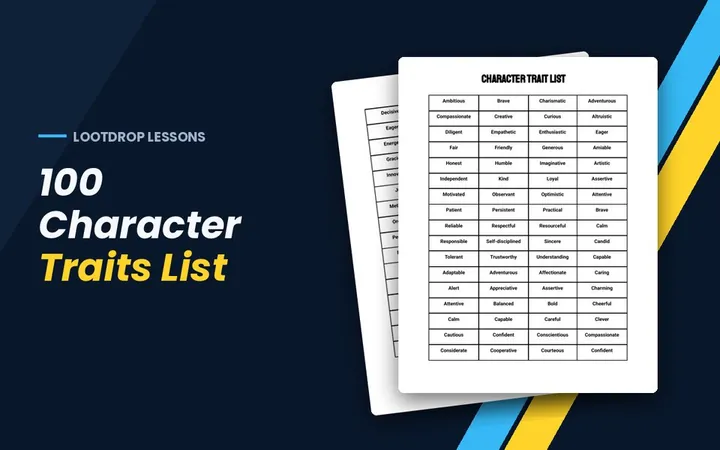
- What does the irony reveal about the character? Montresor's calm, polite words show he's patient and cold. Della and Jim's sacrifices show they're selfless. Give students a character traits list so they can name traits precisely instead of falling back on "nice" or "mean."
- What does the irony say about life? This is the theme question. "The Gift of the Magi" suggests that love is measured by sacrifice, not by the gift. "The Monkey's Paw" suggests that trying to control fate leads to disaster. Push students to state theme as a full sentence, not just one word like "love" or "greed."
A simple assessment
To wrap up, I give students a short story they haven't read, or a passage from one we read, and ask two questions:
- Identify one example of irony, name the type and explain how it affects the story.
- Identify one example of figurative language and explain how it supports a character trait or theme.
Two well-developed paragraphs tell me more than a 20-question matching quiz ever could.
Tips that make it smoother
- Keep the irony anchor chart up all unit so students refer to it constantly.
- Read endings aloud. Situational irony lands harder when students hear it together.
- Have students write their own example of each type of irony. Creating it proves they understand it.
- Revisit irony in every story you read afterward. It shows up everywhere once students know to look.
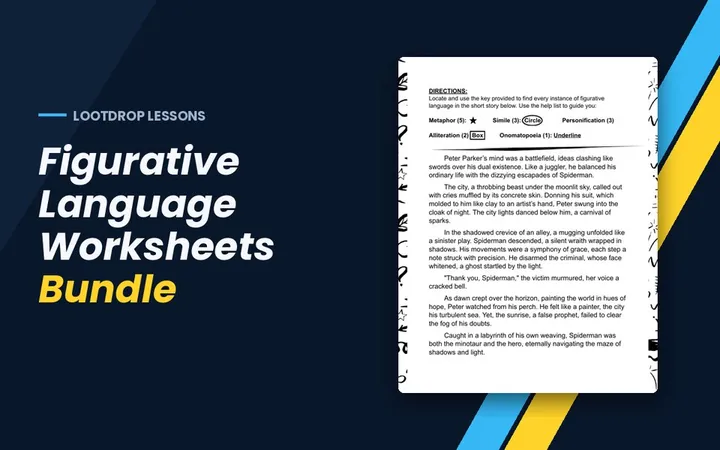
If you'd like ready-made materials, my Irony and Its Types slide lesson covers the three types with a warm-up and examples. The Figurative Language Worksheets Bundle gives students a passage to mark up plus five practice sets with keys. The Themes and Ideas lesson helps students state theme as a full idea and back it with evidence, and the 100 Character Traits List gives them precise words for character analysis. They're below.