

Parent Communication for Teachers: Email Templates and When to Send What
 Andy Navarro · Classroom & Free Tools ·
A practical guide to parent communication for teachers: which emails to send and when, plus simple parent email templates you can adapt today.
Parent communication is one of those parts of teaching nobody really trains you for. You figure it out one awkward email at a time. The good news is that most of what you'll ever send falls into a handful of types, and once you have parent email templates for each one, the whole job gets faster and a lot less stressful.
This is the system I use: what to send, when to send it and what to say. Steal any of it.
The golden rule: the first contact should be good news
If the first time a family hears from you is about a missing assignment or a behavior problem, you start the relationship in a hole. If the first time they hear from you is a friendly welcome or a quick positive note, the harder conversations later go much better. Families who already know you're on their kid's side read your concerns as help, not attacks.
So the order matters: welcome first, positives early and concerns after that.
A parent communication calendar for the year
Here's roughly when each kind of message goes out in my room:
- Before school or the first week: a welcome email with who you are, how to reach you and what the class is about.
- First month: a positive note home for as many students as you can manage. A sentence or two is plenty.
- Before open house or meet the teacher night: an invitation and a reminder.
- Before each grading period ends: a heads-up for students who are missing work or at risk of failing, while there's still time to fix it.
- Conference season: sign-up info and a reminder the day before.
- Big units, projects or trips: a short update so families know what's coming.
- Whenever it's needed: concern emails, follow-ups after a phone call and thank-yous.
The parts of every good parent email
Whatever the reason for the email, the same structure works:
- A clear subject line. "Quick update on [Student]'s English grade" gets opened. "Concern" gets dreaded.
- A warm opening. One line that shows you know and like their child.
- The facts. What happened or what's missing, with dates and specifics. No labels like "lazy" or "disrespectful."
- The plan. What you're doing, what the student can do and how the family can help.
- An open door. How to reach you and an invitation to talk.
Keep it short. If an email needs more than a few short paragraphs, it probably needs to be a phone call.
Parent email templates you can use today
Here are three I use all the time. Swap in your own details.
The quick positive note
Subject: Good news about [Student]
Hi [Family name], I wanted to share something good. Today in class, [Student] [specific thing they did]. It made a real difference for the class, and I wanted you to hear about it. Thank you for sharing [him/her/them] with us this year. [Your name]
The key is the specific thing. "Is doing great" is nice. "Helped a classmate fix their thesis statement without being asked" is something a parent will remember.
The missing work heads-up
Subject: [Student]'s missing work in [class]
Hi [Family name], I'm reaching out because [Student] has [number] missing assignments in [class]: [list them]. The grading period ends on [date], and [he/she/they] can still turn these in by [deadline] for credit. [Student] is welcome to come to tutoring on [days] if [he/she/they] need help. Please let me know if you have any questions. I want to make sure [Student] finishes strong. [Your name]
The behavior concern
Subject: Checking in about [Student] in [class]
Hi [Family name], I'm reaching out because I want [Student] to be successful in my class. Over the past [time period], I've noticed [specific behavior, with dates if you have them]. I've talked with [Student] about it and we're working on [what you're doing]. I'd love your help. Would you be open to a quick call this week? [Your name]
Notice what's missing from that one: guesses about why, judgments about the student and anything you couldn't back up with facts.
Email or phone call?
Email is great for information, reminders and quick positives. It's not great for anything emotional. Pick up the phone when:
- It's the second or third time you've reached out about the same problem.
- A student is upset, hurt or involved in something serious.
- You're worried your tone will be misread.
- The family has replied angrily to an email. Don't email back and forth. Call.
After any important call, send a short follow-up email: "Thank you for talking with me today. Here's what we agreed on." Now there's a record, and nobody has to remember the details.
Tips that save you trouble
- Write it, then wait. If you're frustrated, draft the email and send it tomorrow. It will be better.
- Copy who you need to. If your campus expects counselors or admin on certain emails, follow that. When in doubt, ask.
- Keep a log. Date, student, reason and how you reached out. When someone asks "Did you contact home?" you'll have the answer.
- Think about language. If a family's home language isn't English, use your district's translation services or a bilingual staff member. A translated email shows real respect.
- Never compare students. Talk only about their child.
- Use your school email. Keep communication on official channels.
Conferences and open house
Two big moments of the year deserve a little extra planning. For meet the teacher night or open house, a short presentation with your background, your classroom expectations and how to contact you means you don't have to repeat yourself to every family. For parent-teacher conferences, the hardest part is often the scheduling. A sign-up sheet with time slots and reminders cuts down on no-shows.
Don't forget recommendation letters
Spring brings a different kind of writing: recommendation letters for scholarships, college applications, NHS and more. Ask students for a short brag sheet with their activities, goals and what they want you to mention. Give yourself a clear deadline policy, like two weeks' notice, and share it early in the year so nobody asks the night before.
Ready-made help
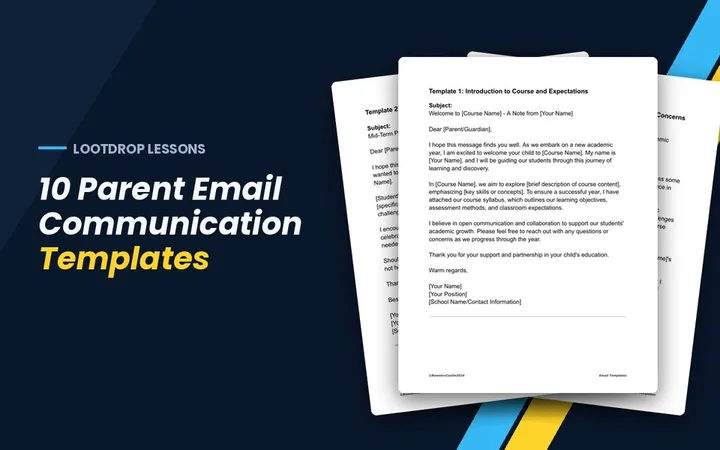
If you'd rather not start from a blank page, my 10 parent email templates include subject lines for everything from welcome letters to missing work, plus a short best-practices guide. My meet the teacher slides are editable and cover your experience, philosophy, classroom and contact info. SlotDrop is my free, ad-free sign-up sheet tool with a conference template, email reminders and a Spanish page for families. And for the letter season, my recommendation letter templates cover scholarships, college, NHS, student teachers and colleagues. They're all below.