
Teaching The Diary of Anne Frank Play in Middle School: A Unit Plan That Works
 Andy Navarro · Shakespeare & Drama ·
Teaching The Diary of Anne Frank play in middle school: context, elements of drama, dramatic irony, conflict and assessment, step by step.
Teaching The Diary of Anne Frank play in middle school is one of the most meaningful units of the year, and one of the easiest to get wrong. The history is heavy, the play is long, and many students meet drama as a genre for the first time here. The good news is that the play itself does a lot of the teaching if you give students the right tools before they start reading.
This post covers how I approach the stage play by Frances Goodrich and Albert Hackett: what context to give, which literary skills to focus on, how to handle the hard parts, and how to assess it. The play is still under copyright, so I'll describe scenes rather than quote them. Use the version in your textbook or class set.
Know which version you're teaching
The Goodrich and Hackett play premiered on Broadway in 1955 and won the Pulitzer Prize for Drama. It's the version found in most middle school literature books, usually in grade 8. There is also a later adaptation by Wendy Kesselman from the 1990s that adds material from the unedited diary. They're different scripts, so check which one you have before you plan page numbers or scene breaks.
It also helps to tell students up front that the play is an adaptation. Two screenwriters turned a real girl's diary into a drama for an audience. That framing sets up great questions later about what playwrights choose to add, cut and change.
Build background first (two days is enough)
Students need enough history to understand why eight people are living in a hidden annex above an office in Amsterdam. Keep it focused:
- Germany occupied the Netherlands in 1940, and laws against Jewish people there got stricter every year.
- The Frank family went into hiding in July 1942, joined by the Van Daan family (the name used in the play) and later by Mr. Dussel.
- Helpers like Miep Gies and Mr. Kraler brought food and news and risked their own lives to do it.
- The people in the annex were discovered and arrested in August 1944. Anne died in the Bergen-Belsen camp in early 1945. Her father, Otto Frank, was the only one of the eight to survive.
Short primary sources work better than long lectures: photos of the annex, a map, a survivor testimony clip from a museum site. Have students write down their questions.
One rule I hold firmly: no simulations. Holocaust education organizations, including the U.S. Holocaust Memorial Museum, advise against activities that ask students to role-play victims or pretend to hide. Empathy comes from real stories and careful reading, not from pretending.
Teach the elements of drama before Act 1
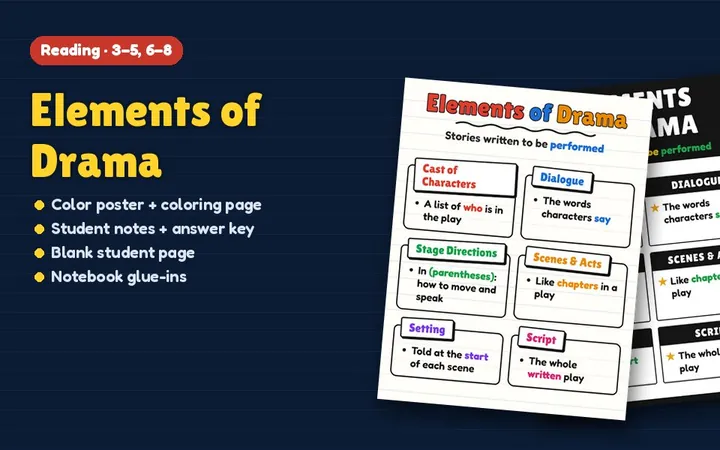
For a lot of eighth graders, this is the first full play they've read. If they don't know how to read a script, they'll miss half of it. I spend one lesson on the basics and keep an anchor chart up for the whole unit:
- Acts and scenes: how a play is divided. This one has two acts, each with several scenes.
- Stage directions: the italic text that tells actors what to do and how to say it. Students skip these. Teach them that stage directions are where a lot of the mood and character lives.
- Dialogue: what characters say, and the main way we learn who they are.
- Setting: almost the entire play takes place in the same cramped rooms. Have students sketch the set from the opening stage directions. It shows them how little space eight people had.
- Cast of characters: make a chart with each character's name, family and one trait. Add to it as you read.
The frame and dramatic irony
The play opens in November 1945, after the war. Mr. Frank returns to the empty annex, and Miep gives him Anne's diary. As he reads, the scene shifts back to 1942. This is a flashback frame, and the play returns to it at the very end.
Ask students: what do we know from that first scene that the characters in 1942 don't know? We know only Mr. Frank comes back. That's dramatic irony, when the audience knows something the characters don't, and it shapes everything. Every hopeful moment, every plan for after the war, every argument about food lands differently because we know how it ends.
I have students keep a dramatic irony log while they read. When a character says or does something that hits harder because of what the audience knows, they note the scene and explain the effect in a sentence. This log becomes their best evidence for writing later. It also lines up well with CCSS RL.8.6, which asks students to analyze how differences in what characters and the audience know create effects like suspense.
Conflict: the annex as a pressure cooker
Put eight people in a few small rooms for two years, with no privacy and not enough food, and conflict is constant. This is the easiest way into analysis for middle schoolers because they recognize it.
I break conflict into two types:
- External: the danger outside, the fear of being heard, scenes like the thief breaking into the office below, and the arguments inside the annex over food, space and noise.
- Internal: Anne wanting to be taken seriously, Anne and her mother clashing, characters struggling with fear, guilt and hope.
Small groups each take one relationship (Anne and her mother, Anne and Peter, Mr. Van Daan and the group, Anne and Mr. Dussel) and track how it changes from Act 1 to Act 2. Then they present one moment where the relationship shifts and explain what caused it. This is exactly the RL.8.3 skill: how particular lines of dialogue or incidents propel the action, reveal character or provoke a decision.
Tone and key moments to slow down for
The play moves between tension and warmth, and students should notice how. A few scenes worth reading closely:
- The Hanukkah celebration in Act 1: Anne gives homemade gifts to everyone. It's one of the warmest scenes in the play, and it's interrupted by a frightening noise. Ask students how the tone shifts and what the playwrights gain by putting those moments side by side.
- The stolen food in Act 2: a character is caught taking bread at night, and the group nearly breaks apart. Great for discussing how fear and hunger change people.
- Anne and Peter's conversations: Anne shares her belief in the goodness of people, even after everything. It's the idea most readers remember, and it's worth asking students whether they agree with her.
For tone, give students a word bank (hopeful, tense, bitter, tender, fearful, defiant) and have them label short sections with a tone word and one piece of text evidence from the stage directions or dialogue.
Assessment ideas
- Quick quizzes after each act to make sure students are following the plot and the characters.
- Short constructed responses: How do the stage directions in the opening scene establish the mood? Answer, one piece of evidence, explain.
- An extended response on dramatic irony or character change. Students pull straight from their logs and charts.
- A unit test mixing elements of drama, vocabulary, and analysis questions.
To close the unit, I like a reflection rather than a project: which moment in the play stayed with you, and why?
A few practical notes: read the play aloud with assigned parts and rotate readers every scene, pause often, and give families a heads-up about the subject matter before you start.
If you want a ready-to-teach version, my Diary of Anne Frank drama unit has fourteen days of original lessons on elements of drama, dramatic irony, tone, conflict and dialogue, with quizzes, a unit test and answer keys. The Elements of Drama anchor chart pairs well with the first week. Both are below.