
How to Teach Comma Rules So Students Actually Use Them
 Andy Navarro · Writing & Grammar · · 4 min read · Updated
The comma rules students really need, taught in a simple order with sentence examples, mentor sentences and quick practice for grades 4–10.
Students tend to use commas in one of two ways: everywhere they'd take a breath, or nowhere at all. Neither works, and a list of fifteen comma rules handed out on a Tuesday won't fix it. What does work is teaching a small number of rules in a logical order, with lots of real sentences, and holding students to those rules in their own writing.
Here's how I teach commas so they stick.
Drop the "breath" rule
Many students were taught to put a comma wherever you'd pause when reading aloud. It sounds helpful, but everyone pauses in different places, and it leads to commas splitting subjects from verbs ("My best friend from fourth grade, moved to Austin"). Tell students up front: commas follow rules, not breaths.
The six comma rules students need most
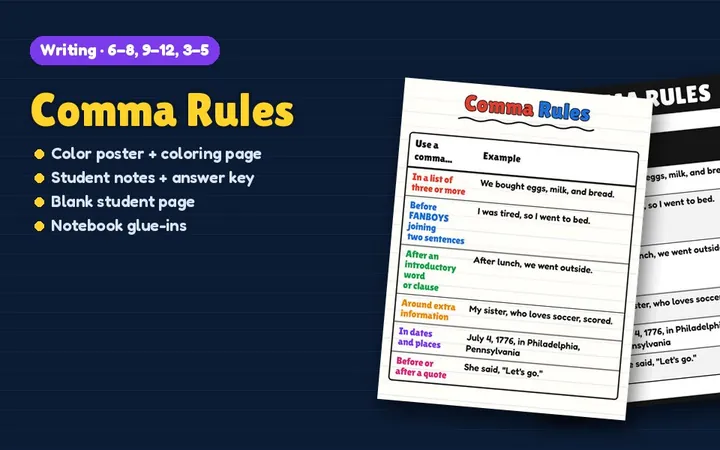
You can cover most real-world comma use with six rules. Teach them in this order, one or two at a time.
1. Items in a series
Use commas to separate three or more items in a list.
We packed sandwiches, chips, and apples.
The comma before and is called the serial or Oxford comma. Style guides disagree on it, so pick a rule for your class and be consistent. I teach students to use it because it prevents confusion.
2. After an introductory word or phrase
Use a comma after a word, phrase or clause that comes before the main part of the sentence.
However, the game was canceled. After the bell rang, students rushed out.
This is the comma students use most once they learn it, and it improves their sentence variety at the same time.
3. Compound sentences (FANBOYS)
Use a comma before a coordinating conjunction that joins two complete sentences. The conjunctions spell FANBOYS: for, and, nor, but, or, yet, so.
I studied all night, but I still felt nervous.
The test students need: can both sides stand alone as a sentence? If yes, comma plus conjunction. If the second part can't stand alone ("I studied all night but still felt nervous"), no comma.
4. Interrupters (extra information)
Use commas around words or phrases that interrupt the sentence and could be removed without breaking it.
My brother, who never cleans his room, is in charge of the party.
Teach the "remove it" test: if you can take out the phrase and the sentence still works, put commas around it.
5. Direct address
Use commas when speaking directly to someone by name.
Let's eat, Grandma. vs. Let's eat Grandma.
This is the example everyone uses for a reason. Students never forget it.
6. Dates, places and dialogue
Use commas between the day and year (July 4, 1776), between a city and state (Dallas, Texas), and to introduce or end a quotation (She said, "Let's go.").
The comma splice: the mistake to fix first
A comma splice joins two complete sentences with just a comma: I love pizza, it's my favorite food. It's the most common comma error in student writing. Teach three fixes:
- Make two sentences: I love pizza. It's my favorite food.
- Add a FANBOYS word: I love pizza, and it's my favorite food.
- Use a semicolon (for older students): I love pizza; it's my favorite food.
Activities that build the habit
Mentor sentences
Pull one great sentence from a book your class is reading. Students notice where the commas are, name the rule, and then write their own sentence that copies the structure. Commas make more sense when students see published writers using them on purpose.
Comma or no comma?
Put a sentence on the board, and students vote with a thumbs up (needs a comma) or down (doesn't). Then a student explains the rule. Fast, low-stakes and great as a warm-up.
Fix my paragraph
Write a short paragraph with comma mistakes (missing, extra and splices), and have students edit it. Telling them how many errors there are turns it into a hunt.
Focus on one rule in writing
When students write, pick one comma rule to grade for. "In this paragraph, I'm checking introductory commas." It's much more effective than marking every comma in red.
Keep a reference handy
Students won't memorize six rules on the first try, so give them a reference they keep in their notebook and a chart on the wall.
Questions teachers ask
What are the most important comma rules to teach?
Focus on the rules students use most: commas in a series, after introductory words and phrases, before a coordinating conjunction joining two sentences, around interrupters, in dates and addresses, and in dialogue.
What is a comma splice?
A comma splice joins two complete sentences with only a comma. Students can fix it with a period, a semicolon, or a comma plus a coordinating conjunction like and, but or so.
Why shouldn't you teach "put a comma where you breathe"?
Because people pause in different places, the breath rule leads to random commas. Teaching specific rules gives students a reason for every comma they use.
Commas 411 is a student-friendly foldable lesson that covers the comma rules with examples and practice, and there's a Commas anchor chart that pairs with it. Both are below.

Comments
Questions, tweaks that worked in your room, ideas for other teachers: share them here.
Loading comments...