
Context Clues Activities That Actually Work: Types, Mini-Lessons and Practice Ideas
 Andy Navarro · Reading Skills & Phonics · · 4 min read · Updated
Teach the main types of context clues with simple mini-lessons, signal words and hands-on activities for upper elementary and middle school.
Students run into words they don't know constantly, in every subject. The dictionary isn't always nearby, and stopping every few lines kills comprehension. Context clues give students a strategy they can use on their own, right in the middle of reading. The trouble is that "use the words around it" is too vague for most kids. They need to know what kinds of clues to look for and what the signal words sound like.
Here's how I break context clues down so they stick, plus activities you can use this week.
The main types of context clues
Teach these one or two at a time, with a short example sentence for each. Underline the unknown word and circle the clue.
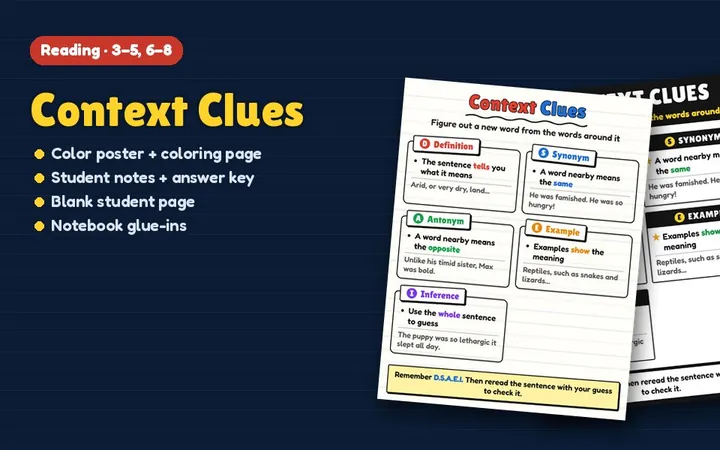
- Definition: the sentence tells you what the word means. A nocturnal animal is one that is active at night. Signal words: is, means, is called, which is.
- Synonym: a word with a similar meaning is nearby. The puppy was timid, or shy, around the big dogs. Signal words: or, also, like, similarly.
- Antonym: a word with the opposite meaning shows contrast. Unlike his gregarious sister, Leo was quiet at parties. Signal words: but, unlike, however, instead.
- Example: the sentence lists examples. We packed provisions such as water, granola bars and apples. Signal words: such as, for example, including, like.
- Inference: no single word gives it away, but the whole situation does. After running the marathon, Maya was so fatigued that she fell asleep on the bus. Students have to put the clues together.
Inference clues are the hardest and the most common in real texts, so save them for last and spend the most time there.
A four-step routine students can use on their own
Give students a routine they can repeat every time they hit an unknown word:
- Stop at the word and reread the whole sentence.
- Look before and after the word for a signal word or a clue.
- Guess a meaning in your own words.
- Check by putting your meaning in place of the word. Does the sentence still make sense?
The check step is the one students skip and the one that matters most. If "fatigued" means "excited," the sentence about falling asleep on the bus doesn't make sense anymore, and they know to try again.
Activities that make context clues stick
Nonsense word sentences
Replace a real word with a made-up one: The cafeteria smelled so florpy that everyone held their nose. Students figure out what "florpy" means. Because nobody knows the word already, every student has to use the clues, and it's genuinely fun. It also shows them that they can figure out a word they've truly never seen.
Clue type sort
Give pairs a stack of sentence strips and a sorting mat with one column per clue type. They sort each sentence and circle the signal word. Mix in a few inference sentences with no signal word so they have to argue about it.
Detective case files
Turn it into a mystery. Each "case" is a short paragraph with three or four unknown words. Students record the word, the clue they found, their guess and their check. Kids love feeling like detectives, and the case file format keeps their thinking organized.
Task card scoot
Put task cards around the room, each with one sentence. Students move from card to card recording the meaning and the clue type. It gets kids out of their seats and gives you lots of quick practice in one class period.
Find it in your own reading
The real goal is transfer. Once a week, have students find one unknown word in their independent reading book or a content area text, copy the sentence and explain what the clues told them. This shows you whether they use the strategy when you aren't setting it up for them.
Common mistakes to watch for
- Grabbing the nearest word. Students sometimes assume the word right next to the unknown word is the definition. Teach them to read the whole sentence, and sometimes the one before and after.
- Missing contrast clues. In an antonym clue, students often guess the opposite meaning. Highlight words like but and unlike in a different color.
- Stopping at the guess. Keep pushing the check step until it's automatic.
Keep it visible
An anchor chart with the clue types and their signal words is worth the wall space. Students will look up at it during independent reading and testing long after the mini-lessons are over.
Questions teachers ask
What are the main types of context clues?
The types students use most are definition, synonym, antonym, example and inference (general) clues. Teaching students to name the type helps them know where to look for meaning in the sentence.
What grade should context clues be taught?
Context clues show up in reading standards from 2nd grade on, and they become a bigger focus in grades 3 to 5 and middle school, when texts get more challenging vocabulary.
How do you teach context clues to struggling readers?
Use a short, repeatable routine: read the whole sentence, look for clue words nearby, make a guess, then plug the guess back in to check it. Keep sentences short at first and practice a little every day.
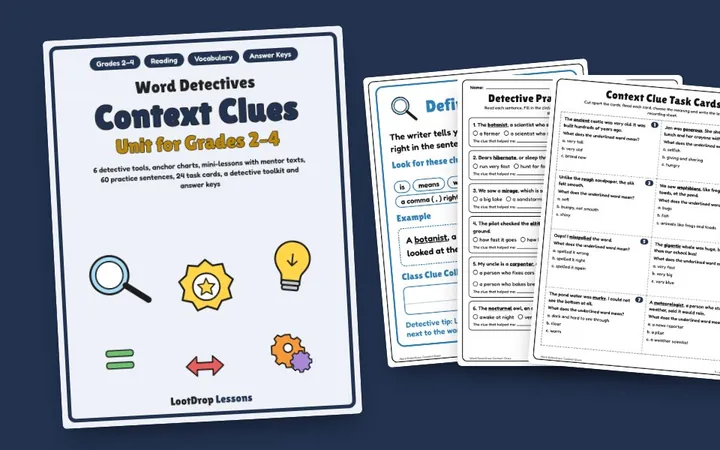
If you want this ready to go, my Word Detectives unit teaches six kinds of context clues with mini-lessons, mentor texts, 36 practice sentences, 24 task cards and detective case files, all with answer keys. There are also Context Clues anchor charts for upper grades and for K–2. They're below.



Comments
Questions, tweaks that worked in your room, ideas for other teachers: share them here.
Loading comments...