


Black History Month Lesson Ideas for ELA in Grades 3 to 12
 Andy Navarro · Seasonal & Holiday · · 3 min read
Meaningful Black History Month lessons for ELA classrooms: biographies, poetry, speeches, nonfiction articles and research projects that go beyond the same few names, for grades 3 to 12.
Black History Month started as Negro History Week, created by historian Carter G. Woodson in 1926. It became a month-long observance in 1976. Woodson's goal was for Black history to be studied seriously, not only during one week. The best February lessons keep that spirit: they're real reading and writing lessons, and they connect to what students study all year.
Here are ideas that work in ELA classrooms from third grade through high school.
Go beyond the same few names
Many students can name the same three or four figures every February. Widen the circle. Introduce scientists, inventors, artists, athletes, authors and local leaders. Let students choose someone they've never heard of to research. Discovering a new name is more memorable than hearing a familiar one again.
Biography research projects
Students research one person and present in a creative format: a one-pager, a museum exhibit, a short podcast, a "wax museum" monologue or a social media profile from the person's point of view. Require at least two sources and one direct quote. It's an authentic nonfiction research task, so it fits your standards, not just the calendar.
Poetry
Poetry is one of the richest places to start. Langston Hughes, Gwendolyn Brooks, Maya Angelou, Lucille Clifton and Nikki Giovanni all wrote poems that work at different grade levels. Students can analyze imagery, repetition and tone, then write a response poem in the same style. Contemporary poets like Amanda Gorman connect easily with teens.
For middle school, pair Hughes's poetry with his short story "Thank You, Ma'am." Harlem Voices has an original Hughes biography, "Mother to Son" and "I, Too" with questions, and a lesson connecting the poems to the story. The Thank You, Ma'am lesson plan walks through the story itself.
Speeches and rhetoric
For middle and high school, famous speeches are perfect for teaching rhetoric. Students identify the speaker's claim, appeals to emotion and logic, repetition and audience. Comparing two speeches on a similar topic from different decades leads to strong discussions and argument writing.
Nonfiction articles
Short, current articles about Black innovators, historical events and present-day achievements give students practice with main idea, summarizing and author's purpose. An article-of-the-week routine makes this easy to sustain beyond February.
Picture books for every grade
Picture book biographies aren't just for little kids. They're short enough to read in one class period and rich enough for older students to analyze author's craft, text structure and theme. Pair one with a mentor-text writing lesson.
Make it more than one month
The most meaningful approach is to include diverse authors and historical figures throughout the year: in your novel choices, your poetry unit and your nonfiction articles. February can be a spotlight, not the only time students see these stories.
Plan with care
Preview texts for age-appropriateness, prepare for hard conversations about injustice with clear norms, and focus on achievement and resilience as well as struggle. Families and colleagues can be great partners in planning.
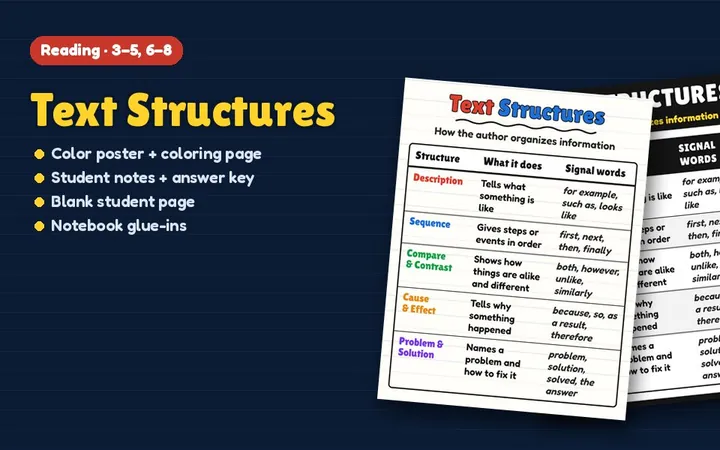
The resources below include a 6th grade article of the week set, a poetry interactive notebook, nonfiction reading worksheets and anchor charts for summarizing nonfiction and argument writing.
Questions teachers ask
Who started Black History Month?
Historian Carter G. Woodson created Negro History Week in 1926. It expanded into Black History Month in 1976.
What are good Black History Month activities for ELA?
Biography research projects, poetry analysis and response writing, speech and rhetoric lessons, nonfiction article study and picture book biographies all build real reading and writing skills.
How can I teach Black history all year?
Include diverse authors, historical figures and current events in your regular units, such as novel choices, poetry, nonfiction articles and research projects, so February isn't the only time students study them.
For biographies that go beyond the same few names, Trailblazers has ten original one-page biographies for grades 4–8 (Bessie Coleman, Matthew Henson, Lewis Latimer, Claudette Colvin, Charles Drew, Mary McLeod Bethune, Marian Anderson, Gwendolyn Brooks, Wilma Rudolph and Garrett Morgan), each with questions, plus a research project with 24 more names, notes pages, a one-pager and trading cards. Younger students can start with Dream Builders in January.



Comments
Questions, tweaks that worked in your room, ideas for other teachers: share them here.
Loading comments...