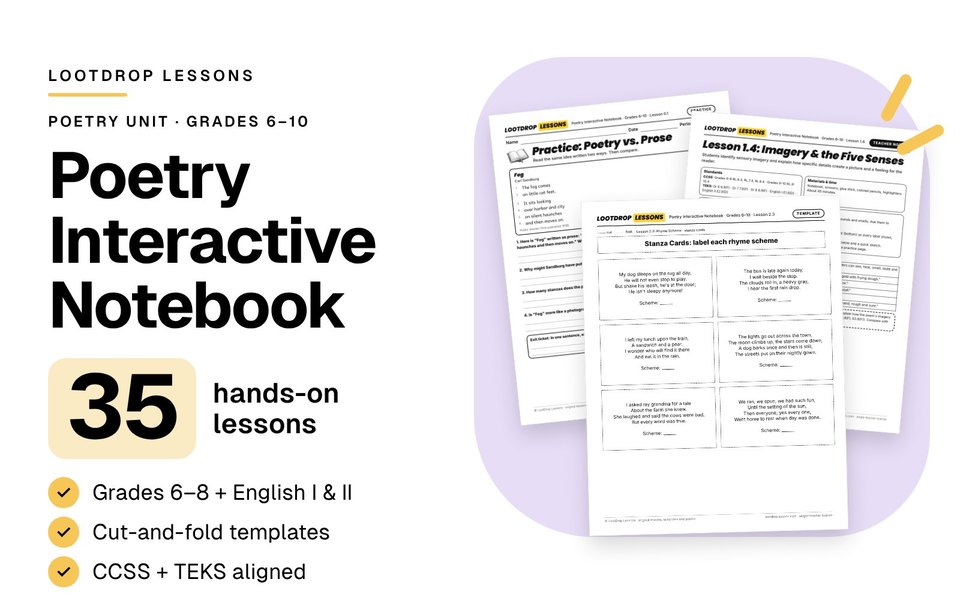
Make poetry the unit students actually look forward to. Every lesson pairs a cut, fold and flip notebook template with a short teacher page and a practice page built around a real poem, from Dickinson, Hughes, Frost, Dunbar, Rossetti, Poe, Keats, Whitman and Shakespeare to original poems written for middle schoolers.
The notebook moves from figurative language to sound, rhyme, meter and structure, then through 12 poetic forms (limerick to villanelle, plus found and blackout poetry) and finishes with meaning and analysis: speaker, mood and tone, theme, diction and syntax, tone shifts, TP-CASTT and paired poems. Every lesson includes a grades 9–10 extension, so the same notebook works for grade 6 through English II.
Each lesson lists Common Core (6–8 and 9–10) and Texas TEKS (grades 6, 7, 8, English I and English II). The editable PowerPoint lets you change any template.
What's included
35 lessons, each with a teacher page (steps, under-the-flap notes, standards, 9–10 extension), a cut-and-fold template and a poem practice page
Answer keys for every practice page, including modeled annotations and a full TP-CASTT
Notebook cover, table of contents and section tabs
Setup guide, pacing guide for grades 6–8 and English I/II, CCSS and TEKS alignment charts
Figurative Language Card Sort (24 cards) and 24 Poetry Task Cards with recording sheet
Poetry Toolkit bookmarks, Tone & Mood Word Bank, Poem Planner and glossary
Unit Test A (grades 6–8) and Unit Test B (English I & II, STAAR-style) with keys
Editable PowerPoint versions of every template
Lessons: 0.1 Poetry vs. Prose; 1.1 Simile & Metaphor; 1.2 Hyperbole & Understatement; 1.3 Personification & Apostrophe; 1.4 Imagery & the Five Senses; 1.5 Symbolism & Allusion; 1.6 Oxymoron, Paradox & Irony; 2.1 Sound Devices; 2.2 Types of Rhyme; 2.3 Rhyme Scheme; 2.4 Annotating Sound & Rhyme; 2.5 Structure in Poetry; 2.6 Line Breaks, Enjambment & Caesura; 2.7 Rhythm & Meter; 2.8 Types of Feet & Line Length; 2.9 Graphic Elements; 3.0 Poetic Forms Organizer; 3.1 Limerick; 3.2 Haiku & Tanka; 3.3 Free Verse; 3.4 Ode; 3.5 Elegy; 3.6 Ballad; 3.7 Narrative Poetry; 3.8 Lyric Poetry; 3.9 Sonnets; 3.10 Villanelle & Fixed Forms; 3.11 Concrete, Found & Blackout Poetry; 4.1 Speaker & Point of View; 4.2 Mood & Tone; 4.3 Theme in Poetry; 4.4 Diction & Syntax; 4.5 Tone Shifts & the Volta; 4.6 TP-CASTT Close Reading; 4.7 Paired Poems: Compare & Contrast
How teachers use it
A full 3–4 week poetry unit in grades 6–8, English I or English II