

Black Friday Ad Analysis Lesson: Ethos, Pathos and Logos for Grades 6–12
 Andy Navarro · Seasonal & Holiday · · 4 min read
A one-period Black Friday ad analysis lesson for grades 6–12: six persuasive techniques, ethos, pathos and logos, the fine print and a short written response.
Students see hundreds of ads in the week before Thanksgiving, and almost none of them have ever stopped to read one. That makes a Black Friday ad the best rhetorical analysis text of the fall. It is short, every word was chosen on purpose, and students already have opinions about it.
This lesson takes one class period and works from grade 6 through AP Language. The only thing that changes is how much you ask students to write at the end.
Pick the right ad
Use one ad for the whole class, on paper, so students can mark it up. A good one has a big headline, a crossed-out price, a time limit, a star rating or a "since 19-something" line, and small print at the bottom. If you would rather not put a real store in front of students, use an invented one. The techniques are the same and nobody argues about the brand.
Step 1: first look (5 minutes)
Before any vocabulary, ask two questions. Where did your eye go first? Who is this ad for, and how can you tell? Students notice size, color and placement on their own, and those answers become evidence later.
Step 2: name six techniques (15 minutes)
Give students the six moves that show up on almost every sale flyer. For each one they quote the exact words from the ad and explain what those words are meant to make a shopper feel or do.
- Scarcity. "Only 50 per store." If there is not much of it, it must be worth having.
- Urgency. "Ends in 3 hours." A deadline leaves no time to compare prices.
- Bandwagon. "Everyone is already in line." Staying home starts to feel like being left out.
- Anchoring. "Was $199.99." The high first number makes the sale price look small.
- Flattery. "You deserve it." The purchase becomes a reward.
- Fear of missing out. "Don't be the one who missed it." Not buying feels like a mistake.
The quoting matters. "It uses urgency" is a label. "It says 'ends in 3 hours,' so a shopper feels there is no time to think" is analysis.
Step 3: ethos, pathos and logos (10 minutes)
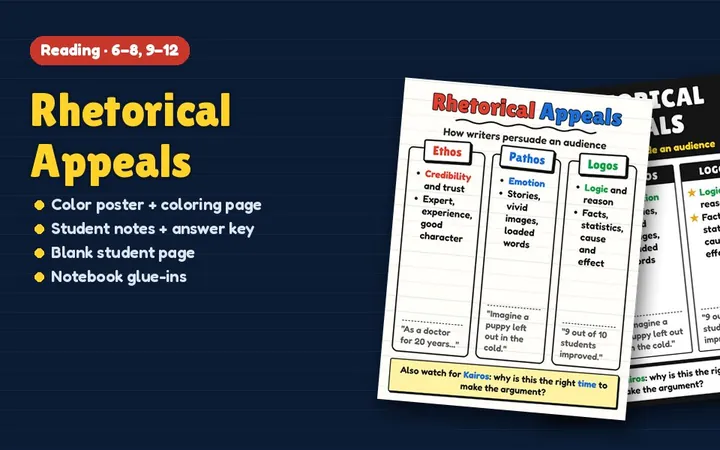
Now sort what they found into the three appeals. "Trusted by families since 1978" is ethos, because it asks for trust. "You deserve it" is pathos. "4.8 stars from 12,000 shoppers" and "save 55%" are logos, because they look like numbers and proof. Older students should notice that logos in an ad is often only the appearance of logic. Who counted the 12,000 shoppers?
Step 4: read the fine print (5 minutes)
This is the part students remember. Have them read the smallest text on the page and answer one question: what does the small print tell a careful reader that the big print does not? Usually the low price lasts a few hours, each shopper can buy one, and the store does not promise to have any. The big print makes a promise and the small print limits it.
Step 5: write (10 minutes)
- Grades 6 to 8: Which technique would work best on someone your age? Explain with evidence from the ad.
- Grades 9 to 10: How does the ad combine two appeals to push a fast decision?
- Grades 11 to 12: Is this ad dishonest, or only persuasive? Take a position and defend it with the text, including the fine print.
Keep it comfortable
Keep the talk on the ad and off what anyone plans to buy. Not every family shops on Black Friday, and money is a private subject. "What is this ad doing?" works for every student in the room.
Questions teachers ask
How do I teach ethos, pathos and logos with ads?
Give every student the same ad, have them quote specific words, and sort each quote into trust (ethos), emotion (pathos) or numbers and logic (logos). Finish with a short written response that uses those quotes as evidence.
What persuasive techniques are in Black Friday ads?
Scarcity, urgency, bandwagon, anchoring with a crossed-out price, flattery and fear of missing out. Most ads use four or more at once.
What grade is ad analysis for?
It works from grade 6 through grade 12. Younger students name techniques and effects. Older students judge how the appeals work together and whether the ad is fair to the reader.
Want it ready to print? The Long Table includes an original Black Friday ad for an invented store, the six-technique chart, the appeals chart and an answer key, along with six more Thanksgiving ELA activities for grades 6–12.
Want more ads to practice with after Black Friday? Ad Lab is a two-week ethos, pathos and logos unit built on 26 original classroom ads, and my guide to teaching the appeals with ads walks through the whole sequence.



Comments
Questions, tweaks that worked in your room, ideas for other teachers: share them here.
Loading comments...