

A Modest Proposal Lesson Plan: How to Teach Swift's Satire in High School
 Andy Navarro · Short Stories & Literature · · 4 min read
A two-day A Modest Proposal lesson plan for grades 9–12: background students need, the persona, where the irony turns, a satire toolkit and a writing task.
Jonathan Swift's "A Modest Proposal" is the best short text for teaching satire, and it is also the one students most often misread. Every year somebody finishes the first page convinced that a real person wanted to do this. That reaction is the lesson. If you plan for it, the essay teaches irony, persona and rhetoric better than any definition can.
This A Modest Proposal lesson plan takes two class periods and works in English II through AP Language. It also fits the week of St. Patrick's Day, because Swift wrote it in Dublin in 1729 while he was dean of St. Patrick's Cathedral.
Give students three facts first
Students cannot hear irony without context. Before reading, give them only this much.
- Ireland in 1729 was poor and getting poorer. Most farmland was owned by landlords, many of whom lived in England and collected rent from tenants who could barely pay it.
- Pamphlets full of plans were everywhere. Writers known as projectors published confident schemes to fix poverty with arithmetic. Readers of the time knew the style well.
- Swift had already tried arguing plainly. He had published serious proposals for Ireland, and they were ignored.
Do not tell students it is satire. Let them find out.
Day 1: read the opening cold
Read the first several paragraphs aloud and stop just before the proposal itself. Ask what kind of person is speaking. Students will say he sounds reasonable, caring and good with numbers. Write those words on the board.
Then read the proposal. Give the room a moment. Now ask the question that drives the unit: is this what Swift thinks, or what the speaker thinks? That is the difference between an author and a persona, and it is easier to see here than in any other text.
Finish the day by having students mark three places where the speaker's calm voice does not match what he is saying. That gap is verbal irony.
Day 2: find the turn and name the tools
Near the end, the speaker lists other ideas and waves them away: taxing landlords who live abroad, buying goods made in Ireland, treating tenants with some mercy. Have students read that paragraph twice. Those rejected ideas are Swift's real proposals. The essay only looks like it is about eating children. It is about everything people refused to try first.
Then give students a short satire toolkit and have them find one example of each.
- Persona: a speaker who is not the author
- Verbal irony: saying one thing and meaning another
- Understatement: calling the plan "modest"
- Hyperbole: pushing an idea to its extreme to expose it
- Mock logic: careful math in service of a monstrous idea
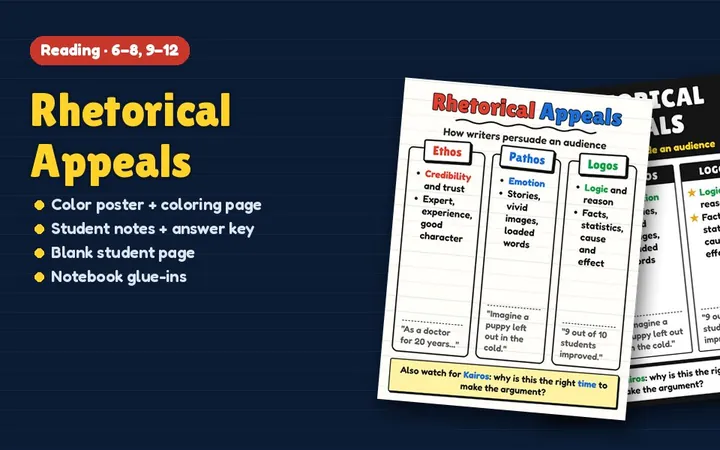
Connect it to the appeals. The speaker builds ethos with humility and expert friends, logos with numbers and prices, and almost no pathos at all. The missing pity is the point. Swift lets the reader supply the outrage.
The writing task: a modest proposal of their own
Students choose a small, school-safe problem, such as crowded hallways or slow lunch lines, and write one paragraph in a calm, reasonable voice proposing an absurd solution. Then they add two sentences in their own voice naming the real problem and one real fix. Keep targets to systems and habits, never people.
For an essay, ask: how does Swift use a persona to criticize the people his speaker claims to serve?
Common mistakes to head off
- Thinking Swift means it. Expect it, and use the author and persona chart to fix it.
- Calling it sarcasm. Sarcasm is a tone. Satire uses irony to criticize something and push for change.
- Naming the wrong target. The target is not the poor. It is landlords, indifferent officials and a public that treated people as numbers.
- Skipping the list of real solutions. Without that paragraph, students miss what Swift wanted.
Pair it with Yeats
For a second Irish text, add W. B. Yeats's "The Lake Isle of Innisfree." One writer attacks a broken country with irony. The other longs for a quiet corner of it with imagery and sound. A synthesis prompt writes itself: how does each writer show what Ireland means to him?
Outside sources
Project Gutenberg has the free text of A Modest Proposal by Jonathan Swift.
Questions teachers ask
What grade level is A Modest Proposal for?
Grades 9 through 12. It is most common in English II, British Literature and AP Language. Younger classes can read an excerpt with heavy support.
What is Swift actually arguing for?
Fair treatment of Ireland's poor. His real ideas appear in the paragraph where the speaker rejects them: tax absentee landlords, buy Irish goods and show tenants mercy.
How long does it take to teach A Modest Proposal?
Two class periods for an excerpt with analysis, or three to four for the full essay with a writing task.
Is A Modest Proposal appropriate for high school?
Yes, with a short introduction. The subject is shocking on purpose, so tell students ahead of time that the essay is disturbing and that the discomfort is part of how it works.
Want it ready to print? St. Patrick's Day ELA for grades 9–12 has Swift excerpts, a satire toolkit with a write-your-own proposal page, a close reading of "The Lake Isle of Innisfree," a synthesis planner, an answer key and a digital version. For every subject that week, see St. Patrick's Day activities for grades 3–12.


Comments
Questions, tweaks that worked in your room, ideas for other teachers: share them here.
Loading comments...