
Thanksgiving ELA Activities for Middle and High School: Gratitude Writing, Debate and Short Reads
 Andy Navarro · Writing & Grammar ·
Thanksgiving ELA activities for middle and high school: gratitude writing, debate, short reading pairings and a low-prep day before break.
The week of Thanksgiving is a strange one. Attendance dips, everyone is counting down, and a brand new unit feels like a waste. But a whole week of movies feels like a waste too. Good Thanksgiving ELA activities for middle and high school land in the middle: short, seasonal, and still built on real reading, writing and speaking skills.
Here is what I lean on every November, from gratitude writing that doesn't feel corny to a debate day, a few short reading pairings, and a plan for the day before break when half the class is already gone.
Gratitude writing teenagers will actually do
If you hand a sophomore a worksheet that says "What are you thankful for?" you will get "my family, my friends, food" and nothing else. Gratitude writing works with older students when it is specific and has a real audience.
- The tiny thanks list. Students list ten small, specific things they are grateful for, nothing big allowed. Not "my mom," but "the way my mom leaves the porch light on when I work late." It is secretly a lesson in concrete detail and imagery.
- The thank-you letter to a staff member. Students write a short letter to someone in the building who helped them: a custodian, a cafeteria worker, a coach, a counselor, a past teacher. Teach the structure (greeting, the specific moment, why it mattered, closing) and then actually deliver them. Staff members keep these for years.
- Gratitude for something hard. For older students, ask them to write about something difficult that taught them something. Make it optional and give an alternate prompt, since not every student wants to go there.
- Ode to an ordinary thing. Students write a short poem praising an everyday object: a hoodie, a bus seat, a lunch tray. It works well with a quick lesson on apostrophe (talking directly to the object) and personification.
To share gratitude without putting anyone on the spot, I have students post one line anonymously to a shared board on the projector. Watching the notes pop up is a nice moment, and nobody has to read out loud.
Thanksgiving argument and discussion activities
Thanksgiving is full of low-stakes arguments, which makes it a great week to practice claim, evidence and reasoning without heavy content. Students care deeply about whether stuffing is better than mac and cheese. Use that.
Thanksgiving food bracket
Set up a bracket with eight or sixteen Thanksgiving foods. For each matchup, students get sixty seconds to make a case, then the class votes. Require a claim and at least one reason every time. By the final round, you will hear better reasoning than some of your essay drafts.
Four corners debate
Post Strongly Agree, Agree, Disagree and Strongly Disagree in the corners of the room. Read a statement, students move, and each corner gets one minute to explain its thinking. Some statements that work:
- Stores should stay closed on Thanksgiving Day.
- Black Friday shopping is worth it.
- The kids' table is unfair to teenagers.
- Thanksgiving is the most underrated holiday.
- Schools should get the whole week off for Thanksgiving.
After each round, ask whether anyone was persuaded to switch corners and what changed their mind. That one question turns a fun activity into a lesson on what makes an argument persuasive.
A quick written argument
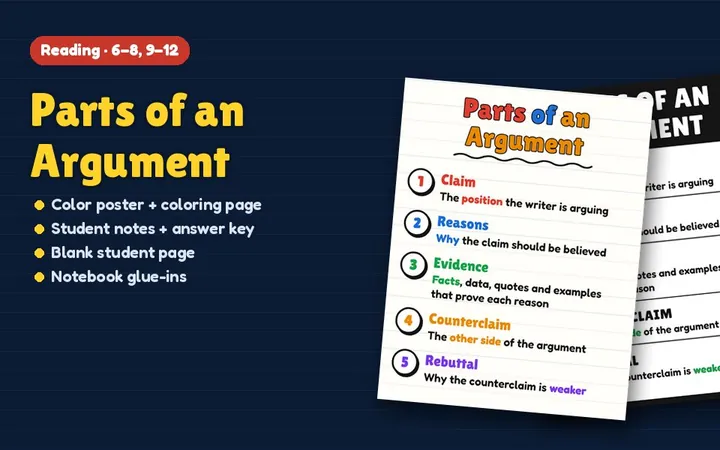
Finish with one paragraph. Students pick a statement from four corners and write a claim, two reasons with evidence or examples, and one counterclaim with a rebuttal. Post a parts of an argument chart and a set of discussion sentence stems ("I agree with ___ because...", "I see it differently because...") so students have the language ready.
Short Thanksgiving reading pairings
Short texts are perfect for this week because you can start and finish in one class period. These are all public domain or easy to find, and each pairs well with a skill you are already teaching.
- O. Henry, "Two Thanksgiving Day Gentlemen" (1907). Stuffy Pete has already eaten an enormous meal when the Old Gentleman arrives to treat him to his yearly Thanksgiving dinner, and he eats a second one rather than break the tradition. The ending holds one more surprise about the Old Gentleman. It is a great text for situational irony and for discussing whether tradition is always a good thing.
- Edward Winslow's 1621 letter. The short passage describing the harvest gathering at Plymouth is one of the only firsthand accounts of the event. It is excellent for primary source reading: who wrote it, for what audience, and what does it leave out?
- The National Day of Mourning. Since 1970, the United American Indians of New England have gathered in Plymouth on Thanksgiving Day to mark a National Day of Mourning. Pair the Winslow letter with a current news article or statement about the gathering and have students compare perspectives on the same history. Keep it centered on reading and point of view, and let students draw their own conclusions.
- Lincoln's 1863 Thanksgiving Proclamation. Issued in the middle of the Civil War, it is short and full of rhetoric worth analyzing. Pair it with the story of Sarah Josepha Hale, the magazine editor who spent years writing letters urging a national Thanksgiving holiday. Students can analyze purpose and audience in both.
- Lydia Maria Child, "Over the River and Through the Wood" (1844). Most students know the song but have never read it as a poem. It is good for younger middle schoolers studying rhyme, rhythm and imagery.
For any of these, a simple routine works: read it once aloud, have students annotate on a second read, then answer one short constructed response. For "Two Thanksgiving Day Gentlemen," try: How does O. Henry use irony to make a point about tradition? Use evidence from the text.
A low-prep plan for the day before break
The day before Thanksgiving break, you might have twelve students or you might have thirty. Either way, nobody wants a test. Here is a plan that needs almost no prep and still keeps students reading, writing and talking.
- Warm-up (10 minutes). A Thanksgiving journal prompt on the board: "Describe your ideal Thanksgiving plate using all five senses," or "What is one tradition, from any holiday, you would keep forever?"
- Thank-you letters (15 minutes). Students write and address a letter to a staff member. Collect them and deliver them during your conference period.
- Food bracket or four corners (15 minutes). Run whichever one you didn't do earlier in the week.
- Calm close (10 minutes). Coloring pages with soft music, or quiet independent reading. Older students like coloring more than they admit, especially when the pages are made for their age instead of for little kids.
Every piece of this works with a small group, a full class or a sub. If you know you will be out, leave the plan as is.
Keep it inclusive
Not every student celebrates Thanksgiving, and for some families the holiday is complicated. A few habits help: frame gratitude writing around everyday life rather than one holiday meal, offer alternate prompts, and present the history from more than one perspective. Students notice when you do this, and it makes the discussion better.
Ready-made Thanksgiving ELA resources
If you want this ready to go, my journal prompt collection includes holiday prompts and a peer discussion routine, the Top 5 Bracket Challenge comes with ready brackets, blank templates and a 60-second timer for the food bracket, and my High School and College Thanksgiving coloring pages are designed for older students. Sticky Drop is free and makes the anonymous gratitude board easy to run from any device. Everything is below.