How to Teach Tone and Mood in Middle and High School (Without the Confusion)
 Andy Navarro · Short Stories & Literature · · 4 min read · Updated
Tone vs. mood made clear for grades 6–10: a one-sentence difference, tone and mood word banks, four activities and the best short stories to teach them with.
Tone and mood might be the two literary terms students mix up most often. They sound alike, they're usually taught together, and they both describe a feeling. The difference is whose feeling it is. Once students lock that in, the rest gets much easier.
Here's how I teach tone and mood in middle and high school, with activities that work with almost any text.
The one-sentence difference
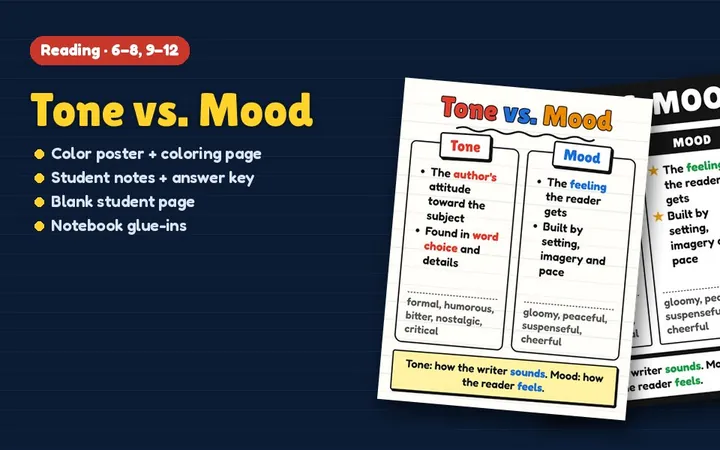
Tone is the author's attitude. Mood is the reader's feeling.
Tone answers: how does the author or narrator feel about this subject? Mood answers: how does this make me, the reader, feel?
A quick example: a narrator might describe a haunted house in a calm, matter-of-fact tone, and that calm voice is exactly what makes the mood creepy. Tone and mood can match, but they don't have to, and the moments where they don't are often the most interesting ones to analyze.
A memory trick students like: mood is me. Both start with m.
Give students better words
Most students only have "happy," "sad" and "scary." Without a word bank, they can't describe tone or mood precisely. I give students two lists and keep them in their notebooks all year.
Tone words (the author's attitude): sarcastic, admiring, bitter, playful, critical, nostalgic, serious, sympathetic, humorous, respectful, mocking, hopeful, defensive.
Mood words (the reader's feeling): tense, eerie, peaceful, gloomy, suspenseful, joyful, unsettling, melancholy, cheerful, anxious, calm, hopeless, mysterious.
Some words fit both, and that's fine. What matters is that students can explain whose feeling they're describing.
Where tone and mood come from
Writers build tone and mood on purpose, and students should be able to point to how. The big three:
- Word choice (diction): "The house stood at the end of the road" vs. "The house crouched at the end of the road." One verb changes everything.
- Imagery and setting: details about light, weather, sounds and smells set the mood fast. Fog, silence and a flickering light do a lot of work.
- Sentence structure: short, choppy sentences build tension. Long, flowing sentences slow the pace and can feel calm or dreamy.
Activities that make it click
Same scene, two moods
Give students a plain description of a setting, like a school hallway after the last bell. Have them rewrite it twice: once to create a peaceful mood and once to create a creepy mood, without changing what's actually there. Then they swap and identify which words did the work. Writing it shows them how mood is built.
Music and mood
Play short clips of instrumental music, like a movie soundtrack, and have students write a mood word for each. Then show a short movie scene with two different soundtracks. Students immediately see how the same images feel completely different. It's a great hook before moving into texts.
Tone in a text message
Write the same text message three ways: "Thanks a lot." "Thanks a lot!!" "thanks a lot." Ask what the sender's attitude is in each one. Students already read tone every day in their phones. They just don't call it that.
Mood tracker for a short story
As students read a suspenseful short story, they stop at four or five points and record a mood word and the specific words or details that created it. Plot the moods on a line graph by intensity. Students can see how the author builds suspense toward the climax.
Short stories that work well
Suspense and horror stories are perfect for mood because the authors are so deliberate about it. "The Tell-Tale Heart" by Edgar Allan Poe is a classic for both: the narrator's frantic, defensive tone and the dread the reader feels. "The Monkey's Paw" by W. W. Jacobs builds an ominous mood out of a cozy family scene. For tone, satire and humor work best, since the author's attitude is so clear.
How to assess it
A good short constructed response question: "What is the mood of this passage, and how does the author create it?" Students need a mood word, two pieces of evidence and an explanation of how the words create the feeling. For tone, ask: "What is the narrator's attitude toward ___? How do you know?"
Questions teachers ask
What is the difference between tone and mood?
Tone is the author's attitude toward the subject. Mood is the feeling the reader gets. An author can use a sarcastic tone that creates a funny mood for the reader.
How do you teach tone and mood in middle school?
Give students strong tone and mood words, show how word choice, setting and imagery create them, and practice with short passages before moving to full stories.
What short stories are good for teaching mood?
Suspenseful stories like "The Tell-Tale Heart" and "The Most Dangerous Game" work well because the mood is strong and easy to trace back to the author's word choice.
My Tone and Mood lesson has notes slides and a three-part worksheet with an answer key. The Tone and Mood anchor chart keeps the difference visible all year, and the Scary and Suspense Short Story Unit has eight original stories that are perfect for mood practice. They're all below.



Comments
Questions, tweaks that worked in your room, ideas for other teachers: share them here.
Loading comments...