How to Teach The Tell-Tale Heart: An Unreliable Narrator Lesson That Works
 Andy Navarro · Short Stories ·
How to teach The Tell-Tale Heart with a simple unreliable narrator lesson: put the narrator on trial, track the evidence, and build to a strong SCR.
If you're figuring out how to teach "The Tell-Tale Heart," here's the good news: Poe already did half the work. The story is short, creepy, and narrated by someone who keeps insisting he's sane while proving the opposite. That makes it the best unreliable narrator lesson I know, and students who usually check out will argue about it for a whole period.
Here's how I teach it, from the hook to the writing, so you can run it with nothing but the story and a copy machine.
Before reading: set up the question
I don't start with Poe's biography or a vocabulary list. I start with a question on the board: Can you trust someone who tells you over and over that they're calm?
Students quick-write for three minutes about a time someone said "I'm fine" or "I'm not mad" and clearly wasn't. Then a few share. Every class has a story, and every story lands on the same idea: sometimes the way a person talks tells you more than what they say.
That's the whole lesson in one sentence, and they figured it out before reading a word.
Then I give them the term. An unreliable narrator is a narrator whose version of events we can't fully trust, because they're lying, confused, biased or, in this case, not mentally well. I keep the definition on the board all week.
Quick background (five minutes, tops)
Students need just enough context to read well:
- Edgar Allan Poe published "The Tell-Tale Heart" in 1843.
- Poe believed a short story should create one single effect on the reader. Here, that effect is building dread.
- It's Gothic fiction: darkness, death, madness, and a creeping sense that something is very wrong.
- The narrator is never named, and we never learn if the narrator is a man or a woman. Most readers assume a man, but it's worth pointing out.
During reading: read it aloud, in three chunks
This story is meant to be heard. I read it aloud (or play a good audio reading) and stop at three natural breaks:
- The setup: the narrator explains why he isn't mad, admits the old man never wronged him, and blames the eye.
- The seven nights and the eighth: the slow, careful entering of the room, the lantern, the murder and hiding the body under the planks.
- The police and the confession: the visit, the narrator's confidence, the sound he hears, and the breakdown.
At each stop, students jot a quick answer to the same question: What does the narrator want us to believe right now, and what do we actually believe? Doing the same question three times is the point. They start seeing the gap between the narrator's claims and the evidence.
The core unreliable narrator lesson: put the narrator on trial
This is the activity that makes the story stick. Students act as investigators building a case. I give them a two-column chart:
- Left column, "The narrator claims": what the narrator says about himself.
- Right column, "The evidence shows": what his own words and actions reveal.
Then I model one row. The story opens with the narrator asking, "How, then, am I mad?" That's the claim: I'm sane. But in the same opening he says he heard "many things in hell." That's the evidence column. A sane person doesn't brag about hearing hell.
From there, pairs fill in at least four more rows on their own. The strongest ones my students find every year:
- He says he had no reason for the murder ("Object there was none. Passion there was none.") but claims to be completely rational. A rational person usually needs a reason.
- He's proud of how slowly and carefully he opened the door each night, as if patience proves sanity. It actually shows obsession.
- He laughs and feels triumphant at moments that should horrify anyone.
- He hears a heartbeat under the floor that no one else hears.
Once the chart is full, I ask the big question: Is the narrator lying to us, or does he really believe he's sane? There's no single right answer, and that's what makes the discussion good. Students have to point to rows on their chart to argue either side.
Look at how Poe writes it, not just what happens
The unreliable narrator lesson gets stronger when students see that Poe builds the madness into the sentences themselves. I put one paragraph on the board and have students mark three things:
- Dashes and exclamation points. The sentences break off and restart, like someone talking too fast.
- Repetition. Words and phrases repeat, especially near the end, as the heartbeat gets louder.
- Short sentences and questions. The narrator keeps asking us questions and answering them himself, like he's arguing with someone who isn't there.
Then I ask: if this narrator were truly calm, how would the paragraph look? A few students rewrite two sentences in a calm, steady voice. Reading the two versions side by side shows exactly how style creates character. It's one of my favorite five-minute activities all year.
The symbols worth ten minutes
You don't need to cover everything. These four give students plenty to write about:
- The eye: the narrator calls it a vulture eye. It might stand for the feeling of being watched or judged, or for the narrator's own guilt.
- The heartbeat: most readers see it as the narrator's guilt, or possibly his own heart pounding. Either reading works if students support it.
- The lantern: a single thin ray of light aimed at the eye. It shows how narrow and obsessive the narrator's focus is.
- The planks: what's hidden under the floor doesn't stay hidden. Guilt finds its way out.
I have small groups take one symbol each, find one line that supports their reading, and teach it to the class in under a minute.
Irony: the detail students love to catch
Once students have the unreliable narrator idea, irony is easy to add. The narrator tells the story to prove he's sane, and the story proves he isn't. That's situational irony. He also hides the body perfectly, fools the police, and then gives himself away anyway. The person who thought he was smarter than everyone is undone by his own mind.
Wrap it up with a short constructed response
By now students have a chart full of evidence, so the writing is the easy part. My go-to prompt:
How does Poe show that the narrator is unreliable? Use evidence from the text to support your answer.
Students answer the question, cite one short piece of evidence from their chart, and explain how it proves the narrator can't be trusted. If they've done the trial chart, they're not starting from a blank page. They're just picking their strongest row.
For a stretch prompt with older students: Should the narrator be held responsible for his actions? This turns into a great argument discussion, and it connects to real conversations about the insanity defense, which was being argued in courts in Poe's own time.
A few tips that make it smoother
- Pre-teach a handful of words (dissimulation, sagacity, vex, hearken) so they don't stall the read-aloud.
- Give struggling readers a version with the same paragraph numbers as everyone else, so they can still join the discussion.
- Let students know up front the story includes a murder. A quick heads-up keeps the focus on the writing.
- Keep the guiding question the same all week. Repetition builds confidence.
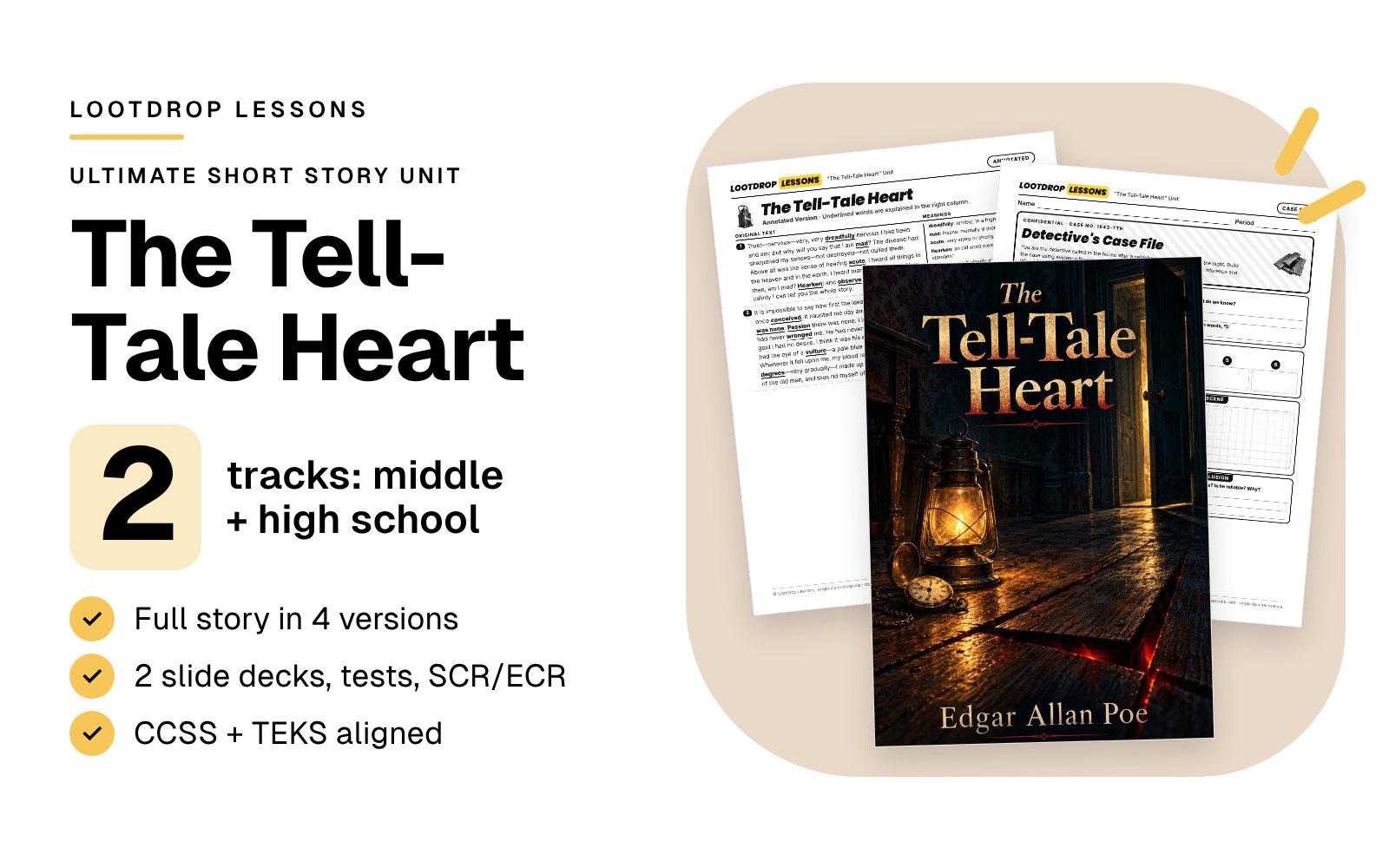
If you'd rather not build all of this from scratch, my Tell-Tale Heart unit has the trial charts, reading guides, symbol work and assessments ready to go, with the story in four versions and separate tracks for middle school and high school. It's below.