

The STAAR ECR Rubric Explained: How the Extended Constructed Response Is Scored
 Andy Navarro · STAAR, TSI & Test Prep · · 4 min read
The STAAR ECR rubric explained in plain language: the two traits, what each score point means, how the 10 points are counted and how to teach students to use it.
Most students write the STAAR essay without knowing how it is scored, which is like playing a game without knowing how to get points. The STAAR ECR rubric is short, and once students understand its two parts they can aim their effort where the points are.
Here is the rubric in plain language, what separates each score, and how to use it in class. The official wording is in the scoring guides the Texas Education Agency releases each year, and it is worth reading the one for your grade.
The short version
- The extended constructed response is scored on two traits.
- Organization and Development of Ideas is worth 0 to 3 points.
- Conventions is worth 0 to 2 points.
- That makes 5 points per scoring. The essay is scored twice and the two scores are added, so the essay is worth up to 10 points.
- An essay that earns a 0 in Organization and Development also earns a 0 in Conventions.
That last rule matters. A student cannot pick up conventions points on an essay that doesn't answer the prompt, so ideas come first.
Trait 1: Organization and Development of Ideas (0–3)
This is where most of the points are. Scorers are looking at four things: the controlling idea or thesis, the organization, the evidence, and how clearly ideas are expressed.
- 3 points. The controlling idea is clear and fully developed. There is a purposeful introduction and conclusion. Evidence from the text is specific, well chosen and clearly explained.
- 2 points. There is a controlling idea, but it is only partly developed. Organization is limited or uneven. Evidence is thin, or some of it doesn't fit, and the writing is basic.
- 1 point. A controlling idea can be found but isn't developed. Organization is weak. Evidence is insufficient or mostly irrelevant.
- 0 points. No real structure, no introduction or conclusion, and evidence that is missing or irrelevant.
The difference between a 2 and a 3 is almost always explanation. Students who earn a 2 drop in a quote and move on. Students who earn a 3 say what the quote shows and connect it back to the thesis.
Trait 2: Conventions (0–2)
- 2 points. Consistent command of sentence construction, punctuation, capitalization, grammar and spelling for the grade. A few errors are fine if they don't get in the way.
- 1 point. Inconsistent command. Several errors, but the reader can still follow.
- 0 points. Errors are frequent enough to make the writing hard to understand.
Notice what this doesn't say. A perfect essay isn't required for a 2. The fastest gains here come from complete sentences, capital letters and end punctuation, which is worth five minutes of proofreading at the end.
What the rubric doesn't reward
- Length. There is no point for a longer essay. A focused four-paragraph response beats a wandering two-page one.
- Personal stories. The ECR is text based. Evidence has to come from the passage.
- Fancy vocabulary. Clear beats impressive.
- Summary. Retelling the passage is the most common reason an essay stalls at a 1.
How to teach with the rubric
- Rewrite it in student language. One page, in "I" statements: "My thesis answers the prompt." "I explain every piece of evidence."
- Score released essays. TEA's scoring guides include real student responses at each score with notes on why. Have students score them before you show the actual score, and argue about it.
- Revise a 2 into a 3. Hand out a mid-level essay and have students add the missing explanation. It is the single most useful ECR activity I know.
- Have them score their own. Before turning in a practice essay, students highlight their thesis, underline evidence and circle explanation. If there is nothing to circle, they know what to fix.
- Proofread on purpose. Teach a two-minute last pass for sentences, capitals and periods. It protects those two conventions points.
Questions teachers ask
How many points is the STAAR ECR worth?
Up to 10. The rubric has 5 points, 3 for Organization and Development of Ideas and 2 for Conventions, and the essay's two scores are added together.
What is a good ECR score?
Anything from 6 up means the student is earning at least a 2 in ideas with solid conventions. Moving from 2s to 3s in ideas comes from better explanation of evidence.
Can a student get a zero?
Yes. A response with no organization and no relevant evidence can earn a 0 in ideas, which also makes conventions a 0.
Is the rubric the same for every grade?
The two traits and the point values are the same from grade 3 through English II. What counts as grade-level conventions and development rises with the grade.
How is the SCR scored?
Short constructed responses are separate. A reading SCR is scored 0 to 2 with a prompt-specific rubric, and a writing SCR is scored 0 or 1.
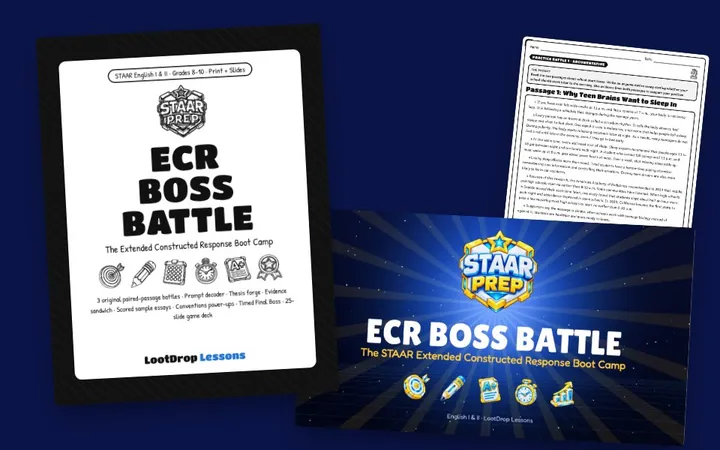
For the teaching side, see my step-by-step guide to teaching the STAAR ECR. If you want practice built in, ECR Boss Battle walks students through the essay as a game, and there are ECR prompt sets for several short stories on the SCR and ECR writing page.
Source: STAAR RLA scoring guides published by the Texas Education Agency. Check the current guide for your grade, since details can change from year to year.



Comments
Questions, tweaks that worked in your room, ideas for other teachers: share them here.
Loading comments...