How to Teach the STAAR ECR: A Step-by-Step Plan for the Extended Constructed Response
 Andy Navarro · STAAR & Test Prep ·
How to teach the STAAR ECR essay step by step: decode the prompt, write a thesis, build evidence paragraphs, plan fast and score with the rubric.
The STAAR ECR, or extended constructed response, is the full essay on the reading test. Students read a passage or a pair of passages, then write an essay that uses evidence from what they read. It's worth a big chunk of the score, and it's the part of the test that stresses students the most. If you're figuring out how to teach the STAAR ECR, the best news I can give you is this: it's a skill with steps, and steps can be practiced.
If your students are still working on short constructed responses, start there. An SCR is one tight paragraph. The ECR asks them to do that same thinking several times, organized into an essay. Here's the order I teach it in.
What the STAAR ECR is actually scored on
Before teaching anything, I show students the rubric, because it's simpler than they expect. The ECR is scored out of five points in two parts:
- Development and Organization of Ideas (up to 3 points): a clear thesis, evidence from the passages, explanation of that evidence, and an organized structure.
- Conventions (up to 2 points): spelling, capitalization, punctuation, grammar and sentence boundaries.
The big thing to tell students: the essay has to be text-based. An essay that ignores the passages and only gives personal opinion won't earn development points, no matter how well it's written. Check your current TEA scoring guides for the exact wording, since that's where the official anchor papers live too.
Step 1: decode the prompt
Most weak ECRs aren't weak because of writing. They're weak because the student answered a different question. So we start by taking prompts apart. A typical prompt has three pieces:
- The box: a short statement or question about the topic. This is the idea students are writing about.
- The task: the line that tells them what kind of essay to write, usually argumentative (take a position) or informational (explain), and depending on the grade, sometimes a correspondence format like a letter.
- The reminders: the bullet list about stating a thesis, organizing, using evidence and using correct conventions. This is basically the rubric in student language.
I have students mark up every prompt the same way: circle the genre, underline the topic, and box the words "from the passage" or "from both passages." Then they rewrite the task as a question in their own words. If they can't, they're not ready to write yet.
Step 2: hunt for evidence before writing
Students want to start writing right away. I make them gather first. With the prompt decoded, they reread the passage and mark only what helps answer that question. Three to five pieces of evidence is plenty.
For paired passages, I require evidence from both. A common mistake is writing a strong essay that only uses one passage when the prompt asks about both. A simple T-chart, Passage 1 on one side, Passage 2 on the other, catches that before it happens.
Step 3: write a thesis that answers the prompt
The thesis is one sentence that directly answers the question. That's it. I teach a simple formula to start:
Topic + position or main idea + the reasons in short.
Then we test it. I project several thesis statements, some strong, some vague, some off-topic, and students vote on which ones actually answer the prompt. They get fast at spotting the vague ones ("This passage is about many things"), and that carries over to their own writing.
Step 4: build body paragraphs with an evidence sandwich
Each body paragraph proves one reason from the thesis. I teach the structure as an evidence sandwich:
- Top bun: a topic sentence that states the reason.
- Lead-in: a few words of context so the evidence doesn't just appear out of nowhere ("In the first passage, the author explains...").
- The filling: short, relevant evidence, quoted or paraphrased.
- Explanation: one or two sentences on how that evidence proves the reason. This is where most of the development points are, and it's the part students cut first.
- Bottom bun: a sentence that ties the paragraph back to the thesis.
Two body paragraphs done well beat four done thin. I'd rather see two strong pieces of evidence, each fully explained, than a list of quotes with nothing connecting them.
Step 5: keep the intro and conclusion short
Students waste a lot of time on fancy introductions. For the ECR, an introduction can be two or three sentences: a sentence about the topic, then the thesis. The conclusion restates the thesis in new words and adds one final thought. Neither one needs to be long. The points are in the body.
Step 6: plan in five minutes
Once students know the parts, I teach a quick planning map they can sketch on scratch paper:
- Thesis at the top.
- Reason 1, with its evidence and passage.
- Reason 2, with its evidence and passage.
- One word for the conclusion's final thought.
We practice the plan by itself, without writing the essay, over and over. Planning three prompts in a class period is great practice and much less exhausting than writing three full essays.
Step 7: score sample essays
This is the step that changes everything. Students score essays with the actual rubric before they're scored themselves. I give them a high, middle and low sample on the same prompt, and in groups they assign a score and justify it. Then we compare with the real score.
When students can explain why an essay earned a 2 instead of a 3, they understand the rubric better than any lecture could teach it. They also start catching the same problems in their own drafts.
Step 8: timed practice, then revision
Build stamina in stages. First, untimed essays on texts students already know well, like short stories from earlier in the year. Then timed essays on new passages. After each one, students revise one body paragraph only, focusing on the explanation. Small, targeted revision sticks better than rewriting the whole thing.
Using stories they've already read is a big deal early on. When comprehension isn't a struggle, students can put all their energy into structure. "The Most Dangerous Game," "Lamb to the Slaughter" and "The Scarlet Ibis" all work well for this.
Common ECR mistakes to watch for
- Retelling the passage instead of answering the prompt.
- Writing the wrong genre, like an argument when the prompt asks to explain.
- Long quotes with no explanation after them.
- Only using one passage on a paired prompt.
- Run-ons and missing capitalization that cost conventions points.
Post this list in your room and have students check their own essays against it before turning them in.
Wrapping up
The STAAR ECR feels huge to students because they see it all at once. Break it into decoding, evidence, thesis, body paragraphs, planning and scoring, and each step is something they can practice and get better at in a single class period.
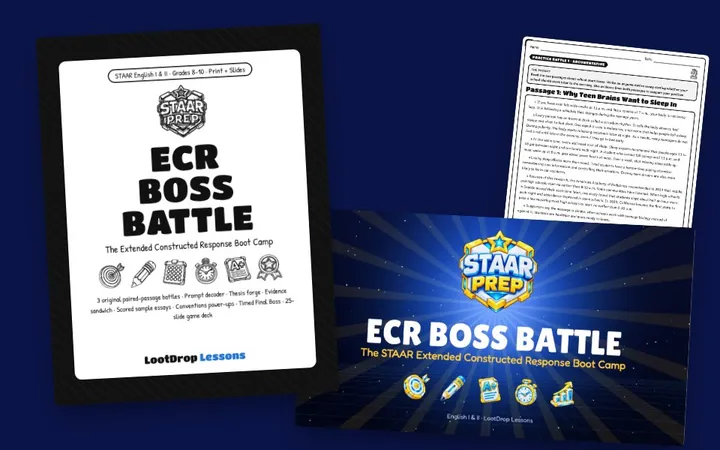
If you'd like this turned into a game-style unit, my ECR Boss Battle boot camp walks students through decoding the prompt, evidence hunting, thesis writing, evidence sandwiches and a Boss Map plan, then has them score sample essays and take on a timed final essay. I also have ECR prompt sets for "The Most Dangerous Game," "Lamb to the Slaughter" and "The Scarlet Ibis," plus an essay structure anchor chart. They're below.