STAAR Reading Review Games and Test Prep Ideas That Aren't Boring
 Andy Navarro · STAAR & Test Prep ·
STAAR reading review games and test prep ideas that keep students engaged: review stations, story-based saga lessons, boss battles and more.
By spring, students have seen a lot of practice passages. Hand out one more packet and you can watch the energy leave the room. That's why I build my STAAR reading review around games, stations and stories instead of worksheets. The skills are the same. The difference is that students are actually thinking instead of bubbling to get it over with.
Here are the STAAR reading review games and test prep ideas I come back to every year. All of them work with any passage you already have.
Start with the data, then pick the game
Games are only useful if they target the right skills. Before review season, I look at benchmark results and pick the three or four standards my students missed most. Usually it's some mix of inference, author's purpose and craft, theme, vocabulary in context, and revising and editing.
Then every game I run is built around those skills. A fun review on the wrong skill is just a fun day.
Review stations: the backbone of STAAR test prep
Stations are my favorite format because they get kids moving and let me pull small groups. I set up four to six stations, each with one skill and a short task that takes about ten minutes:
- Inference station: a short passage and three questions that start with "Which sentence best supports..." Students have to find the evidence, not just the answer.
- Vocabulary in context station: sentences with an unfamiliar word underlined. Students guess the meaning, name the context clue that helped, and then check.
- Theme station: a short story and a set of theme statements. Students rank them from strongest to weakest and defend their top pick.
- Revising and editing station: a paragraph with planted errors and a note telling them how many to find.
- SCR station: one prompt, one response box, a partner who scores it.
- Teacher table: my small group, working on whatever the data says they need most.
Keep a timer on the board and a clear rotation signal. Stations fall apart when kids don't know when to move.
The saga format: review as a story
This is the idea that changed my review the most. Instead of random passages, each lesson is a chapter in an ongoing story, like levels in a video game. Characters come back, the stakes build, and students want to know what happens next. The questions are still STAAR-style. The passages are just connected.
How to set it up:
- Write or pick a short original story with a clear hero and a goal.
- Break it into parts, and attach one skill to each part. Chapter one might focus on vocabulary and inference, chapter two on conflict and theme, chapter three on author's purpose.
- Frame each lesson as a level. Students "clear" it by getting a set number of questions right.
- End each part on a small cliffhanger. It's amazing how much a cliffhanger helps attendance on review days.
Students who groan at practice passages will read a story about a character they already care about. That's the whole trick.
Boss battles for the hard stuff
Save the toughest skill for a boss battle. The class works together to "defeat" the boss by answering a series of harder questions. Each correct answer takes away a chunk of the boss's health bar on the board. Wrong answers let the boss hit back, and the class loses a point.
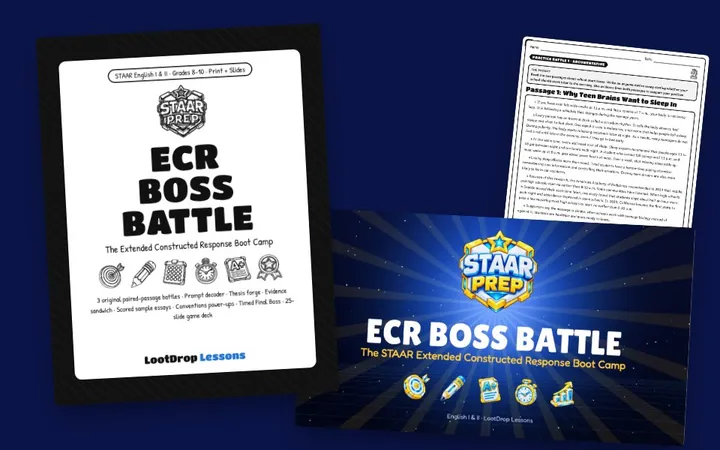
It works for multiple choice, but it works even better for writing. A boss battle for the ECR might have levels for decoding the prompt, finding evidence, writing a thesis and explaining evidence, with a timed essay as the final boss. Breaking a big task into levels makes it feel beatable.
Five quick games that need almost no prep
- Four corners: project a multiple-choice question and label each corner A, B, C or D. Students walk to their answer. Then each corner has thirty seconds to convince the others. Kids change corners when they hear a good argument, which is exactly the thinking you want.
- Wrong answer autopsy: give the correct answer up front, then make students explain why each wrong choice is wrong. This builds the skill of eliminating distractors, which matters on almost every item.
- Whiteboard showdown: teams write answers on mini whiteboards and reveal at the same time. Fast, loud, and you see every student's thinking at once.
- Stump the teacher: students write their own STAAR-style question about a passage. If I get it wrong, or if the question is good enough to fool another team, they earn points. Writing questions forces them to understand how questions are built.
- Fix-it race: partners race to find and fix the errors in a short paragraph. Tell them how many errors are hiding so they know when to stop looking.
Practice the new item types, too
STAAR includes more than standard multiple choice now. Students may see questions where they select more than one answer, choose from a drop-down inside a sentence, drag answers into place, or click on a sentence in the passage. If students only practice A, B, C, D, the new formats can throw them off on test day.
You don't need special software to practice. Multiselect works fine on paper with "choose two." Hot text works by having students highlight the one sentence that best supports an answer. Mix these into your games so the formats feel normal.
Use themes students already love
A review packet built around an anime, a video game or a superhero story gets read more carefully than a generic passage. The skill stays the same: figurative language, inference, theme. Students just bring more energy because the content feels like theirs. Original stories in a familiar style are the way to go here, so you're not copying anyone's work.
Keep the games honest
A few rules keep review fun without losing the point:
- Every game ends with students explaining at least one answer with evidence.
- Points go to the team, not individuals, so struggling readers aren't put on the spot.
- Track which questions the class misses during the game. That's your reteach list for tomorrow.
- Finish the week with one short, quiet, timed practice so students get used to test conditions.
The short version
- Pick three or four skills from your data.
- Run stations with one skill per station.
- Connect your passages into a saga so students want to keep reading.
- Use boss battles for the hardest skills, including the essay.
- Mix in quick games and the newer item types all week.
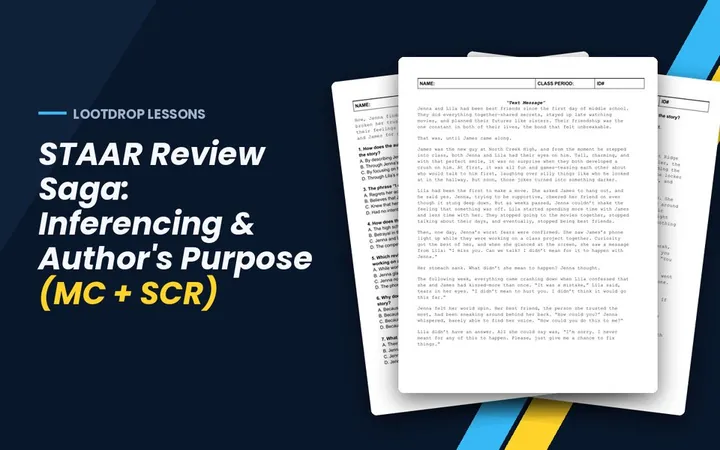
If you want ready-made versions, my STAAR Review Saga lessons give review a video game theme, with original stories and STAAR-style questions covering vocabulary, inference, editing, conflict, theme and author's purpose. I also have an anime-themed figurative language review packet, the Glitch Fix editing arcade for revising and editing practice with younger grades, and the ECR Boss Battle for the essay. They're all below.