
How to Teach Multi-Step Word Problems: Strategies That Go Beyond Key Words
 Andy Navarro · Elementary Math · · 4 min read · Updated
5 strategies for multi-step word problems in grades 2–4: retell without numbers, find the hidden question, draw a model, estimate first and label everything.
Students can often do the math in a word problem. What trips them up is figuring out what math to do, especially when there's more than one step. Multi-step word problems ask students to keep track of a story, find a question the problem never asks out loud, and use that answer to solve the real question. That's a lot to hold in your head at once.
Here are the strategies that help students tackle multi-step problems with confidence, plus a caution about the most popular shortcut.
Why key words alone don't work
Many classrooms teach key word lists: "in all" means add, "left" means subtract. The trouble is that key words often point the wrong way. Look at this problem:
Jake had some stickers. He gave away 8 and has 15 left. How many did he have in all?
"Left" and "in all" are both there. A student following key words could subtract and get 7. The right answer is 23. Math educators have warned about this for years. Key words can be a helpful clue, but students need to understand the story, not hunt for words.
Acronym strategies like CUBES (circle the numbers, underline the question, box the key words, evaluate, solve) can still be useful as a checklist, as long as the "evaluate" step means really thinking about what's happening. Teach it as a way to slow down, not a way to skip thinking.
Strategy 1: Retell the story without numbers
Before students touch a pencil, have them retell the problem in their own words, with no numbers. "A girl had some money, bought two things, and wants to know what she has now." If they can't retell it, they're not ready to solve it. This one step catches most of the confusion.
Strategy 2: Find the hidden question
Every multi-step problem has a question it doesn't ask out loud. Look at this one:
Ms. Lee bought 3 packs of markers with 8 markers in each pack. She gave 5 markers away. How many markers does she have now?
The hidden question is "How many markers did she buy?" (3 × 8 = 24). Then the real question: 24 − 5 = 19. Teach students to ask, "What do I need to know first?" and write the hidden question down before solving.
Strategy 3: Draw a model
Pictures and bar models (also called tape diagrams) show the structure of a problem. For the marker problem, students draw three bars of 8, then show 5 being taken away. Bar models work especially well for comparison problems ("Sam has 12 more cards than Ana...") because students can see the difference.
Keep drawings simple. A box with a number in it beats a detailed drawing of 24 markers.
Strategy 4: Estimate first, check last
Before solving, ask, "About how much should the answer be? More or less than what we started with?" After solving, students compare their answer to the estimate and reread the question. Does 19 markers make sense? Yes, she started with 24 and gave a few away. This catches backward operations and careless mistakes.
Strategy 5: Label everything
Students lose track of what each number means in a multi-step problem. Have them label each step: "24 markers bought," "19 markers left." Labels also make it easy for you to see where their thinking went wrong.
Routines that build the skill
Numberless word problems
Show the problem with the numbers removed: "Ms. Lee bought some packs of markers. Each pack had some markers. She gave some away." Ask what students notice and what they could find out. Then reveal the numbers. This keeps the focus on understanding the situation.
One problem a day
Short, daily practice beats a big unit once a year. Start math with one word problem on the board, solved and discussed in five to ten minutes.
Task cards by level
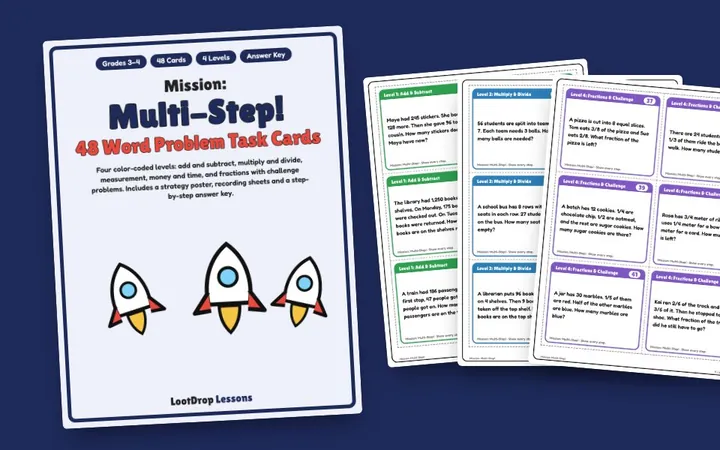
Leveled task cards let you differentiate easily. Start students on two-step addition and subtraction, then move to problems with multiplication and division, then measurement, money and time, and finally fractions.
Write your own
Students write a two-step problem for a partner and include the answer key. Writing a problem forces them to think about the hidden question from the other side.
Questions teachers ask
Why don't key words work for word problems?
Key words can point to the wrong operation. "Left" or "more" can show up in problems that need different operations, so students who only hunt for key words often solve the wrong problem.
How do you teach multi-step word problems in 3rd grade?
Have students retell the story without numbers, find the hidden question they need to answer first, draw a model, estimate and label every number. Practice a little every day.
What is the hidden question in a word problem?
In a multi-step problem, the hidden question is the step students must solve before they can answer the question asked. Finding it is the key to planning the steps.
The Multi-Step Word Problem Lesson teaches the C.U.B.E. method with 39 practice problems, and Mission: Multi-Step! has 48 leveled task cards with a strategy poster and step-by-step answer key. For K–2, Story Problems All Year has 200 addition and subtraction story problems within 20, and the winter set is ready for December. They're below.




Comments
Questions, tweaks that worked in your room, ideas for other teachers: share them here.
Loading comments...