
How to Teach Long Division So It Sticks: Steps, Strategies and Remainders for 4th and 5th Grade
 Andy Navarro · Elementary Math · · 3 min read
A clear way to teach long division in 4th and 5th grade: build place value first, use a simple step routine, handle two-digit divisors and teach students what remainders mean.
Long division has a reputation. Students learn the steps, forget one, and suddenly the whole problem falls apart. The fix isn't more worksheets. It's making sure students understand what they're doing at each step, so they can catch their own mistakes.
Here's the order I teach it in.
Start with what division means
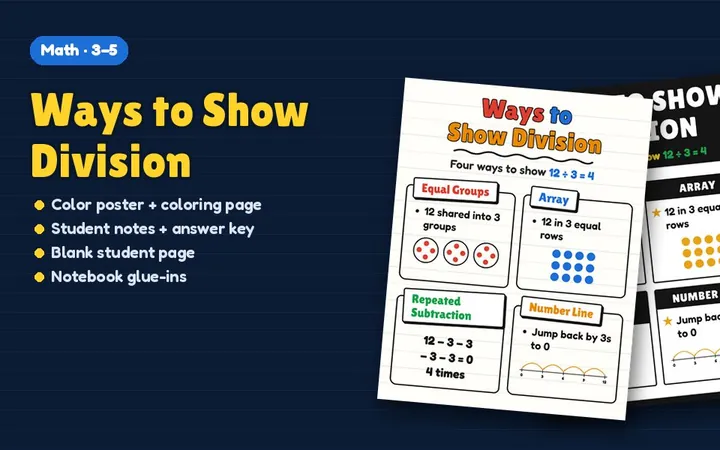
Division is fair sharing. 84 ÷ 4 means "share 84 into 4 equal groups." Before the algorithm, students should model this with base-ten blocks: share the 8 tens first (2 tens in each group), then the 4 ones (1 in each group). Each group gets 21. That's exactly what the algorithm does, one place value at a time.
Make sure the basics are solid
Long division uses division facts, multiplication facts and subtraction in every step. If a student can't recall 7 × 8 quickly, they'll stall. A few minutes of fact practice each day pays off more than any trick.
A simple step routine
Most teachers use some version of these steps:
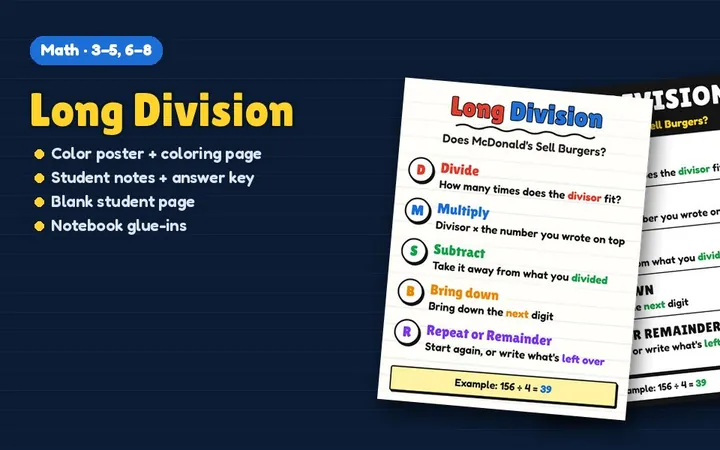
- Divide: how many times does the divisor go into this part of the dividend?
- Multiply: multiply that quotient digit by the divisor.
- Subtract: subtract to find what's left.
- Bring down: bring down the next digit and repeat.
A silly mnemonic helps (Does McDonald's Sell Burgers?), but I always tie each step back to sharing. "Bring down the 2" means "now we share the ones."
Where does the first digit go?
This is the most common place-value mistake. In 738 ÷ 6, 6 goes into 7 one time, so the 1 goes above the 7 in the hundreds place. If students write quotient digits in the wrong place, they'll get 12 instead of 123. Have them draw light lines between place values or use graph paper to keep columns straight.
Estimate before and check after
Before solving, estimate: 738 ÷ 6 is a little more than 600 ÷ 6 = 100. After solving, check by multiplying the quotient by the divisor and adding the remainder. These two habits catch almost every error.
Two-digit divisors
Two-digit divisors feel hard because students can't rely on facts. Teach them to round the divisor to estimate each quotient digit. For 962 ÷ 26, think "about 100 ÷ 25, so about 3 or 4." Try 3: 3 × 26 = 78. If the subtraction leaves a number bigger than the divisor, the estimate was too small. A quick multiples list for the divisor (26, 52, 78, 104…) also helps.
Teach what remainders mean
Word problems with remainders are where students show real understanding. The same answer can mean different things:
- Drop it: 86 marshmallows, 6 per mug. 14 full mugs. The 2 extra don't make another mug.
- Round up: 213 riders, 14 per wagon. 15 R3 means you need 16 trips so everyone rides.
- Use it in the answer: 534 inches is 44 feet 6 inches.
Every time there's a remainder, ask, "What happens to the leftovers?"
Use error analysis
Show a worked problem with one mistake, like a student who forgot to bring down a digit and got 3 R18 instead of 37. Students find and explain the error. It's more engaging than solving another problem, and it builds the self-checking habit you want.
Differentiate with the same skill
Not every student needs the same page. Give one-digit divisors to students still building confidence and two-digit divisors or multi-step problems to students who are ready. Everyone practices the same skill at the right level.
The resources below include a free long division quiz or review with one- and two-digit divisors, remainders and an answer key, plus long division anchor charts and a holiday division activity.
Questions teachers ask
What are the steps of long division?
Divide, multiply, subtract and bring down the next digit, then repeat until there are no digits left to bring down. Whatever is left is the remainder.
What grade learns long division?
Students usually learn long division with one-digit divisors in 4th grade and with two-digit divisors in 5th grade.
How do you help students with two-digit divisors?
Teach them to round the divisor to estimate each quotient digit, and to list the first few multiples of the divisor. Checking with multiplication shows whether the estimate was too big or too small.



Comments
Questions, tweaks that worked in your room, ideas for other teachers: share them here.
Loading comments...