

How to Teach Limericks: A Limerick Lesson Plan for Grades 3–8
 Andy Navarro · Writing & Grammar · · 4 min read
A one-period limerick lesson plan for grades 3–8: the AABBA pattern, the bouncing rhythm, a five-step writing routine and the mistakes students make most.
The limerick is the one poem almost every student is willing to write. It is short, it is supposed to be silly, and the form tells you exactly where the rhymes go. It also shares its name with a city and county in Ireland, which makes it a natural fit for the week of St. Patrick's Day.
This limerick lesson plan takes one class period and works from 3rd grade through 8th. Older students spend more time on rhythm. Younger ones spend it on rhyme.
What is a limerick?
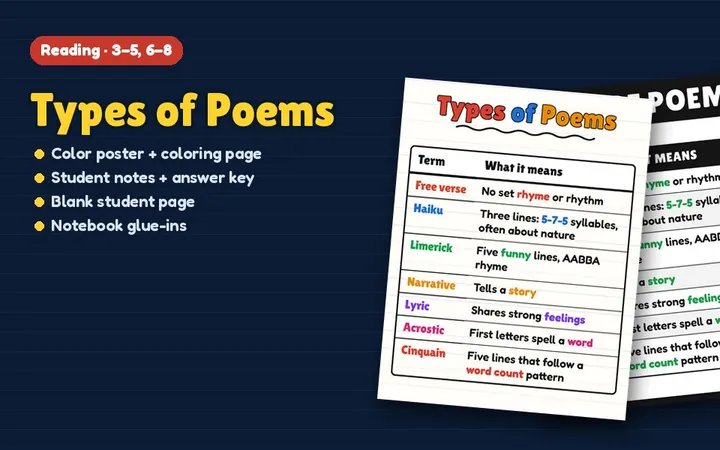
A limerick is a five-line humorous poem with two rules.
- Rhyme: lines 1, 2 and 5 rhyme with each other. Lines 3 and 4 rhyme with each other. The pattern is AABBA.
- Rhythm: lines 1, 2 and 5 are longer, with three strong beats. Lines 3 and 4 are shorter, with two.
Here is one to put on the board:
A leprechaun hid in a shoe
With a pot full of gold painted blue.
He said with a grin,
"You will never get in,"
Then he sneezed, and we knew what to do.
Step 1: hear it before you label it (5 minutes)
Read two limericks aloud and have students clap the strong beats. They will feel the long, long, short, short, long shape before you name it. Then show the poem and have students mark the end words with A and B.
Step 2: pick a character and a place (5 minutes)
Most limericks open by introducing someone: "There once was a cat from Peru." The last word of line 1 sets the A rhyme for the whole poem, so it has to be easy to rhyme. Have students test it before they commit. If they cannot list five rhymes in a minute, they need a new word.
Step 3: build a rhyme bank (5 minutes)
Students list six or more words for the A rhyme and four for a B rhyme. This step prevents the most common problem, which is a forced last line. With a bank in hand, students choose the rhyme that makes the best joke instead of the only one they can think of.
Step 4: draft, then clap it (15 minutes)
Give a frame for the first draft:
- Line 1: who and where (A)
- Line 2: something odd about them (A)
- Line 3: what happened (B)
- Line 4: what happened next (B)
- Line 5: the surprise ending (A)
When the draft is done, partners read it aloud and clap. A line that trips the clapping has too many or too few syllables. Students fix it by swapping a word, not by starting over.
Step 5: share (10 minutes)
Limericks are meant to be heard. Let volunteers read, post the rest, and have the class vote on the best last line. Set one rule ahead of time: the joke is never about a real person in the room.
Mistakes to head off
- Right rhymes, wrong rhythm. Students count rhymes and ignore beats. Clapping fixes it faster than counting syllables.
- Lines 3 and 4 too long. They should feel quick. If they are as long as line 1, cut words.
- A hard word at the end of line 1. Nothing useful rhymes with "orange" or "Wisconsin."
- Repeating line 1 as line 5. Some older limericks do this, but a new last line is funnier and takes more skill.
- No story. A limerick is a tiny story with a twist. Ask: what changed by line 5?
Grading it quickly
Four checks, a point or two each: five lines, AABBA rhyme, short third and fourth lines, and a last line that lands. In grades 6–8, add a point for rhythm that survives being read aloud.
Outside sources
The Academy of American Poets defines the form in its glossary entry for limerick.
Questions teachers ask
What is the rhyme scheme of a limerick?
AABBA. The first, second and fifth lines rhyme, and the third and fourth lines share a different rhyme.
How many syllables are in a limerick?
There is no fixed count. Lines 1, 2 and 5 usually have eight or nine syllables and three strong beats. Lines 3 and 4 usually have five or six syllables and two beats.
What grade can write limericks?
Third grade and up. Grades 3–5 focus on the rhyme pattern. Grades 6–8 add rhythm and word choice.
Why are they called limericks?
The form shares its name with Limerick, Ireland. Nobody is certain how the name stuck, which is a good small lesson in how word histories work.
Want it ready to print? St. Patrick's Day reading and writing for grades 3–5 has a Leprechaun Limericks page along with a passage on Saint Patrick and a how-to writing planner. St. Patrick's Day ELA for grades 6–8 pairs limericks with the legend of the Giant's Causeway. See every subject in St. Patrick's Day activities for grades 3–12.



Comments
Questions, tweaks that worked in your room, ideas for other teachers: share them here.
Loading comments...