
Poem of the Week: A 10-Minute Fluency Routine for Grades 3–5
 Andy Navarro · Reading Skills & Phonics · · 3 min read
How to run a poem of the week in grades 3–5: one poem, five days, ten minutes a day, with a focus for each day that builds fluency and comprehension.
A poem of the week is one of the easiest routines to add to an upper elementary classroom. It takes about ten minutes a day, it needs one page, and it gives every student a reason to read the same text more than once. Repeated reading is how fluency grows, and a poem is short enough that students do not mind doing it.
Here is how to run a poem of the week in grades 3–5, with a job for each day.
Why a poem works better than a passage
- It is short. Students can read the whole thing several times in a few minutes.
- It has rhythm. Line breaks and rhyme show students where to pause and what to stress.
- It rewards rereading. A poem gives up more on the third read than on the first.
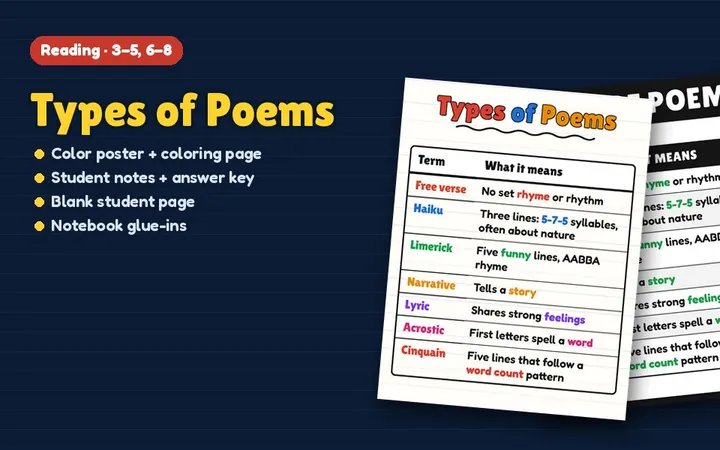
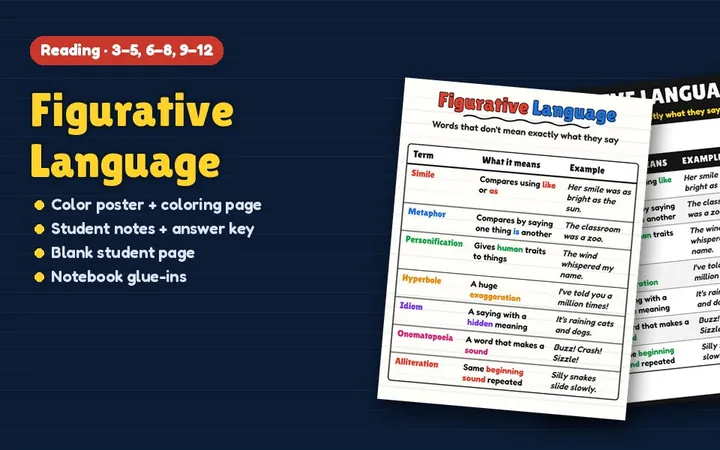
- It carries skills. Rhyme scheme, figurative language and inference all fit on one page.
The five-day routine
- Monday, meet the poem. Read it aloud while students follow along, then read it together. Ask what they notice and what they wonder.
- Tuesday, read for accuracy. Students read with a partner and circle any word that slowed them down. Sort out those words as a class.
- Wednesday, read for phrasing. Mark where the voice should pause. Punctuation tells you more than line breaks do.
- Thursday, read for expression. Decide how the speaker feels and read it that way. This is the day to annotate: circle rhymes, underline a comparison, highlight a clue.
- Friday, show what you know. Students read to a partner one last time and answer a few comprehension questions.
A simple tracker with one box per day keeps students honest and gives you something to glance at.
Choosing the poems
Pick poems that are different from each other across the month. A rhyming story in couplets, a poem with an ABAB pattern, a riddle told by a mystery narrator and a quiet set of haiku will each teach something new. Seasonal poems help, because students bring background knowledge to leaves, pumpkins and the first cold morning.
Keep the length to what your class can read in about a minute.
What to ask on Friday
- A question about what happens in the poem
- A question about a word or phrase
- A question about rhyme or structure
- A question that needs an inference, such as who is speaking or how the speaker feels
Mistakes to head off
- Racing. Fluency is not speed. Praise the reader who sounds like they are talking, not the one who finishes first.
- Stopping at every line break. Teach students to read to the punctuation.
- Skipping the talk. If nobody discusses what the poem means, it turns into a reading drill.
- One poem for too long. A week is enough. Start fresh on Monday.
- Only silly poems. Funny poems hook students, but a calm one teaches them to slow down.
Outside sources
Poetry 180, a Library of Congress project started by poet laureate Billy Collins, offers a poem for each day of the school year, chosen for high school students.
Questions teachers ask
What is a poem of the week?
A routine where the class reads one short poem every day for a week, with a different focus each day, to build fluency and comprehension.
How long does poem of the week take?
About ten minutes a day. It fits at the start of reading block, after lunch or during morning work.
What grade is poem of the week for?
It works from 1st grade through 5th. In grades 3–5, add annotation, rhyme scheme and inference questions.
Does repeated reading really help fluency?
Yes. Reading the same short text several times improves accuracy, pace and expression, and those gains carry over to new texts.
Want October ready to go? Pumpkin Patch Poems has four original fall poems for grades 3–5, each as a fold-up booklet and a single page, with annotation tasks, a Monday–Friday fluency tracker, comprehension checks, an answer key and a digital version.



Comments
Questions, tweaks that worked in your room, ideas for other teachers: share them here.
Loading comments...