Informational Text Anchor Chart
$1.50
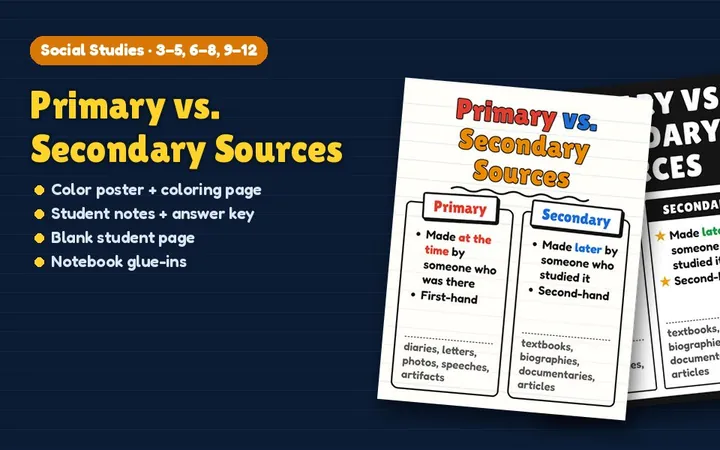
Anchor charts · Grades 3–12 · PDF, 8 pages · $1.50
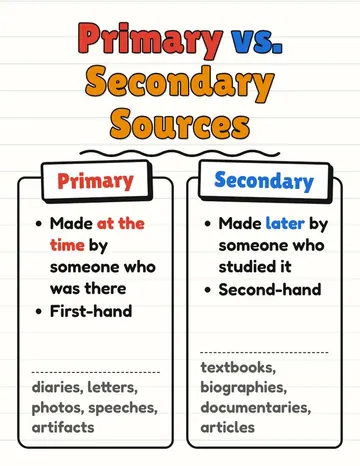
A primary source was created by someone who was there at the time, such as a diary, letter, photograph, speech or interview. A secondary source was created later by someone who studied the event, such as a textbook, encyclopedia entry or documentary. Students can sort a pile of examples into the two groups and explain who created each one and when.
A ready-to-hang Primary vs. Secondary Sources anchor chart in our chart-paper style: lined easel paper, big marker titles and clear labels students can read from across the room. Print it on letter paper as a poster, or project it and trace it onto chart paper.
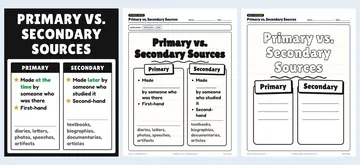
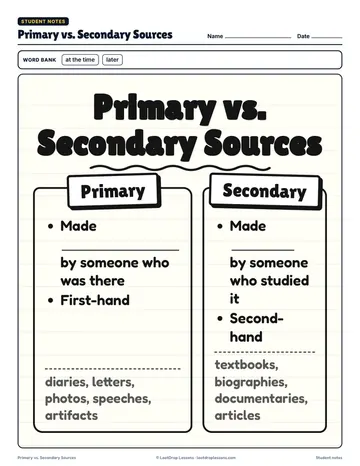
You get it in two designs, our chart-paper style and a bold black-banner style, plus matching student pages: a black-and-white coloring version, fill-in-the-blank notes with a word bank and answer key, a blank page where students build their own chart, and notebook glue-ins sized for composition notebooks and folders.
Download the free Primary vs. Secondary Sources Anchor Chart poster (PDF)
The chart is laid out as a side-by-side comparison of Primary and Secondary:
Topics: anchor, chart, poster, visual, coloring, pages, printable, sel, social, emotional, elementary, middle, school, high, grade, 3, 4, 5, 6, 7, 8, 9, 10, 11, 12
Martin Luther King Jr. Day lesson ideas for grades 6–12: analyze his speeches for rhetorical appeals, read primary sources, connect to the civil rights movement and write about service.
Presidents' Day lesson ideas for upper elementary: the three branches of government, primary sources, president research projects, data and money math and an "if I were president" persuasive essay.
Women's History Month activities for grades 6–12: nonfiction reading, primary source analysis, speech and rhetoric study, research profiles and argument writing about women who changed history.
Built for grades 3–5, 6–8, 9–12 (elementary and middle school and high school). Format: PDF, 8 pages. $1.50 on its own, or included with All-Access. Ways to use it: hang it as a poster or project and trace it on chart paper; students glue the notes into interactive notebooks.
Grades 3–12, so it fits elementary and middle school and high school classes.
PDF, 8 pages.
$1.50, or free with an All-Access membership.
Full-color poster in two designs: chart paper and bold banner (8.5 × 11 in), Black-and-white coloring version, Fill-in-the-blank student notes with a word bank, Answer key, Blank "build your own" student page, Notebook glue-ins: complete and blank (7 × 4¾ in).
Yes, an answer key is included.
Popular ways to use it: Hang it as a poster or project and trace it on chart paper; Students glue the notes into interactive notebooks; Fill in the blank page together as you teach the lesson.
Yes. The full-color Primary vs. Secondary Sources poster is a free one-page PDF you can download from this page. The $1.50 set adds a second poster design, a coloring version, fill-in notes with an answer key, a blank build-your-own page and notebook glue-ins.