Pre-Reading Activity for "The Lottery"
$5

Lessons · Grades 8–10 · PDF + PowerPoint · $5
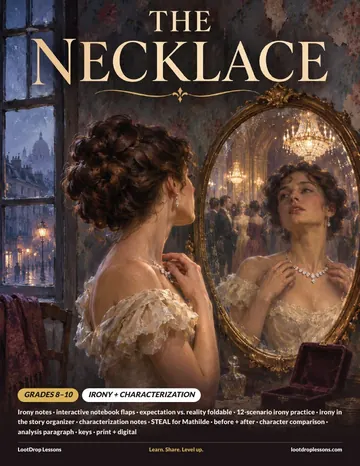
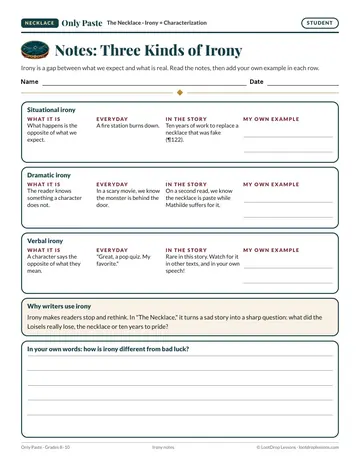
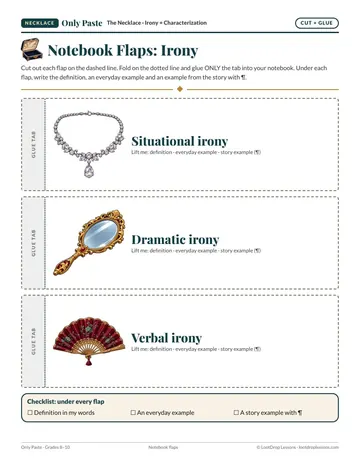
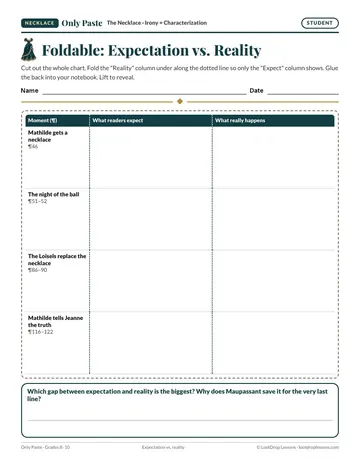
Only Paste teaches the two big ideas in "The Necklace": irony and character. Students take notes on situational, dramatic and verbal irony, build interactive notebook flaps and an expectation-vs-reality foldable, and practice with twelve everyday scenarios.
Then they track five moments of irony in the story with paragraph numbers. The characterization half covers direct and indirect characterization, a STEAL organizer for Mathilde, a before-and-after look at how ten years change her, and a three-way comparison of Mathilde, Loisel and Madame Forestier.
A fate-or-choice analysis paragraph planner and a full answer key are included. The complete story is printed in every resource (Guy de Maupassant, 1884, in a public-domain English translation), with paragraph numbers so every answer can cite the text.
Also included in The Necklace Complete Bundle.
Topics: math, sel, social, emotional, slides, powerpoint, presentation, bundle, value, pack, middle, school, high, grade, 8, 9, 10
A 5-day unit plan for Guy de Maupassant's "The Necklace": background, close reading with annotation, plot, figurative language, irony, characterization, theme and projects.
Teach the three types of irony and figurative language with classic short stories: clear definitions, story pairings and activities for grades 7 to 10.
Built for grades 8–10 (middle school and high school ELA). It goes with "The Necklace" by Guy de Maupassant. Format: PDF + PowerPoint. $5 on its own, or included with All-Access. Ways to use it: irony lesson; characterization.
Grades 8–10, so it fits middle school and high school ELA classes.
"The Necklace" by Guy de Maupassant.
PDF + PowerPoint. You can edit it to fit your class.
$5, or free with an All-Access membership.
Teacher guide, Irony notes, Interactive notebook flaps, Expectation vs. reality foldable, 12-scenario irony practice, Irony in "The Necklace" organizer, Characterization notes (STEAL), STEAL organizer: Mathilde.
Yes, an answer key is included.
Popular ways to use it: Irony lesson; Characterization; Interactive notebooks; Grades 8–10.