U.S. History EOC Review: Era Stations That Cover 1877 to Today
 Andy Navarro · STAAR, TSI & Test Prep · · 3 min read
A U.S. History STAAR EOC review plan for Texas: eight era stations from the Gilded Age to today, timeline and cause-and-effect activities, the civics questions on the test, and tips for primary sources and data questions.
The U.S. History EOC covers almost 150 years, from 1877 to the present, and students take it at the end of a course that probably spent half the year on the first half of that span. By April, the Gilded Age feels like ancient history and the Cold War blurs into the 1960s.
The fix is a review that moves fast, era by era, and keeps students active. Here is how I would set it up.
What the test covers
The EOC is based on the U.S. History Studies Since 1877 TEKS: history, geography, economics, government, citizenship, culture and science and technology, plus social studies skills like reading primary sources, maps, graphs and political cartoons.
It also includes 10 civics questions randomly selected from the U.S. citizenship test used in naturalization. Different students see different civics questions, and the results are reported at the state, district and campus levels but don't count toward a student's individual score. They are still worth a quick review, because most of them are fast points of pride.
Eight era stations
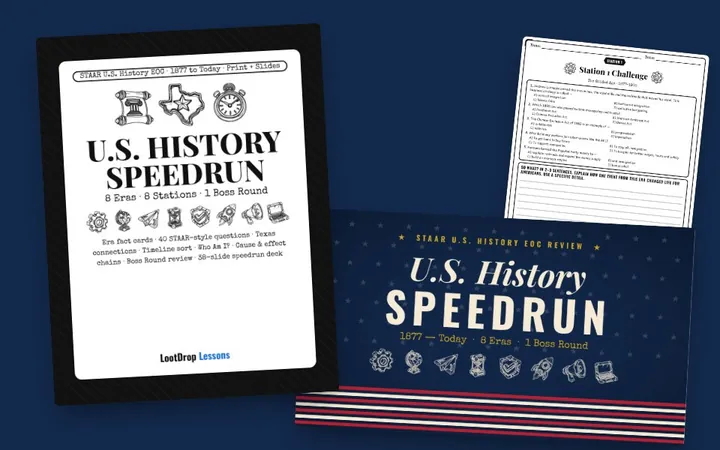
Break the course into eight eras and give each one a station. Each station gets a one-page era card (the big idea, five key events, five key people, must-know vocabulary and a Texas connection) and five STAAR-style questions.
- Gilded Age and industrialization: railroads, immigration, labor unions, political machines.
- Progressive Era: muckrakers, reforms, the 16th through 19th Amendments.
- Imperialism and World War I: the Spanish-American War, entering the war, the home front.
- The 1920s and Great Depression: the Roaring Twenties, the crash, the New Deal.
- World War II: mobilization, the home front, major turning points.
- Early Cold War: containment, Korea, the Red Scare.
- Civil rights and the 1960s: the movement's leaders, laws and court cases, Vietnam.
- Modern America: the end of the Cold War, 9/11, the digital age.
Rotate every 10 to 12 minutes with a visible timer and have students track their score at each station. Two class periods covers all eight.
Activities that build connections
- Timeline sort. Sixteen event cards, one timeline. Pairs argue about the order, which is where students sort out what came first.
- Who am I? Clues about a key person, revealed one at a time. Great as a warm-up or exit ticket.
- Cause and effect chains. Give one event and have students build the chain forward and back: the Great Depression to the New Deal to an expanded federal government.
- Quote and data rounds. Read short presidential quotes and simple data tables and ask what they show. Primary sources and data are where students lose the most points.
Test-taking tips specific to history
- Use the source first. Read the excerpt, map or cartoon carefully before the question. The answer is often in the stimulus.
- Date clues. If a question gives a date, place it in an era first, then think about what was happening.
- Cartoons. Identify the symbols, the label, and what the artist wants you to feel.
- Graphs. Read the title and axes before the data. Many students skip straight to the bars.
A note on HB 8
Under Texas House Bill 8 (2025), STAAR is replaced by new tests beginning in the 2027–28 school year, and high school students will still take a U.S. History test. High school districts may require up to two benchmarks per tested subject each year. Era-by-era teacher-made review works under either system.
Questions teachers ask
What years does the U.S. History EOC cover?
1877 to the present, based on the U.S. History Studies Since 1877 TEKS.
Are there civics questions on the U.S. History EOC?
Yes. The test includes 10 questions randomly selected from the U.S. citizenship test, aligned to the U.S. History TEKS. Results are reported at the state, district and campus levels and do not count toward individual student scores.
How should I review for the U.S. History EOC?
Move era by era with short stations, then connect the eras with timeline, cause-and-effect and primary source activities. Spend extra time on reading sources, maps, cartoons and data.
Want it ready to go? U.S. History EOC Speedrun has all eight era stations with era cards, 40 STAAR-style questions, a Speedrun Passport, a timeline sort, a Who Am I? round, cause-and-effect chains, a Boss Round with quotes and data, and a 38-slide game-style deck. More test prep is on the STAAR and TSI prep page.



Comments
Questions, tweaks that worked in your room, ideas for other teachers: share them here.
Loading comments...