
Text Structure Activities for 3rd, 4th and 5th Grade: Teach the Five Structures Step by Step
 Andy Navarro · Reading Skills & Phonics · · 4 min read · Updated
How to teach the five informational text structures in grades 3–5 with signal words, graphic organizers, games and short constructed response practice.
Text structure is one of those skills that shows up on every reading test and confuses students every year. Kids can often name the structures after a lesson, but they struggle to prove which one a passage uses, and they almost never explain why the author chose it. Those last two steps are where the real reading happens.
This post walks through how to teach the five text structures in grades 3 to 5, with activities for each step.
The five structures and their signal words
Authors of informational texts organize their ideas in a few predictable ways. Here are the five most taught structures with the words that usually signal them:
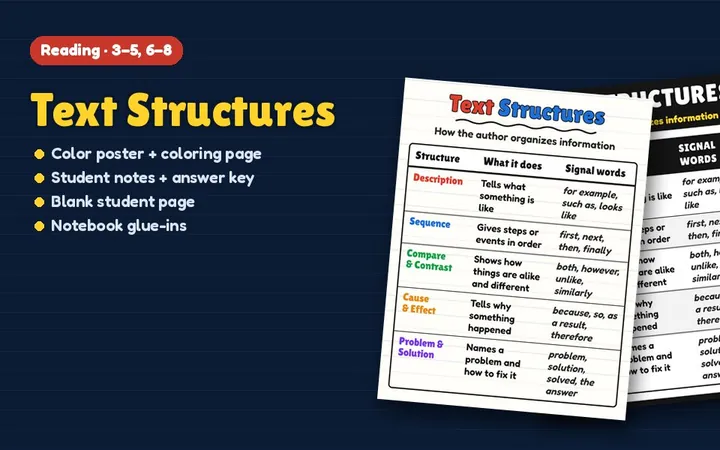
- Description: the author tells about a topic with details and features. Signal words: for example, such as, also, characteristics, looks like.
- Sequence or chronological order: events or steps happen in order. Signal words: first, next, then, after, finally, dates and times.
- Compare and contrast: the author shows how two things are alike and different. Signal words: both, similar, alike, however, but, unlike, on the other hand.
- Cause and effect: the author explains why something happens and what results. Signal words: because, so, as a result, since, therefore, led to.
- Problem and solution: the author describes a problem and one or more ways to solve it. Signal words: problem, issue, solved, one answer is, to fix this.
Pair each structure with a simple graphic organizer: a web for description, a timeline or numbered boxes for sequence, a Venn diagram or T-chart for compare and contrast, arrows for cause and effect, and a two-box chart for problem and solution. Students remember the shape long after they forget the definition.
Step 1: Name it
Teach one structure a day. Read a short paragraph aloud that clearly uses that structure, then have students highlight the signal words. After all five, mix them up. Give students five short paragraphs on the same topic, each written in a different structure. Writing about the same topic five ways shows students that structure is a choice the author makes, not something the topic decides.
For example, five paragraphs about sharks:
- Description: what sharks look like and where they live.
- Sequence: the life cycle of a shark.
- Compare and contrast: sharks vs. dolphins.
- Cause and effect: why shark populations are dropping.
- Problem and solution: how people are protecting sharks.
Step 2: Prove it
Signal words help, but they can also mislead. A cause and effect passage might include the word first. Teach students that the structure is about the whole passage, not one word. Have them answer: "What is the author mostly doing in this passage?" Then they cite two pieces of evidence, such as signal words, the way the paragraphs are organized, or the headings.
A quick way to practice: give students a passage and the five organizers. They fill in the organizer that fits. If the information doesn't fit neatly, it's probably the wrong structure.
Step 3: Explain the author's choice
This is the step most tests ask about and most lessons skip. Ask students why the author organized the text this way. For example, "The author used sequence because the reader needs to know the steps in order to make the recipe." Or, "The author used compare and contrast to show readers that sharks and dolphins are more different than they look."
A sentence frame helps: The author used ___ structure to help the reader understand ___.
Games and activities
Five corners
Label each corner of the room (and the center) with a structure. Read a short passage aloud. Students walk to the structure they think it is and then defend their choice to someone in their corner. You can see at a glance who's confused.
Structure detectives in science and social studies
Text structure transfers perfectly to content areas. Have students look at one page of their science or social studies book and identify the structure of each section. Textbooks change structures constantly, which makes for good discussion.
Write it five ways
Give students a topic they know well, like recess or a favorite food, and have them write one short paragraph in each structure. Writing the structures is the fastest way to understand them as a reader.
Use high-interest passages
Text structure practice works better when kids want to read the passage. Weird, gross and surprising science topics, like why we get brain freeze or why feet smell, are great for this. Students will reread a passage about boogers without complaint.
Questions teachers ask
What are the five text structures?
Description, sequence (chronological order), compare and contrast, cause and effect, and problem and solution.
What are signal words for text structure?
Signal words point to the structure: first, next and finally for sequence; however and similarly for compare and contrast; because and as a result for cause and effect; problem and solution for problem and solution.
How do you teach text structure in 3rd grade?
Teach one structure at a time: name it, prove it with signal words and evidence, then explain why the author chose it. Use short, high-interest passages and graphic organizers.
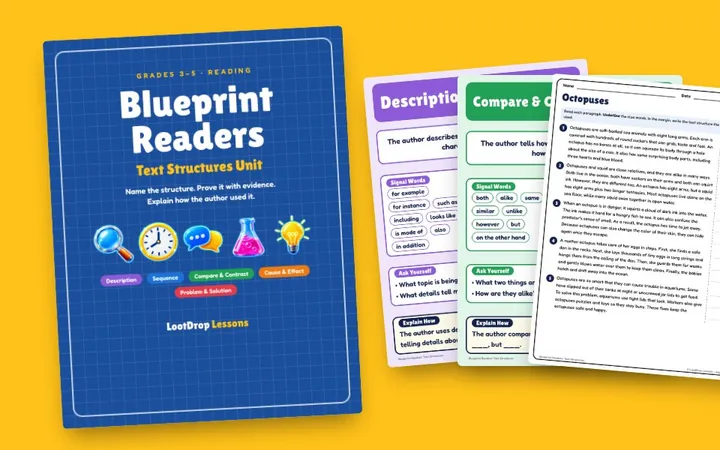
When you're ready to check what stuck, the free Text Structures Check-Up has a quick check, five passages and a writing task with answer keys. My Blueprint Readers unit covers all of this: posters, the Five Corners game, six original passages and short constructed response practice where students name, prove and explain. Why Though?! has twelve high-interest science passages that make great extra practice, and there's a Text Structures anchor chart for your wall. All three are below.


Comments
Questions, tweaks that worked in your room, ideas for other teachers: share them here.
Loading comments...