
Nonfiction Magazine Project: Text Structures and Text Features (Grades 3 to 6)
 Andy Navarro · Reading Skills & Phonics · · 3 min read
Wrap up your nonfiction unit with a student magazine project. How to plan it, which text structures and features to require, a two-week schedule, rubrics and publishing ideas.
After weeks of identifying text structures and text features in other people's writing, students are ready for the real test: using them. A student-made magazine is my favorite way to end a nonfiction unit. Every student becomes the editor-in-chief of a magazine about one topic they love, and they have to use every structure and several features to build it.
Why a magazine works
Magazines are made of short articles, so students don't have to write one long report. Each article can use a different text structure, and magazines naturally include pictures, captions, sidebars and diagrams. Students also have real models: bring in a few kids' magazines and let them flip through before they start.
The basic assignment
- Choose one main topic. Sea turtles, volcanoes, soccer, the Olympics. Broad enough for five articles, narrow enough to research.
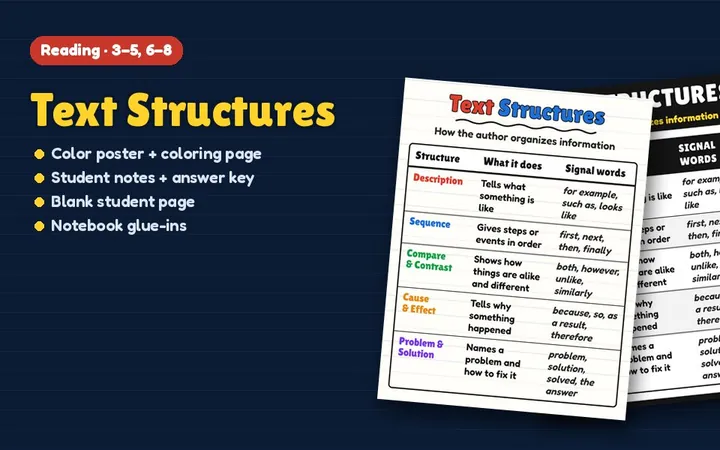
- Plan five articles, each with a different subtopic and a different text structure: description, compare and contrast, sequence, problem and solution, and cause and effect.
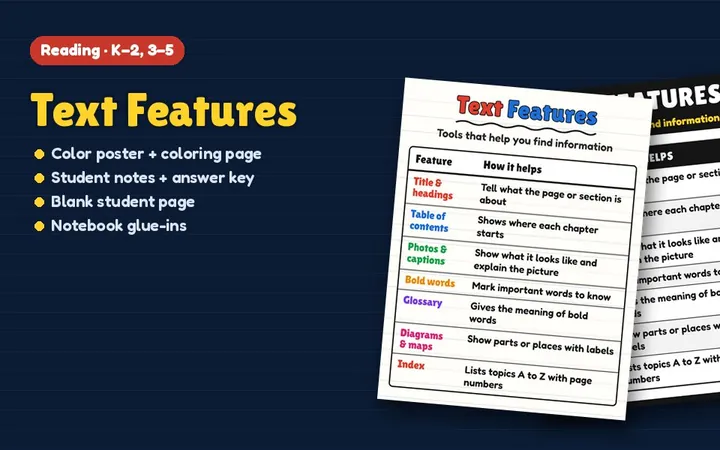
- Add text features: pictures with captions, a diagram, map, timeline or chart, a glossary, bold or italic words and a sidebar.
- Write a reader quiz so classmates can test what they learned.
- Design a cover and table of contents.
Matching structures to subtopics
Students often get stuck choosing which subtopic fits which structure. A sample helps. For a sea turtle magazine:
- Description: what sea turtles look like and how their bodies help them swim
- Compare and contrast: leatherback vs. green sea turtles
- Sequence: a hatchling's journey from nest to ocean
- Problem and solution: plastic in the ocean and how people are helping
- Cause and effect: how sand temperature affects whether hatchlings are male or female
Plan with graphic organizers
Each structure has a matching organizer: a web for description, a Venn diagram for compare and contrast, a flow chart for sequence, a problem-solution chart and a cause-effect map. Requiring the organizer before the draft keeps each article organized around its structure instead of turning into a list of random facts.
A two-week schedule
- Day 1: assignment, topic and subtopics
- Days 2–4: research and organizers
- Days 5–7: one draft a day
- Day 8: text features and the reader quiz
- Day 9: cover, contents and peer editing
- Day 10: publish and hold a "newsstand" gallery walk
Grading it fairly
Decide up front what you're grading. A points rubric (for example, 50 points for articles, 30 for features, 10 for the quiz and 10 for presentation) is quick to score. A process rubric that also scores organizers and drafts rewards students who work hard but write slowly. Share the rubric on day one so students know what "done" looks like.
Publishing ideas
- Fold 11 × 17 paper into a booklet or staple sheets together.
- Build it in Google Slides with a slide for each page.
- Set up a classroom magazine rack and let students check out each other's issues.
- Have readers take the quiz at the back. Writers love seeing classmates answer their questions.
Make it fit your class
For younger or struggling writers, require three structures and four features. For students who need a challenge, add an interview sidebar or a second visual. The project scales well because every student works on their own topic at their own level.
The resources below include a free text structures and features magazine project with an assignment sheet, three rubrics, five planning organizers, draft pages and a digital version, plus text features and text structure anchor charts.
Questions teachers ask
What are the five nonfiction text structures?
The five common text structures are description, compare and contrast, sequence (or chronological order), problem and solution, and cause and effect.
What text features should students include in a nonfiction project?
Good choices are pictures with captions, a diagram, map, timeline or chart, a glossary, headings, bold or italic words for key terms and a sidebar with a fun fact.
How long does a nonfiction magazine project take?
About two weeks of class time works well: a few days to plan and research, a few days to draft articles and a few days to add features, edit and publish.



Comments
Questions, tweaks that worked in your room, ideas for other teachers: share them here.
Loading comments...