
Teaching Transition Words and Sentences in 3rd to 5th Grade (So Writing Flows)
 Andy Navarro · Writing & Grammar · · 3 min read
Help students move past "first, next, last." Teach transition words by job, practice transition sentences between paragraphs, and fix choppy writing.
Upper elementary writers usually know three transitions: first, next and last. Their paragraphs make sense on their own but feel like a stack of separate notes. Transitions are what turn those notes into writing that flows.
Here's how I teach transitions so students choose them on purpose instead of sprinkling them in.
Teach transitions by job
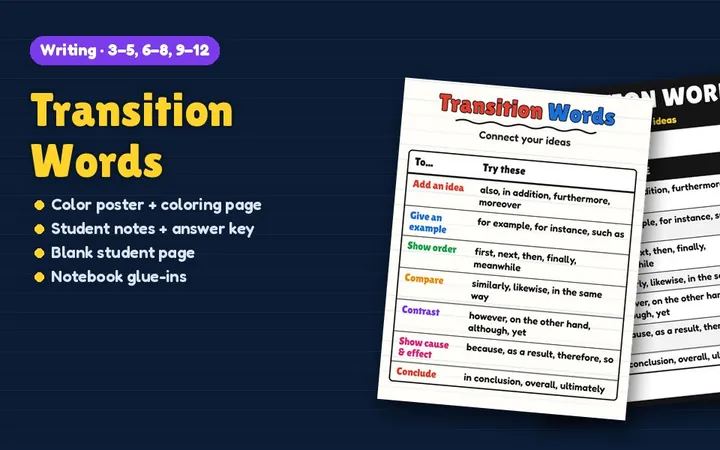
A long list of transition words doesn't help much. Sort them by what they do, so students pick the one that fits:
- Order: first, next, then, after that, finally
- Adding on: also, in addition, another reason, furthermore
- Giving an example: for example, for instance, such as
- Showing a contrast: however, on the other hand, but, even though
- Cause and effect: because, as a result, so, therefore
- Wrapping up: in conclusion, overall, all in all, in the end
Put this on an anchor chart and add to it all year as students find new transitions in their reading.
Words vs. sentences
A transition word links ideas inside a paragraph. A transition sentence links two paragraphs. It looks back at the idea that just ended and points forward to the next one: "Dogs make loyal pets, but they aren't the only animals that do. Cats can be just as loving."
That back-and-forward move is the skill to practice. Students can call it a bridge: one side touches the old idea, the other side touches the new one.
Activities that build the habit
- Choppy to smooth. Give a paragraph with no transitions. Students add three and read both versions aloud to hear the difference.
- Pick the job. Give two sentences and ask which kind of transition fits between them: adding on, contrast or example.
- Bridge sentences. Give the end of one paragraph and the start of the next. Students write the transition sentence that connects them.
- Transition hunt. In a mentor text or their independent reading book, students find five transitions and sort them by job.
- Revise your own. Students highlight every transition in their latest draft. If a paragraph has none, or the same one three times, that's the revision goal.
Common problems to fix
- Overusing one transition. "Also, also, also." Point students to the anchor chart for other words with the same job.
- The wrong job. "However" used to add an idea instead of contrast it. Ask: is this the same idea or the opposite?
- Transitions everywhere. Not every sentence needs one. Too many sounds as choppy as none.
Connect it to every kind of writing
Narratives need time-order transitions. Opinion writing needs adding-on and example transitions. Informational writing uses all of them. Point out which jobs matter most for each genre so transitions become part of planning, not an afterthought.
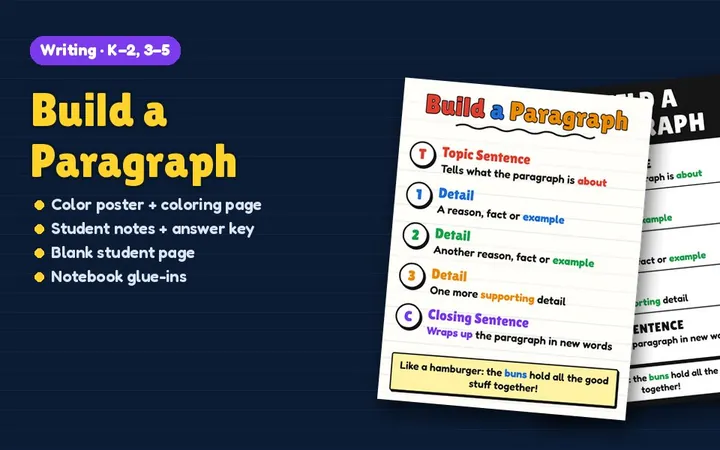
The resources below include transition sentence practice pages and anchor charts for transitions and paragraph structure.
Questions teachers ask
What are transition words?
Transition words connect ideas in writing, like first, also, for example, however, as a result and in conclusion. Each one shows how two ideas relate to each other.
What is a transition sentence?
A transition sentence connects two paragraphs. It looks back at the idea that just ended and introduces the next one, so the writing flows from one section to the next.
How do you teach transitions in 3rd grade?
Start with order transitions in how-to and narrative writing, then sort transitions by their job on an anchor chart. Practice by adding transitions to choppy paragraphs and reading both versions aloud.



Comments
Questions, tweaks that worked in your room, ideas for other teachers: share them here.
Loading comments...