

Teaching Inference with Pictures: Literal vs. Inferential Observations in 2nd to 5th Grade
 Andy Navarro · Reading Skills & Phonics · · 4 min read
Use pictures to teach inference before text. A simple I see + I know = I infer routine, anchor chart ideas and activities that help 2nd to 5th graders tell observations from inferences.
Inference is one of the hardest reading skills to teach because it happens inside a student's head. When we start with a paragraph, kids have to decode, understand and infer all at once, and the struggling readers never get to the thinking part.
That's why I teach inference with pictures first. A good picture takes the reading load away, so every student can practice the actual move: notice what's really there, add what you already know and reach a smart conclusion.
Start with literal vs. inferential
Before students can infer, they need to know what an observation is. I use two simple definitions:
- Observation (literal): something you can see, hear or point to. Everyone looking at the picture would agree.
- Inference: a smart guess that goes beyond the picture. You use clues plus what you already know, and it could be wrong.
The quickest check I've found: "Can you point to it?" If yes, it's an observation. If you had to figure it out, it's an inference.
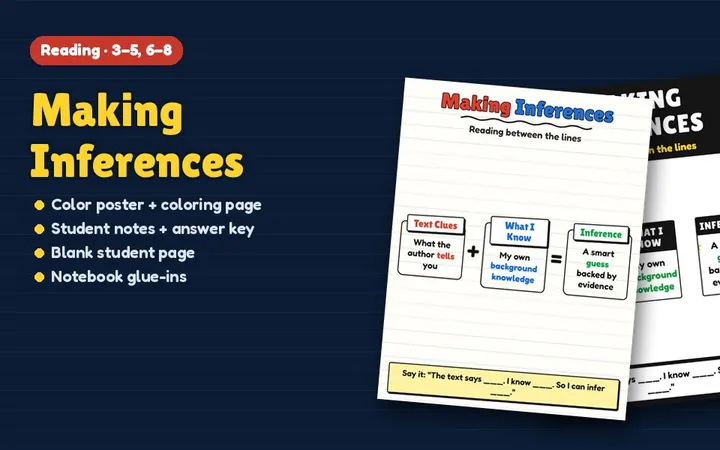
The formula: I see + I know = I infer
Students need a routine they can use every time. This one works from second grade up:
- I see: list two or three clues that are really in the picture.
- I know: what do you already know about things like this from your own life?
- I infer: put them together. What is probably happening, or what just happened?
Example: I see a girl holding an umbrella and wearing rain boots. I know people use umbrellas when it rains. So I infer it's raining and she wants to stay dry.
Build a class anchor chart with sticky notes
Project one picture for the whole class. Give each student a yellow sticky note and have them write one observation. Stick them in a column on chart paper titled "Literal vs. Inferential Thinking." Then go through them together and add a pink sticky note beside each one with an inference it supports.
Two things happen. Students see that one observation can lead to an inference, and they catch each other when an "observation" is really a guess. Keep the chart up and point back to it when you move to text.
Activities that work
- Clue photo cards. Give partners a picture card and a three-column chart: I see, I know, I infer. They fill it in, then compare with another pair.
- Observation or inference sort. Write 12 to 16 statements about the same pictures on strips. Students sort them into two columns. This is where the "can you point to it?" test really sticks.
- Mystery bag. Bring in a bag with three objects that belong to one person (a whistle, a stopwatch and a clipboard). Students infer who it belongs to and explain their clues.
- Draw a clue picture. Students draw a scene with clues in it but don't explain it. A partner writes what they see and what they infer. If the partner gets it, the artist planted good clues.
Accept more than one answer
A picture of a boy packing a lunch box could mean he's going to school, a field trip or a picnic. All three are reasonable. Instead of hunting for one right answer, ask, "What clue makes you think that?" If a student can point to evidence, the inference counts. If they can't, they're guessing, and that's the conversation to have.
Move from pictures to text
After a week of pictures, use the same routine with a short paragraph. Replace "I see" with "The text says." Students will recognize the thinking right away because they've already practiced it. Picture books with strong illustrations are a nice bridge, since students can use both the words and the pictures as clues.
Language to listen for
Inference words sound like probably, maybe, I think, it must be and because. Observation words sound like I see, there is and she is holding. When a student says "She's sad" about a picture, ask, "Is that something you can point to, or something you figured out?" That one question does a lot of teaching.
The resources below include a free picture-based inference activity with clue photo cards, a sticky-note anchor chart model, an observation vs. inference sort and a digital version, plus inference anchor charts.
Questions teachers ask
What is the difference between an observation and an inference?
An observation is something you can see or point to, and everyone would agree it's there. An inference goes beyond what you can see: it's a conclusion you reach by combining clues with what you already know.
Why teach inference with pictures first?
Pictures remove the reading load, so all students, including struggling readers and English learners, can practice the thinking behind inference before applying it to text.
What grade do students learn to make inferences?
Students start making simple inferences in kindergarten and first grade, and inference becomes a major reading standard in grades 2 through 5, when students must support inferences with evidence from the text.



Comments
Questions, tweaks that worked in your room, ideas for other teachers: share them here.
Loading comments...