Dream Builders: MLK Day Reading, Writing + Kindness Activities (Grades K–5)
$4

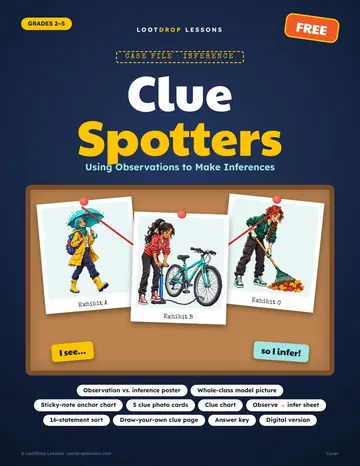
Activities & projects · Grades 2–5 · PDF + Google Slides · Free
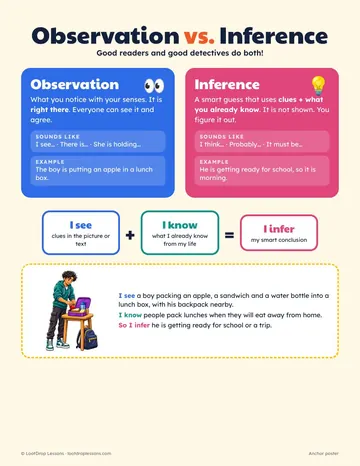
Teaching inference starts with seeing the difference between what is really there and what we figure out. Clue Spotters uses pictures to take the reading load away, so students can focus on the thinking move: I see + I know = I infer.
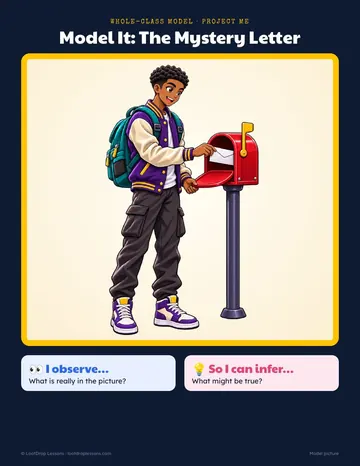
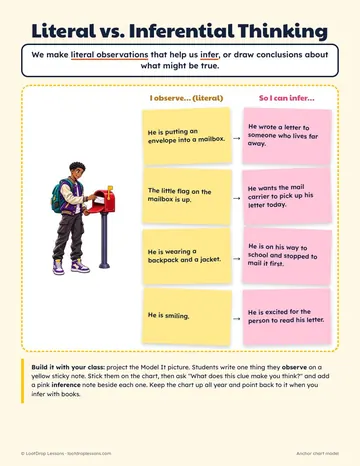
Start whole-class with the Model It picture and build a Literal vs. Inferential Thinking anchor chart with yellow observation notes and pink inference notes. Then students study five clue photos, from a rainy walk to a flat bike tire and a pile of autumn leaves, and record their observations, background knowledge and inferences on the Clue Chart.
Students keep practicing on the Observe It, Infer It sheet, sort 16 statements as observation or inference (write-in or cut-and-glue), and finish by drawing their own clue picture for a partner to solve. A ready-to-go lesson plan, answer keys and a digital version with type-in boxes are included.
Topics: anchor, chart, poster, visual, centers, stations, slides, powerpoint, presentation, elementary, grade, 2, 3, 4, 5, free
Built for grades 2–5 (elementary ELA). Format: PDF + Google Slides. Free to download. Ways to use it: whole-class lesson; small-group reading.
Grades 2–5, so it fits elementary ELA classes.
PDF + Google Slides.
It is free.
Lesson plan + teacher notes, Observation vs. inference poster, Whole-class model picture, Sticky-note anchor chart model, 5 clue photo cards, I See + I Know = I Infer chart, Observe It, Infer It sheet, 16-statement sort + cut-and-glue mat.
Yes, an answer key is included.
Yes. The digital version works in Google Slides or PowerPoint, so students can type their answers and you can assign it in Google Classroom.
Popular ways to use it: Whole-class lesson; Small-group reading; Reading center; Google Classroom.