
Point of View Activities for 3rd to 6th Grade: Teaching Perspective with Pictures
 Andy Navarro · Reading Skills & Phonics · · 3 min read
Point of view and perspective activities for grades 3–6: a picture placemat, first vs. third person practice, fractured fairy tales and discussion questions.
"Point of view" means two different things in upper elementary, and students mix them up. Sometimes it means who is telling the story (first or third person). Sometimes it means how a character thinks or feels about what's happening (perspective). Both matter, and both are easier to teach with pictures than with text.
Separate the two meanings
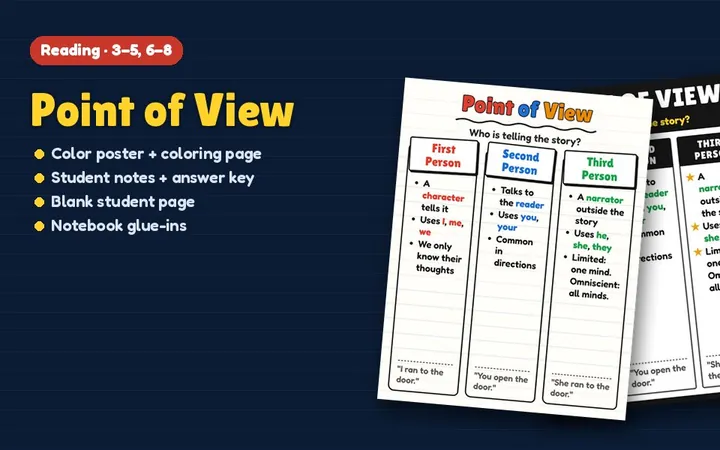
- Narrator's point of view: who tells the story. First person uses I and we. Third person uses he, she and they.
- Character perspective: how a character sees, thinks and feels about events. Two characters in the same scene can have completely different perspectives.
I teach them in that order, then show how they connect: a first-person narrator only knows their own perspective.
In 5th and 6th grade, add the three kinds of third person: limited (the narrator knows one character's thoughts), omniscient (the narrator knows everyone's thoughts) and objective (the narrator only reports what can be seen and heard).
Why pictures work so well
Show a picture of a boy whose kite is stuck in a tree while his little sister laughs. Ask: How does the boy feel? How does the sister feel? How does the tree feel? (Kids love that one.) In 30 seconds, students see that the same moment looks different depending on whose eyes you use. No reading required.
Picture placemat activity
Put a picture in the middle of a large sheet of paper with a section for each student in a group of four. First the group lists everyone who could tell the story: a person in the picture, an animal, even an object. Then each student writes about the moment from a different point of view and signs their section. Then they read their pieces aloud and compare. The collaboration makes it feel like a game, and every student writes.
First person vs. third person practice
- Pronoun hunt. Give students short paragraphs and have them circle the pronouns outside of dialogue. That tells them who is narrating.
- Rewrite it. Students rewrite a third-person paragraph in first person from one character's view. They'll notice what they can and can't know.
- Two diaries. Students write two short diary entries about the same event from two characters, like the wolf and the third little pig.
Read fractured fairy tales
Retold fairy tales from the villain's point of view are perfect for this skill. Students already know the original, so they can focus on how the story changes when someone else tells it. Ask: What did this narrator leave out? What did they want us to believe?
Discussion questions that work with any text
- Who is telling this story? How do you know?
- How would this scene be different if another character told it?
- What does this character know that another character doesn't?
- Do you trust this narrator? Why or why not?
Connect it to empathy
Point of view is a reading skill, but it's also a life skill. When students practice seeing a scene through someone else's eyes, they get better at understanding classmates, too. I often connect these lessons to class meetings: "How might this look from the other person's side?"
The resources below include free point of view picture placemats with two versions and a digital version, plus a point of view anchor chart.
Questions teachers ask
What is the difference between point of view and perspective?
Point of view usually describes who narrates a story (first or third person). Perspective is how a particular character thinks and feels about events. Two characters can share a scene but have different perspectives.
How do you teach first and third person point of view?
Have students look at the pronouns the narrator uses outside of dialogue. "I" and "we" signal first person; "he," "she" and "they" signal third person. Rewriting a paragraph from one point of view to another makes the difference clear.
What grade teaches point of view?
Students compare points of view in 3rd grade, distinguish first and third person in 4th grade, and explain how a narrator's point of view affects how events are described in 5th and 6th grade.



Comments
Questions, tweaks that worked in your room, ideas for other teachers: share them here.
Loading comments...