
Fraction Misconceptions in 3rd to 5th Grade: What to Look for and How to Check Understanding
 Andy Navarro · Elementary Math · · 3 min read
The most common fraction misconceptions in grades 3 to 5, from "bigger denominator means bigger fraction" to unequal parts, and quick ways to assess and reteach them.
Fractions are the first time many students find out that math rules they trusted don't always work. Bigger numbers don't always mean bigger amounts, and the same amount can have many names. That's why fraction misconceptions are so common, and why it's worth checking for them before they turn into habits.
Here are the ones I see most and how I catch them.
1. "The parts don't have to be equal"
Students will call a shape cut into four unequal pieces "fourths." Fractions only work with equal parts. Show a few shapes split into equal and unequal pieces and ask which ones show fourths. A student who can explain why the unequal one doesn't count understands what a fraction is.
2. "A bigger denominator means a bigger fraction"
Students see 1/8 and 1/4 and think 1/8 is bigger because 8 is bigger than 4. Pizza helps: would you rather have one slice of a pizza cut into 4 pieces or 8? The more pieces, the smaller each one. Fraction strips side by side make this obvious.
3. "Fractions are only parts of a shape"
Fractions also describe parts of a set (3 of 5 marbles are red) and points on a number line. Students who only know pizzas struggle with the number line. Put fractions on number lines early, and ask "how far from 0?" instead of "how many pieces?"
4. "Equivalent fractions are different amounts"
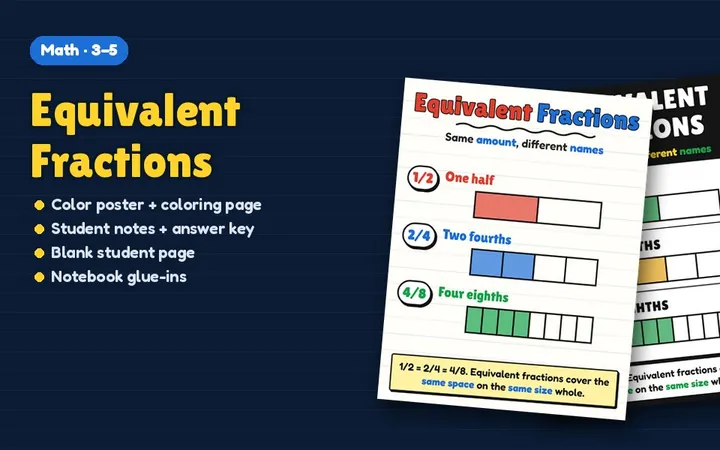
1/2, 2/4 and 4/8 look different, so students think they're different sizes. Fold paper strips: fold one in half, another in fourths, another in eighths, and line them up. Same length, different names. Then show the multiply-by-the-same-number rule once students have seen why it works.
5. "Compare by looking at one number"
To compare 3/4 and 5/8, students often compare just the numerators or just the denominators. Teach benchmark thinking first: is each fraction more or less than one half? 3/4 is a quarter past a half, 5/8 is only an eighth past. Then teach common denominators for trickier pairs.
6. "Add the tops and add the bottoms"
1/4 + 1/4 = 2/8? It's the most common addition mistake. Ask students to model it: one fourth plus one fourth is two fourths, or one half. The denominator names the size of the pieces, and adding more of the same piece doesn't change their size.
How to check understanding quickly
- Explain, don't just answer. "Which is bigger, 1/6 or 1/3? How do you know?" One sentence tells you more than ten multiple-choice questions.
- Mix representations. Use shapes, sets and number lines on the same check so you see whether understanding transfers.
- Short and frequent. A one-page check-up after each part of the unit catches problems early. Break a longer assessment into pages you can give on different days.
- Sort the mistakes. After a check, group student work by the misconception it shows, not by the score. Then reteach to each group.
Reteach with models, not rules
When a student has a misconception, a rule ("the bigger the denominator, the smaller the piece") rarely fixes it alone. Go back to fraction strips, drawings and number lines until the student can show why. Rules work best after understanding, not instead of it.
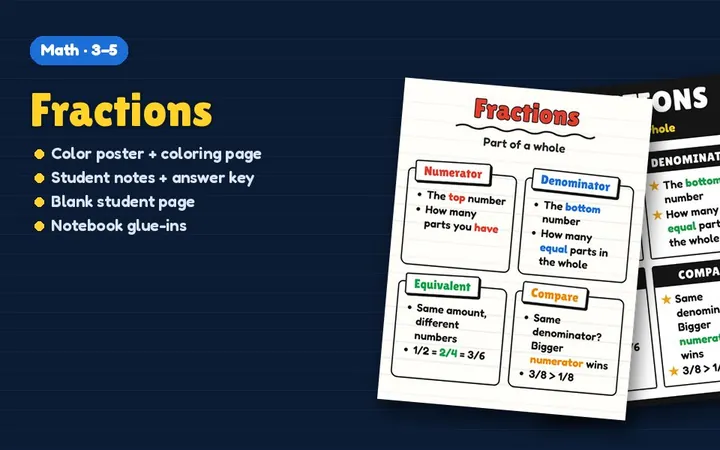
The resources below include a free four-page fractions check-up with an answer key and digital version, plus fraction anchor charts for equivalent fractions, comparing fractions and fractions on a number line.
Questions teachers ask
What is the most common fraction misconception?
One of the most common is thinking a fraction with a bigger denominator is bigger, such as believing 1/8 is greater than 1/4. Students need to see that more pieces means smaller pieces.
How do you assess fraction understanding?
Ask students to explain their thinking, use several representations (shapes, sets and number lines) and give short check-ups often so you can reteach before misconceptions stick.
What fraction skills are taught in 3rd grade?
Third graders learn unit fractions, fractions on a number line, equivalent fractions with simple models and comparing fractions with the same numerator or the same denominator.




Comments
Questions, tweaks that worked in your room, ideas for other teachers: share them here.
Loading comments...