Personal Narrative Unit: Family Story / School Story
$12

Lessons · Grades 11–12, Dual credit · PDF + Google Slides · $4.99
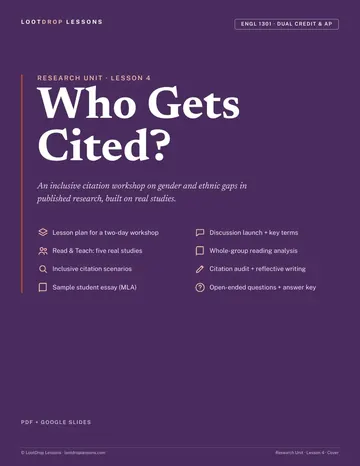
Who Gets Cited? is Lesson 4 of the ENGL 1301 Research Unit. It is a two-day workshop that helps dual-credit and AP students see whose voices show up in published research, whose are missing, and what a student researcher can do about it.
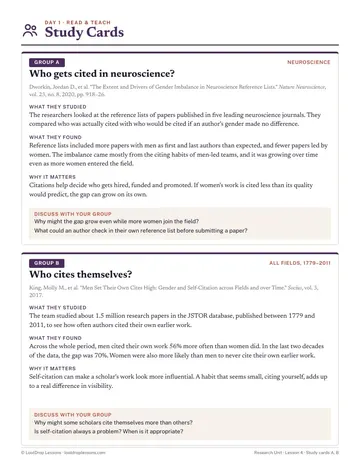
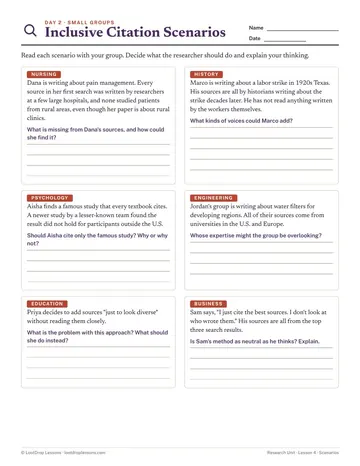
Student groups read and teach five real peer-reviewed studies, summarized on study cards with full citations: gender imbalance in neuroscience reference lists, the gender gap in self-citation across 1.5 million papers, the gender citation gap in international relations, racial gaps in communication journals, and intersectional gaps in U.S. science. The class then analyzes patterns, causes and consequences together and works through six inclusive citation scenarios from nursing, history, psychology, engineering, education and business.
Students finish by auditing the sources in their own Lesson 2 annotated bibliography and writing a reflection on gender, ethnicity and other gaps. A model MLA essay shows inclusive citation in action, including a counterargument, and the open-ended questions invite real disagreement. The lesson stays focused on evidence and research habits, not quotas.
Topics: ecr, essay, writing, journal, prompts, bell, ringer, slides, powerpoint, presentation, high, school, grade, 11, 12, college, dual, credit
How to write an AI and academic honesty policy for your syllabus: strict, balanced and open sample statements, an AI use scale for assignments, disclosure and citation, and a fair process when you suspect misuse.
How to teach The Canterbury Tales as satire in AP Literature and dual credit: medieval background, reading the General Prologue in Middle English beside a modern paraphrase, SPACECAT, pilgrim portraits and an AP-style essay.
Built for grades 11–12, Dual credit (high school ELA). Format: PDF + Google Slides. $4.99 on its own, or included with All-Access. Ways to use it: ENGL 1301 / dual-credit research units; AP Language and AP Seminar.
Grades 11–12, Dual credit, so it fits high school ELA classes.
PDF + Google Slides.
$4.99, or free with an All-Access membership.
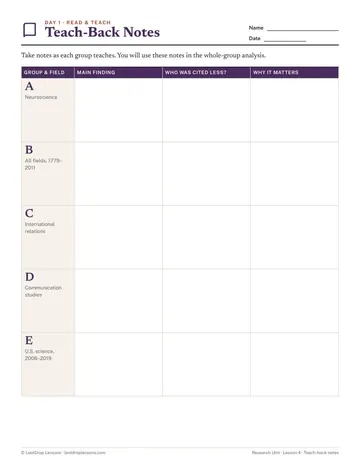
Two-day lesson plan with timeline, Discussion launch + key terms, Read & Teach study cards on five real studies, Teach-back notes + whole-group synthesis chart, Six inclusive citation scenarios, Inclusive citation toolkit, Citation audit + reflective writing, Model student essay with MLA Works Cited.
Yes, an answer key is included.
Yes. The digital version works in Google Slides or PowerPoint, so students can type their answers and you can assign it in Google Classroom.
Popular ways to use it: ENGL 1301 / dual-credit research units; AP Language and AP Seminar; Before the final research paper; Library and information literacy sessions.