Five Short Constructed Responses: The Scarlet Ibis
$2.50

Back to school · Grades 6–12 · PDF + interactive PowerPoint · $4
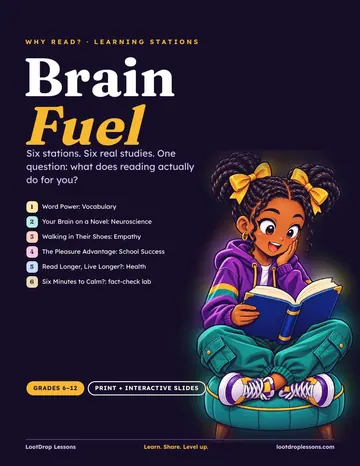
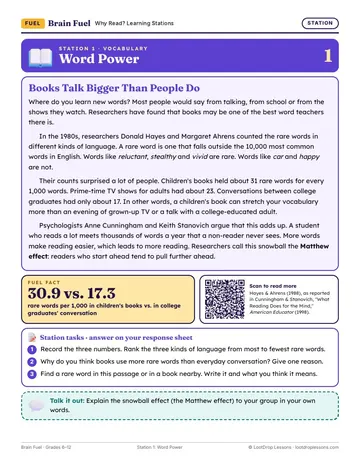
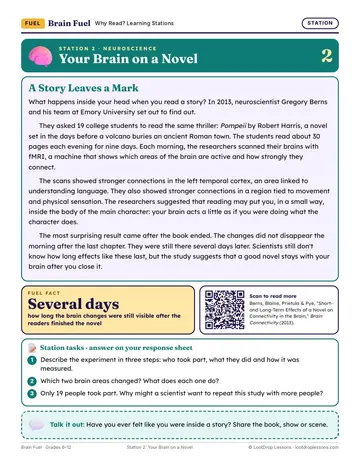
Students don't need another lecture about why reading matters. They need evidence. Brain Fuel sets up six learning stations around the room, each with a short informational passage built on a real, cited study and a QR code to a readable article about it.
Stations cover Word Power (why books hold more rare words than TV or conversation), Your Brain on a Novel (an Emory brain-scan study), Walking in Their Shoes (a famous empathy finding and the bigger study that tested it), The Pleasure Advantage (reading for fun and progress in school), Read Longer, Live Longer? (a Yale study of 3,635 adults) and Six Minutes to Calm? (a fact-check lab on a viral statistic).
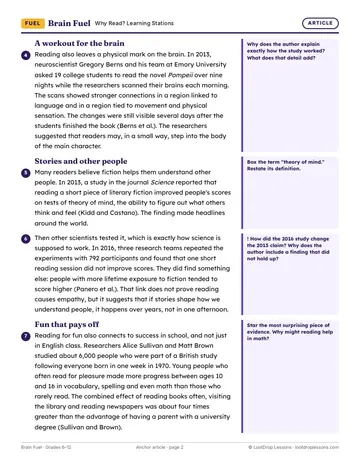
A four-page anchor article, "Fuel for the Mind: Why Reading Still Matters," pulls the research together in one original nonfiction text with a works cited list. The article runs down the left side of the page with an annotation margin on the right, where a prompt beside every paragraph guides students to find claims, evidence, counterclaims and the limits of each study. A one-page article check (multiple choice and short response) and a teacher key with annotation look-fors are included.
At each station students record the key number, answer three questions and talk it over. They open with an anticipation guide, close by ranking the evidence and writing a claim-evidence-reasoning paragraph, and make a personal reading plan. The interactive PowerPoint has a clickable station menu and type-in answer boxes beside every station, and it works in Google Slides.
Topics: journal, writing, prompts, bell, ringer, math, literature, reading, ela, intervention, rti, mtss, sped, centers, stations, slides, powerpoint, presentation, middle, school, high, grade, 6, 7, 8
Built for grades 6–12 (middle school and high school ELA). Format: PDF + interactive PowerPoint. $4 on its own, or included with All-Access. Ways to use it: first weeks of school; launching independent reading or literature circles.
Grades 6–12, so it fits middle school and high school ELA classes.
PDF + interactive PowerPoint. You can edit it to fit your class.
$4, or free with an All-Access membership.
Teacher guide + answer guide, Kickoff anticipation guide (before + after), 6 informational text stations with QR links to the research, Response sheet (2 pages), Anchor article with sources: text on the left, annotation margin on the right (4 pages), Article check + key with annotation look-fors, Rank the Evidence + CER paragraph, My Reading Plan + 28-day tracker.
Popular ways to use it: First weeks of school; Launching independent reading or literature circles; Informational text + evaluating evidence; Grades 6–12.