

Place Value Activities for 2nd to 5th Grade: Place vs. Value, Expanded Form and Games
 Andy Navarro · Elementary Math · · 4 min read · Updated
Place value activities that build real understanding in grades 2–5: base-ten blocks, place vs. value, expanded form, number puzzles and games.
Place value is the foundation for almost everything else in elementary math. Adding with regrouping, multiplying big numbers, rounding, decimals: all of it depends on understanding that the 4 in 472 is worth 400, not 4. When students struggle with multi-digit math later, a shaky understanding of place value is often the real problem.
Here are place value activities that build real understanding from second grade through fifth grade.
What students learn by grade
- 2nd grade: three-digit numbers. Hundreds, tens and ones, and that 100 is a bundle of ten tens (CCSS 2.NBT.A.1, TEKS 2.2A).
- 3rd grade: place value for rounding and adding and subtracting within 1,000.
- 4th grade: numbers up to 1,000,000. Each place is ten times the place to its right (CCSS 4.NBT.A.1). Read and write numbers in standard form, word form and expanded form.
- 5th grade: place value extends to decimals, to the thousandths.
Start concrete with base-ten blocks
Before students write numbers in charts, they need to see and touch them. Base-ten blocks (unit cubes, ten rods and hundred flats) make the idea of bundling visible. Have students build numbers with blocks, then trade 10 ones for a ten and 10 tens for a hundred.
A key activity: build the same number different ways. 135 can be 1 hundred, 3 tens and 5 ones, or 13 tens and 5 ones. Understanding that both are correct is exactly what students need later for regrouping in subtraction.
Place vs. value: the big idea
This is the distinction students mix up most:
- Place is where the digit lives. In 472, the 7 is in the tens place.
- Value is what the digit is worth. In 472, the 7 is worth 70.
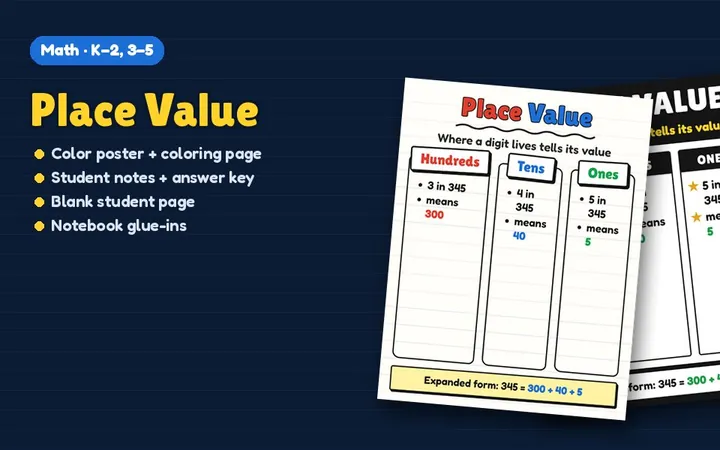
Teach the two words with a simple pairing: "The 7 is in the tens place. Its value is 70." Have students say both every time. A poster or anchor chart with this example on the wall saves you from re-teaching it all year.
Three forms of a number
Students should be able to move between:
- Standard form: 472
- Expanded form: 400 + 70 + 2
- Word form: four hundred seventy-two
Watch for numbers with zeros, like 604 or 120,975. Zeros cause the most errors in every form, so include them often. In expanded form, students can skip the zero place: 604 = 600 + 4.
Place value activities and games
Place value puzzles
Give students a set of clues to find a number: "The 9 is in the hundreds place. The value of the 8 is 80." Students have to read carefully and use both place and value to find the answer. Puzzles where every clue has exactly one right answer let students check their own work.
Build the greatest number
Students draw digit cards and arrange them to make the greatest and least possible numbers. Then they explain their thinking: why does the biggest digit go in the hundreds place? It's quick, works with any number of digits, and makes a great warm-up.
Place value war
Each partner draws three (or six) cards and builds the greatest number they can. Students read their numbers aloud, and the bigger number wins the round. Reading the numbers aloud practices word form without a worksheet.
Mystery number riddles
"I have 4 hundreds, 0 tens and 7 ones. What number am I?" Students solve riddles and then write their own for a partner. Writing riddles takes deeper understanding than solving them.
Number of the day
Each morning, write one number on the board. Students write it in expanded form and word form, find the value of a given digit, and say 10 more, 10 less, 100 more and 100 less. Five minutes a day adds up to a lot of practice.
Common mistakes to watch for
- Writing four hundred seven as 4007 instead of 407. Have students build it with blocks or a place value chart.
- Saying the value of the 7 in 472 is 7. Keep pushing the place vs. value language.
- Forgetting commas in big numbers. Commas separate groups of three digits and help students read big numbers correctly.
Questions teachers ask
What is the difference between place and value?
Place is the position of a digit, like the tens place. Value is how much the digit is worth in that place. In 347, the 4 is in the tens place and its value is 40.
What are the three forms of a number?
Standard form (347), expanded form (300 + 40 + 7) and word form (three hundred forty-seven). Students should move between all three.
What is a good way to teach place value?
Start concrete with base-ten blocks, then move to pictures and numbers. Games that build, compare and round numbers help the skill stick.
Place Value Park is a free activity where students solve place value clues to find each spot on a park map, then glue on the swings, slide and pond. It has a 3-digit level and a 6-digit level, a place vs. value poster, practice pages and answer keys. There are also place value anchor charts for the concept and the vocabulary. They're below.




Comments
Questions, tweaks that worked in your room, ideas for other teachers: share them here.
Loading comments...