
How to Teach Elapsed Time in 3rd and 4th Grade: Number Lines, T-Charts and Games
 Andy Navarro · Elementary Math · · 3 min read
Elapsed time doesn't have to be the unit students dread. A step-by-step plan for teaching elapsed time with open number lines, T-charts and hands-on games.
Elapsed time is one of those topics that looks simple until you teach it. Students who can read a clock still get stuck when the start time is 9:45 and the end time is 11:20. The problem usually isn't math. It's that time doesn't work like the base-ten numbers they're used to.
Here's the order I teach it in and the tools that help most.
Start by checking clock reading
Before elapsed time, make sure students can tell time to the nearest minute on an analog clock. If they're shaky, spend a few days there first. Elapsed time on top of shaky clock reading is a recipe for frustration.
Why 60 trips students up
In most of their math, students regroup at 10. Time regroups at 60. That's why a student will subtract 10:15 minus 9:50 and get 65 minutes, or count 9:55, 9:56... and then write 9:60. Say it out loud early: there are 60 minutes in an hour, so time "rolls over" at 60, not 100.
Strategy 1: the open number line
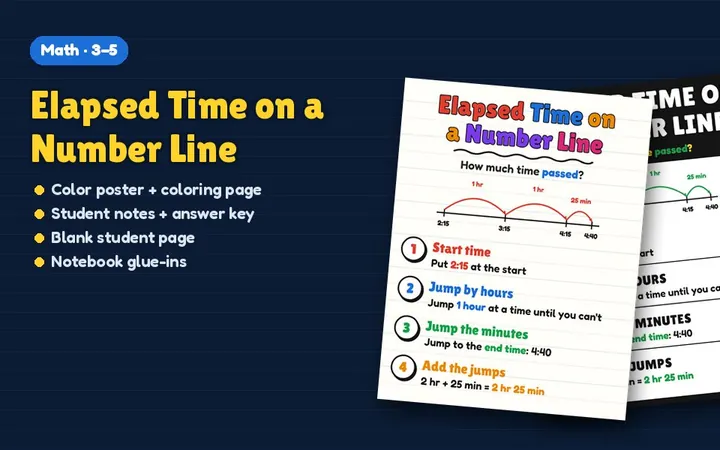
The open number line is the most reliable strategy for most students:
- Write the start time on the left and the end time on the right.
- Jump to the next friendly time (the next hour or half hour) and label the jump.
- Jump by whole hours as far as you can.
- Jump the remaining minutes to the end time.
- Add up the jumps.
From 9:45 to 11:20: jump 15 minutes to 10:00, 1 hour to 11:00, then 20 minutes to 11:20. Total: 1 hour 35 minutes. Students can see every step, and mistakes are easy to spot.
Strategy 2: the T-chart
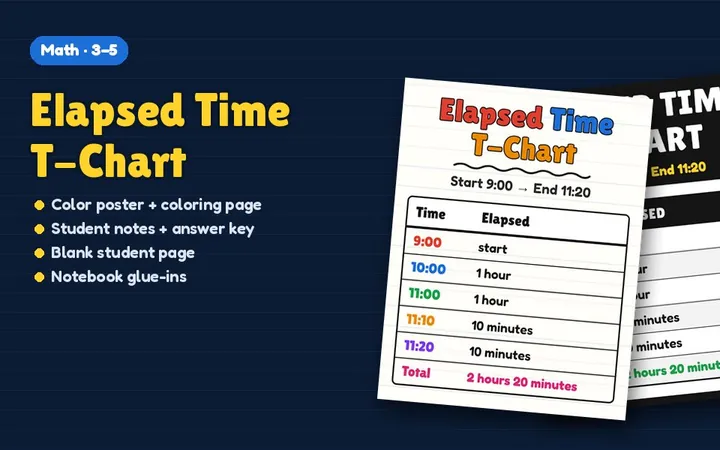
Some students prefer counting in a T-chart: start time on one side, elapsed time on the other, adding hours or chunks of minutes row by row until they reach the end time. It works especially well for finding a start or end time when the elapsed time is given.
The three kinds of elapsed time problems
- Find the elapsed time: start and end are given.
- Find the end time: start time and elapsed time are given. Jump forward.
- Find the start time: end time and elapsed time are given. Jump backward.
Teach them in that order. Start-time problems are the hardest, so save them until students are confident with the number line.
Make it hands-on
- Real schedules. Use your class schedule: how long is lunch? How long until dismissal?
- Game boards and block games. Students solve an elapsed time card to earn a move or pull a block. The game gives them lots of reps without feeling like a worksheet.
- Movie and TV times. Give a start time and a show length and ask when it ends.
- Clock manipulatives. Let students move the hands to see the jumps on a real clock.
Common mistakes to watch for
- Regrouping at 100 instead of 60.
- Forgetting to switch from a.m. to p.m. when crossing noon.
- Adding the jumps incorrectly at the end, especially when minutes add up to more than 60.
The resources below include a stacking block elapsed time game with 36 cards and anchor charts for the number line and T-chart strategies.
Questions teachers ask
What grade do students learn elapsed time?
Elapsed time is usually introduced in 3rd grade, with more complex problems, like crossing noon or finding start times, in 4th grade. Standards vary by state.
What is the easiest way to teach elapsed time?
The open number line is the easiest for most students. They jump to the next friendly time, jump whole hours, then jump the remaining minutes and add the jumps.
Why is elapsed time so hard for students?
Time regroups at 60 minutes instead of 10 or 100, so the regrouping students use everywhere else in math doesn't work. Number lines make the 60-minute jumps visible.



Comments
Questions, tweaks that worked in your room, ideas for other teachers: share them here.
Loading comments...