Intro to Short Constructed Responses (SCR)
$5


Worksheets & warm-ups · Grades 6–8 · PDF, 31 pages + digital (Google Slides / PowerPoint) · $6
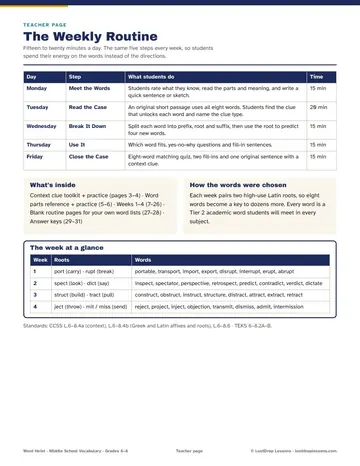
Word Heist gives middle school vocabulary a routine students can run on autopilot: fifteen to twenty minutes a day, the same five steps every week, so their energy goes into the words instead of the directions.
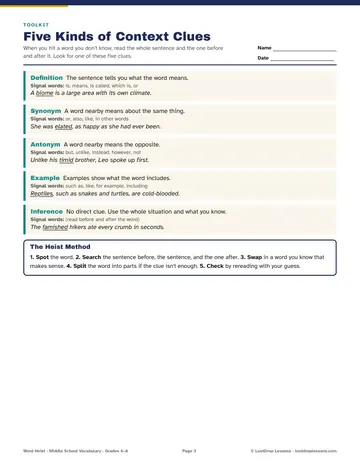
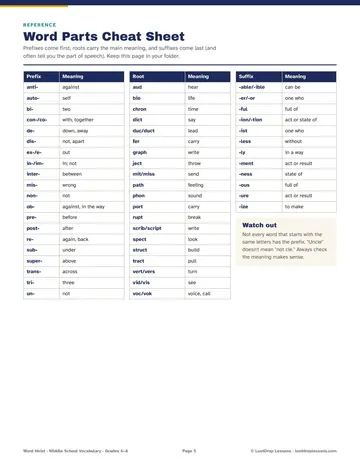
The toolkit teaches five kinds of context clues (definition, synonym, antonym, example and inference) with signal words and a practice page, plus a cheat sheet of 20 prefixes, 20 roots and 12 suffixes and a Build It / Break It page.
Four full weeks pair two high-use Latin roots each (port and rupt, spect and dict, struct and tract, ject and mit/miss) for 32 Tier 2 words. Every week has Meet the Words, an original story that uses all eight words with clues to find, Break It Down with a root detective challenge, Use It practice and a Friday quiz. Blank pages let you run the same routine with any word list, and answer keys cover every week.
Topics: staar, test, prep, review, bilingual, spanish, ell, esl, intervention, rti, mtss, sped, slides, powerpoint, presentation, middle, school, grade, 6, 7, 8
Built for grades 6–8 (middle school ELA). Format: PDF, 31 pages + digital (Google Slides / PowerPoint). $6 on its own, or included with All-Access. Ways to use it: weekly ELA vocabulary; bell work and warm-ups.
Grades 6–8, so it fits middle school ELA classes.
PDF, 31 pages + digital (Google Slides / PowerPoint). You can edit it to fit your class.
$6, or free with an All-Access membership.
Weekly routine teacher page, Context clue toolkit + practice, Word parts cheat sheet (52 prefixes, roots, suffixes), 4 weeks × 5 days of student pages, 4 original passages, 4 Friday quizzes, Blank routine pages + word maps, Answer keys.
Yes, an answer key is included.
Yes. The digital version works in Google Slides or PowerPoint, so students can type their answers and you can assign it in Google Classroom.
Popular ways to use it: Weekly ELA vocabulary; Bell work and warm-ups; Context clue and root word units; STAAR and state test vocabulary review.