Dream Builders: MLK Day Reading, Writing + Kindness Activities (Grades K–5)
$4

Lessons · Grades 4–6 · PDF + Google Slides · $2
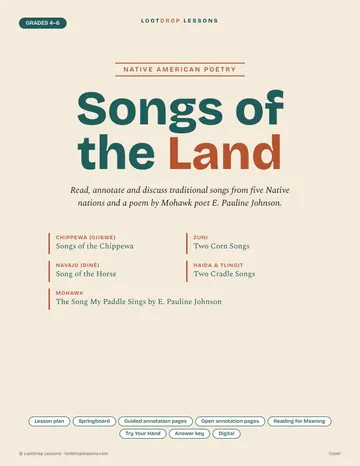
Songs of the Land helps students explain how Native American songs and poetry reflect the cultures and values of the people who created them.
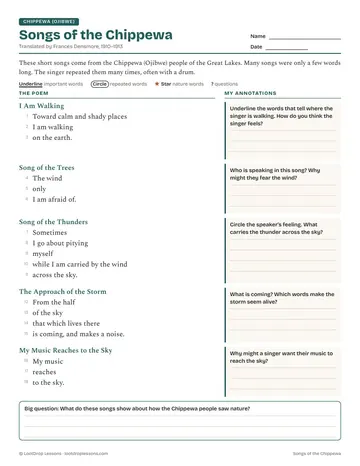
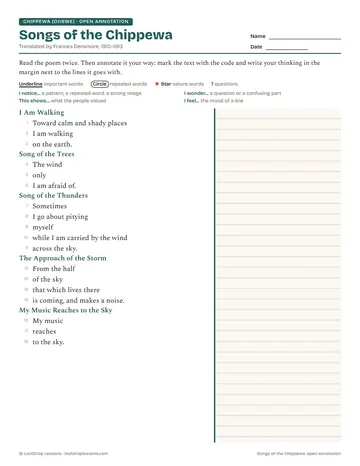
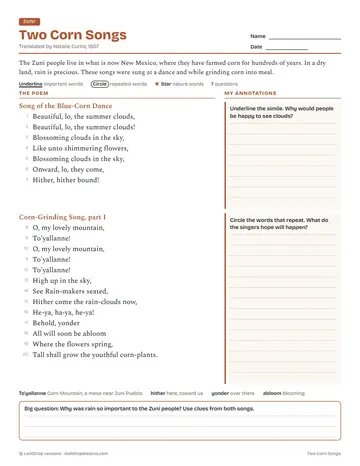
Students read traditional songs from the Chippewa (Ojibwe), Zuni, Navajo, Haida and Tlingit peoples, in public-domain translations, along with "The Song My Paddle Sings" by Mohawk poet E. Pauline Johnson. Every poem comes two ways, both with the poem on the left and line numbers: a guided page with annotation questions on the right, and an open page with a blank margin on the right for students to annotate on their own. A model page shows what strong open annotations look like. Each page has a short introduction to the nation, a glossary and a big question about culture and values.
A springboard reading introduces E. Pauline Johnson. The lesson ends with a Reading for Meaning organizer and a Try Your Hand page where students write their own song-poem. A full answer key with sample annotations and a digital version with type-in boxes are included, plus teaching notes on presenting Native cultures with respect.
Topics: journal, writing, prompts, bell, ringer, literature, reading, ela, slides, powerpoint, presentation, elementary, middle, school, grade, 4, 5, 6
Built for grades 4–6 (elementary and middle school ELA). Format: PDF + Google Slides. $2 on its own, or included with All-Access. Ways to use it: native American Heritage Month; poetry and annotation practice.
Grades 4–6, so it fits elementary and middle school ELA classes.
PDF + Google Slides.
$2, or free with an All-Access membership.
Lesson plan with objective, terms and procedure, Springboard: Meet E. Pauline Johnson, 7 guided annotation pages (poem left, question prompts right), 7 open annotation pages (poem left, blank margin right) + a model page, Reading for Meaning organizer, Try Your Hand writing page, Answer key with sample annotations, Digital version with type-in boxes.
Yes, an answer key is included.
Yes. The digital version works in Google Slides or PowerPoint, so students can type their answers and you can assign it in Google Classroom.
Popular ways to use it: Native American Heritage Month; Poetry and annotation practice; ELA and social studies connections; Small groups or partners.